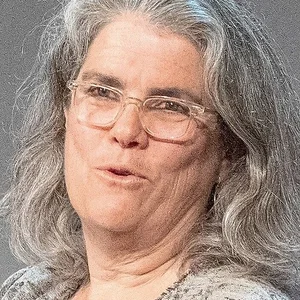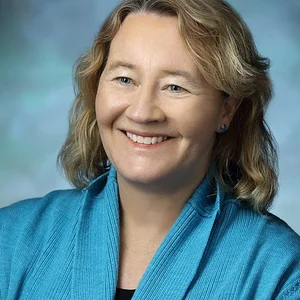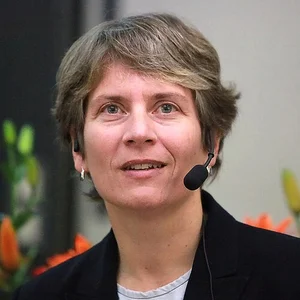

American chemist born in 1966, a pioneer of bioorthogonal chemistry. She developed chemical reactions capable of taking place inside living organisms without disrupting their functioning. She received the Nobel Prize in Chemistry in 2022.
Carolyn Bertozzi(1966 — ?)
Carolyn R. Bertozzi
États-Unis
5 min read
Frequently asked questions
Key Facts
- Born on October 10, 1966, in Boston (Massachusetts)
- Develops the concept of bioorthogonal chemistry beginning in the 2000s
- Professor at the University of California, Berkeley, and later at Stanford
- Receives the Nobel Prize in Chemistry in 2022, shared with Morten Meldal and K. Barry Sharpless
- One of the few women to win the Nobel Prize in Chemistry
Works & Achievements
A gentle chemical reaction, compatible with living cells, that lays the groundwork for bioorthogonal chemistry.
She names and develops the theory behind a new way of doing chemistry directly inside living organisms.
A non-toxic version of click chemistry that makes it possible to label molecules in living animals without poisoning them.
A spectacular demonstration: her reactions make the sugars on the surface of a living embryo's cells visible in real time.
A technology that directs unwanted proteins toward the cell's "shredder," opening up avenues against cancer.
Worldwide recognition of her work on click chemistry and bioorthogonal chemistry, which have become essential tools in medicine.
Anecdotes
Carolyn Bertozzi grew up in a family of scientists: her father, William Bertozzi, was a physicist at the prestigious MIT, and her older sister Andrea would become a renowned mathematician. At the dinner table, conversations often revolved around science, which sparked her curiosity at a very early age.
During her studies at Harvard University, she was passionate not only about chemistry: she played keyboards in rock bands. One of her fellow guitarists, Tom Morello, would become famous a few years later with the band Rage Against the Machine.
In 2003, she coined the term “bioorthogonal chemistry” to describe her revolutionary idea: triggering chemical reactions inside a living cell without disturbing the thousands of other reactions taking place there, a bit like two people meeting up in a dense crowd without bumping into anyone.
In 1999, at just 33 years old, she received the MacArthur Fellowship, nicknamed the “genius grant,” which rewards exceptionally creative minds and grants them total freedom in their research.
When she received the Nobel Prize in Chemistry in 2022, she shared it with Morten Meldal and Barry Sharpless. She thus became one of the very few women to have won this prize since its creation in 1901.
Primary Sources
The prize is awarded “for the development of click chemistry and bioorthogonal chemistry.”
A bioorthogonal reaction is a chemical reaction that can occur inside a living system without interfering with the cell's natural biochemical processes.
The goal was to create chemical tools to observe sugars on the surface of cells in their natural environment, that is, within the living organism.
Key Places
The region where Carolyn Bertozzi is born and raised, in a family of scientists connected to MIT.
The university where she studies chemistry and earns her degree in 1988, all while playing in rock bands.
The site of her doctorate and then her first major research as a professor starting in 1996.
The research center where she completes her postdoctoral training, learning about the biology of cellular sugars.
The university she joins in 2015 and where she leads her laboratory at the time of her Nobel Prize.
The Swedish capital where she receives the Nobel Prize in Chemistry at the ceremony in December 2022.
Typical Objects

A device that illuminates molecules tagged with glowing dyes to make them visible. Bertozzi uses it to observe the sugars on the surface of living cells.

An instrument that weighs molecules with extreme precision to identify their composition. An everyday tool for chemists to verify their syntheses.

A machine that uses powerful magnets to determine the exact structure of molecules. Essential for confirming that a reaction has worked.
A small precision instrument that draws up and dispenses tiny volumes of liquid. The most repeated gesture of a day in the lab.

Two families of molecules designed to snap together like a belt buckle, at the heart of click chemistry. Bertozzi uses them to label molecules within living systems.

A white garment that protects the body from chemicals and splashes. A symbol of the researcher's profession.

Transparent glasses that protect the eyes from splashes and dangerous fumes. Mandatory in every chemistry laboratory.
School Curriculum
Vocabulary & Tags
Key Vocabulary
Tags
Daily Life
Morning
The morning of a leading researcher often begins early, with reading the latest scientific papers and emails from around the world. She then meets her team at the laboratory to review the experiments under way.
Afternoon
The afternoon is split between meetings with her PhD students, analyzing results, and writing papers or funding applications. She also regularly teaches chemistry to the university's students.
Evening
The evening may be devoted to video conferences with other laboratories or to preparing presentations. Carolyn Bertozzi also keeps time for music, a passion from her youth.
Food
Like many very busy scientists, her meals are often eaten on a university campus, between cafeterias and coffee shops. Californian culture favors a varied diet, with plenty of fresh fruits and vegetables.
Clothing
In the laboratory, she wears a white coat, safety goggles, and gloves to handle chemicals safely. Outside, her outfit is the casual style of American universities.
Housing
She lives in the San Francisco Bay Area, near Stanford University, in a vibrant academic setting. Her true professional “home” remains her laboratory, equipped with cutting-edge instruments.
Historical Timeline
Period Vocabulary
Liens externes & ressources
Références
Œuvres
Ligation de Staudinger modifiée
2000
Invention du concept de « chimie bioorthogonale »
2003
Chimie click sans cuivre
2004
Imagerie des sucres dans le poisson-zèbre vivant
2008
Développement des LYTAC
2020
Prix Nobel de chimie
2022