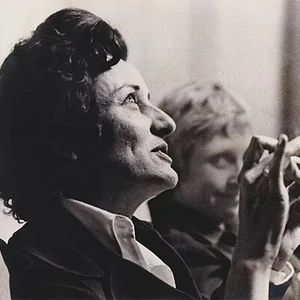

A leading American poet of the confessional movement, Anne Sexton explored depression, death, and the female condition in her work with a devastating autobiographical intensity. Winner of the Pulitzer Prize for Poetry in 1967 for *Live or Die*, she remains an essential figure in twentieth-century American literature.
Anne Sexton(1928 — 1974)
Anne Sexton
États-Unis
8 min read
Frequently asked questions
Famous Quotes
« It doesn't matter who my father was; it matters who I remember he was.»
« Put your ear down close to your soul and listen hard.»
Key Facts
- 1928: Born in Newton, Massachusetts
- 1960: Publication of her first collection, *To Bedlam and Part Way Back*
- 1965–1967: Teaches creative writing at Boston University
- 1967: Pulitzer Prize for Poetry for the collection *Live or Die*
- 1974: Dies at age 45, leaving behind a body of work comprising eleven collections
Works & Achievements
Anne Sexton's debut collection draws directly from her psychiatric hospitalizations. Its courageous publication paved the way for radically autobiographical poetry in the United States.
Inspired by the deaths of both her parents and the losses that marked her life, this collection cemented her central place in the confessional movement and earned her growing critical recognition.
The collection for which she received the Pulitzer Prize for Poetry in 1967. Arranged chronologically, it traces the chaotic path between the temptation of suicide and the will to live.
In this collection, Sexton explores sexuality and female emotion with a candor considered scandalous at the time. These poems are rooted in the context of the women's liberation movement.
A verse retelling of sixteen Brothers Grimm fairy tales, steeped in sharp feminist irony. This accessible and groundbreaking collection reached a far wider audience than her previous work.
Published a few months before her death, this collection reveals a growing obsession with death and spirituality. It stands as a striking testament to the poet's final years.
A posthumously published collection written in the last months of Sexton's life. It bears witness to her anguished spiritual search and her ambivalent relationship with faith.
Anecdotes
Anne Sexton had no literary training when she began writing poetry at the age of 28. It was her psychiatrist, Dr. Martin Orne, who suggested writing as a way to cope with her severe depression. Within just a few years, this suburban housewife became one of the most powerful poetic voices in the United States.
In 1958, Anne Sexton was admitted to Robert Lowell's poetry seminar at Boston University, where she met Sylvia Plath and poet George Starbuck. After class, the three poets would meet at the Ritz-Carlton in Boston to discuss their work over drinks. This intense friendship between Sexton and Plath — two women drawn to the same dark themes — remains one of the most celebrated in the history of American literature.
In 1967, Anne Sexton received the Pulitzer Prize for Poetry for her collection *Live or Die* — one of the most prestigious literary awards in the United States. The honor was all the more remarkable given that she had only begun writing ten years earlier, with no academic training in literature, on the simple advice of her doctor.
In the 1970s, Anne Sexton formed a rock group called “Anne Sexton and Her Kind,” in which she recited her poems accompanied by professional musicians. This bold and unprecedented venture reflected her determination to bring poetry out of academic circles and make it accessible to a broader, younger audience.
After Anne Sexton's death, biographer Diane Middlebrook gained access to an exceptional resource: Dr. Martin Orne had preserved hundreds of hours of recordings from the poet's therapy sessions. With the family's consent, these recordings informed the biography published in 1991, revealing an artist's inner life with a level of intimacy unique in literary history.
Primary Sources
I have gone out, a possessed witch, / haunting the black air, braver at night; / dreaming evil, I have done my hitch / over the plain houses, light by light.
Gone, I say and walk from church, / refusing the stiff procession to the grave, / letting the dead ride alone in the hearse. / It is June. I am tired of being brave.
Some women marry houses. / It's another kind of skin; it has a heart, / a mouth, a liver and bowel movements. / The walls are permanent and pink.
Since you ask, most days I cannot remember. / I walk in my clothing, unmarked by that voyage. / Then the almost unnameable lust returns.
Key Places
Anne Sexton's hometown, where she was born on November 9, 1928. She spent her childhood there in a comfortable but emotionally difficult middle-class environment, a setting she would often evoke in her poems.
The renowned psychiatric hospital where Anne Sexton was hospitalized on several occasions. Sylvia Plath was also treated there, making McLean a symbolic landmark of American confessional poetry and of the struggles with mental illness during that era.
Sexton attended Robert Lowell's poetry seminar here in 1958–1959 and met Sylvia Plath. She later taught creative writing there herself toward the end of her life, passing on her experience to a new generation of writers.
A suburb of Boston where Anne Sexton spent the final years of her life. This typically American middle-class suburban setting stood in stark contrast to the inner anguish she described in her poems.
After Robert Lowell's classes, Anne Sexton, Sylvia Plath, and poet George Starbuck would gather at this grand Boston hotel to discuss their poems. The place symbolizes the creative camaraderie among the confessional poets of the Lowell generation.
Liens externes & ressources
Références
Œuvres
To Bedlam and Part Way Back
1960
All My Pretty Ones
1962
Live or Die
1966
Love Poems
1969
Transformations
1971
The Death Notebooks
1974
The Awful Rowing Toward God
1975