 flip
flipCapon and Prune Pie with Sweet Spices
Capon and Prune Pie with Sweet Spices
Why this dish? As official painter to Charles I and a knight, Van Dyck frequented the aristocratic tables of London and Brussels. The grand poultry pie with dried fruit and costly spices was the prestige dish of banquets: it proclaimed the host's wealth as much as a full-length portrait proclaimed the sitter's grandeur.
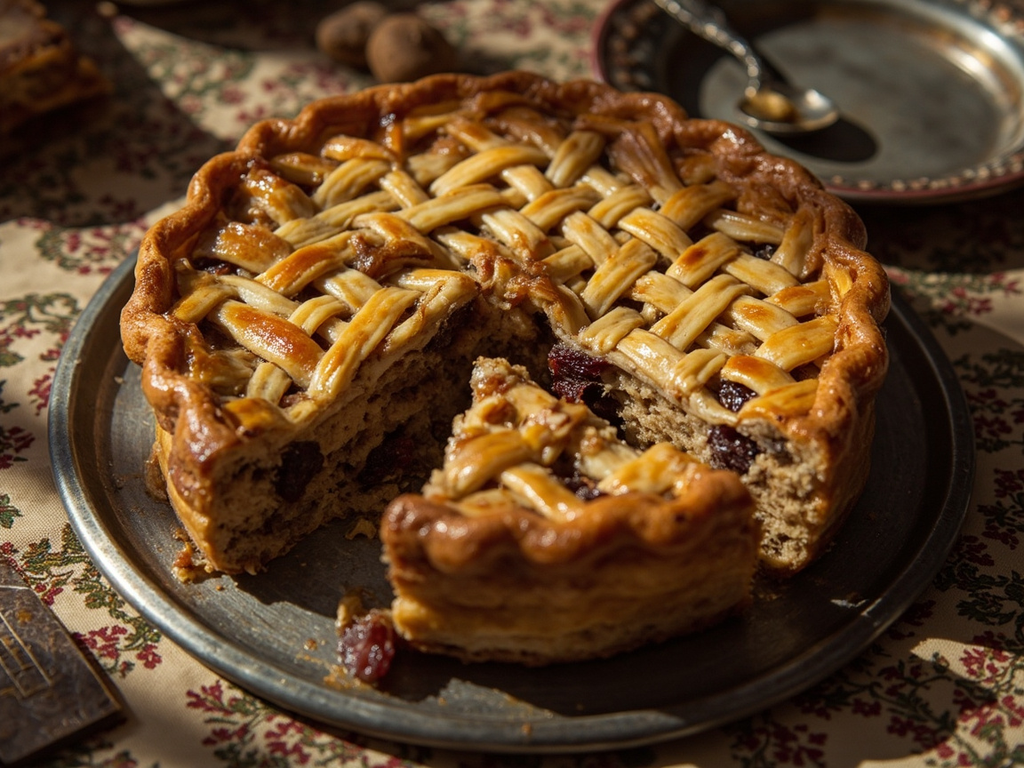
A golden pie filled with capon meat, soft prunes and raisins, perfumed with cinnamon, nutmeg and mace, brightened with a dash of verjuice. The sweet-spicy over savory is the great taste of baroque courts.
Here, Sir, is a dish worthy of a table where kings' portraits are painted. In London, among the greats I painted, such a pie was served on feast days: the fine flesh of capon, the prunes swollen with their juice, and those precious powders — cinnamon, mace — not spared to display one's rank. A dash of verjuice to wake it all, and the crust golden as the gold chain His Majesty hung around my neck. It is served whole, to make its effect before being cut.
- •Capon (boned meat) — a fine capon (noble meat)
- •Prunes — a handful (soft fruit)
- •Raisins — a handful (sweetness)
- •Cinnamon, nutmeg, mace, ginger — fine spices (court perfume)
- •Verjuice — a dash (fine acidity)
- •Butter — generous (richness)
- •Sugar — a pinch (sweet-savory)
- •Pie dough (flour, butter, eggs) — for the pie (crust)
Capon and Prune Pie with Sweet Spices
A golden pie filled with capon meat, soft prunes and raisins, perfumed with cinnamon, nutmeg and mace, brightened with a dash of verjuice. The sweet-spicy over savory is the great taste of baroque courts.
Why this dish? As official painter to Charles I and a knight, Van Dyck frequented the aristocratic tables of London and Brussels. The grand poultry pie with dried fruit and costly spices was the prestige dish of banquets: it proclaimed the host's wealth as much as a full-length portrait proclaimed the sitter's grandeur.
Here, Sir, is a dish worthy of a table where kings' portraits are painted. In London, among the greats I painted, such a pie was served on feast days: the fine flesh of capon, the prunes swollen with their juice, and those precious powders — cinnamon, mace — not spared to display one's rank. A dash of verjuice to wake it all, and the crust golden as the gold chain His Majesty hung around my neck. It is served whole, to make its effect before being cut.
Ingredients (period version)
- Capon (boned meat) — a fine capon (noble meat)
- Prunes — a handful (soft fruit)
- Raisins — a handful (sweetness)
- Cinnamon, nutmeg, mace, ginger — fine spices (court perfume)
- Verjuice — a dash (fine acidity)
- Butter — generous (richness)
- Sugar — a pinch (sweet-savory)
- Pie dough (flour, butter, eggs) — for the pie (crust)
Ingredients
- Thighs and breasts of free-range chicken (or capon) — 600 g (noble meat)
- Pitted prunes — 150 g (soft fruit)
- Raisins — 60 g (sweetness)
- Cinnamon — 1 tsp (perfume)
- Grated nutmeg + mace — 1/2 tsp (court perfume)
- Ground ginger — 1/2 tsp (warmth)
- Verjuice (or grape juice + dash vinegar) — 3 tbsp (fine acidity)
- Butter — 50 g (richness)
- Sugar — 1 tsp (sweet-savory)
- Butter shortcrust pastry — 2 rolls (crust)
- 1 egg yolk — for glazing (glaze)
Method
- Cut the poultry into small pieces, brown in butter, salt, then add spices.
- Add prunes, raisins, sugar and verjuice; stew a few minutes then let cool slightly.
- Line a pie dish with pastry, fill with the mixture, cover with a second pastry disk and seal the edges.
- Cut a steam vent, glaze with egg yolk, decorate with pastry scraps.
- Bake at 190°C for about 40 min until golden crust.
- Rest 10 min and serve whole, presented at the center of the table.
How it was made : Large poultry pies mixing dried fruit, sugar and Eastern spices (cinnamon, mace, ginger) are characteristic of European grand cuisine of the 16th-17th centuries. Verjuice, green grape juice, served as a noble acidulant before lemon became common. Spices, imported at great cost, signaled the host's status.
The contemporary twist : Glaze the crust and mark it with a knife in a large lace collar 'à la Van Dyck' as a signature decoration for the pie.
Sources : Bartolomeo Scappi, Opera (1570) · Een notabel boecxken van cokeryen (c. 1514) · European tradition of sweet-savory banquet pies
Anthony van Dyck · Charactorium