 flip
flipGeometer's Maza, with Oil and Cheese
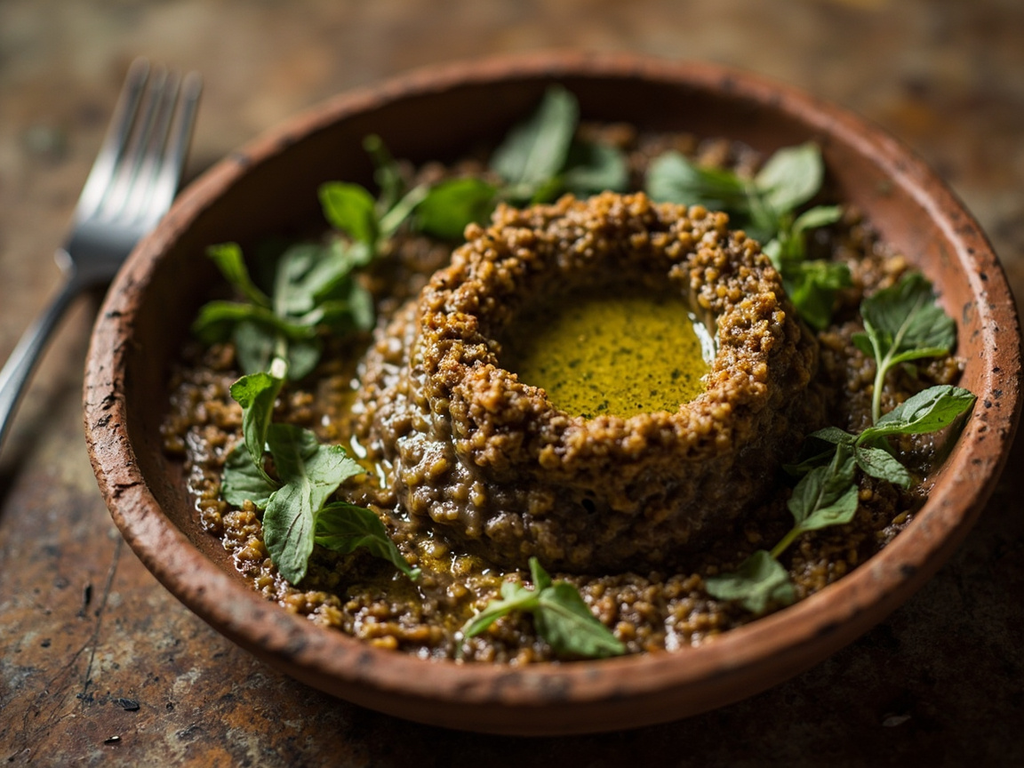
Geometer's Maza, with Oil and Cheese
Why this dish? Bent for entire days over his papyrus rolls drawing cones and sections, Apollonius ate like any studious Greek: a maza of barley quickly prepared, without oven or long cooking, drizzled with oil and brightened with a little cheese. The bread of the working mind.
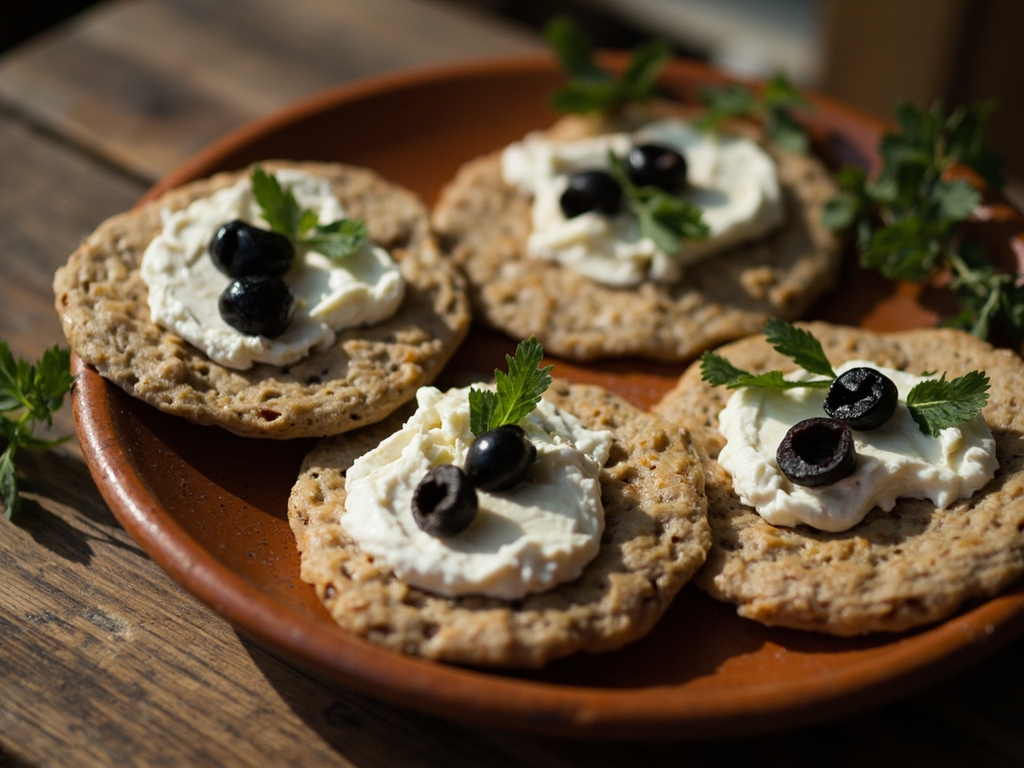
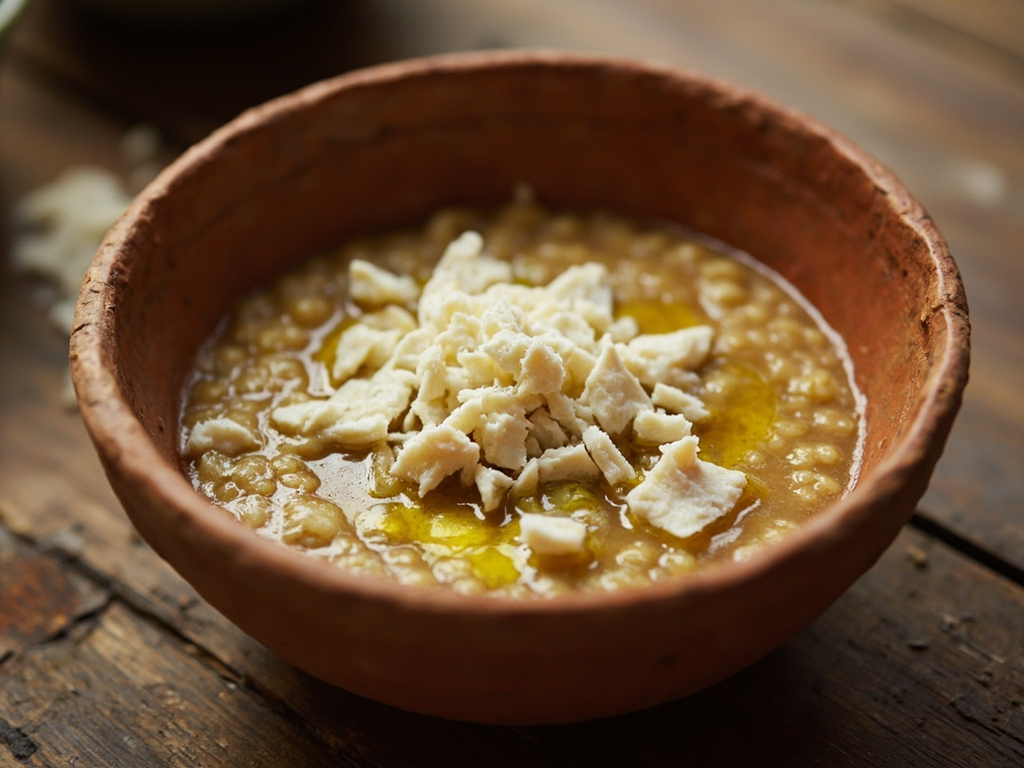
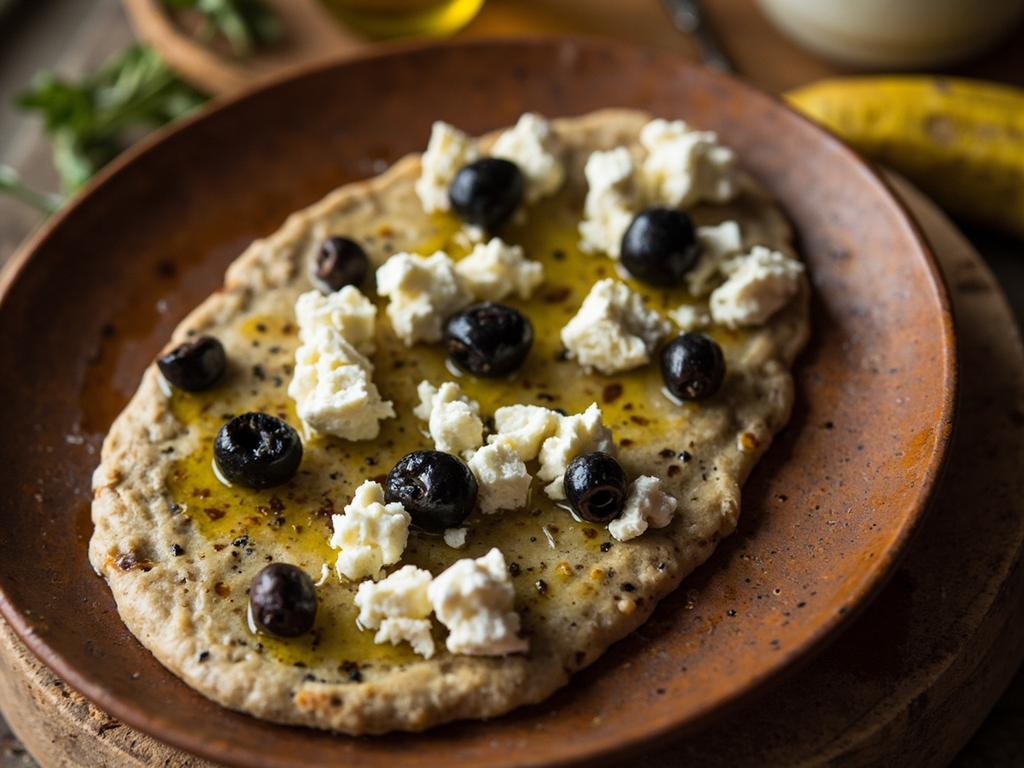
A thick flatbread of toasted barley flour, kneaded with water and olive oil, rubbed with fresh cheese and a few olives. The scholar's basic meal: nourishing, quick, without fire.
Approach, you who read, and see: just as a straight line carries the curve, this barley flatbread carries everything else. I ask of my table neither splendor nor long flame — ground barley, a drizzle of oil, water just enough, and the measure is made. On it I place a little cheese and three olives, and I return to my cones with a clear mind, for a simple belly leaves the thought straight. Keep yourself from excess: what nourishes the body without weighing it down is, like a beautiful demonstration, what removes the superfluous.
- •Slightly toasted barley flour — two handfuls (base of the flatbread)
- •Olive oil — a drizzle (binder and fat)
- •Water — as needed (kneading)
- •Fresh sheep or goat cheese — a piece (opson, relishes the bread)
- •Olives — a few (salty accompaniment)
- •Salt — a pinch (seasoning)
Geometer's Maza, with Oil and Cheese
A thick flatbread of toasted barley flour, kneaded with water and olive oil, rubbed with fresh cheese and a few olives. The scholar's basic meal: nourishing, quick, without fire.
Why this dish? Bent for entire days over his papyrus rolls drawing cones and sections, Apollonius ate like any studious Greek: a maza of barley quickly prepared, without oven or long cooking, drizzled with oil and brightened with a little cheese. The bread of the working mind.
Approach, you who read, and see: just as a straight line carries the curve, this barley flatbread carries everything else. I ask of my table neither splendor nor long flame — ground barley, a drizzle of oil, water just enough, and the measure is made. On it I place a little cheese and three olives, and I return to my cones with a clear mind, for a simple belly leaves the thought straight. Keep yourself from excess: what nourishes the body without weighing it down is, like a beautiful demonstration, what removes the superfluous.
Ingredients (period version)
- Slightly toasted barley flour — two handfuls (base of the flatbread)
- Olive oil — a drizzle (binder and fat)
- Water — as needed (kneading)
- Fresh sheep or goat cheese — a piece (opson, relishes the bread)
- Olives — a few (salty accompaniment)
- Salt — a pinch (seasoning)
Ingredients
- Barley flour — 150 g (base)
- Extra virgin olive oil — 3 tbsp (binder)
- Warm water — 80-100 ml (kneading)
- Fresh sheep cheese (like brousse or mild feta) — 80 g (topping)
- Pitted black olives — about ten (topping)
- Salt — 1 pinch (seasoning)
Method
- Dry-toast the barley flour in a pan for a few minutes until it smells nutty, then let cool.
- Mix the flour, salt, oil, and warm water to form a pliable but non-sticky dough.
- Shape into a thick flatbread about 1.5 cm thick and cook 4-5 minutes per side on a hot griddle or pan.
- Crumble the fresh cheese over the warm flatbread, add the olives, and finish with a drizzle of oil.
- Serve immediately, cut into pieces as one shares a theorem.
How it was made : Barley was the everyday grain of the Greeks, cheaper than wheat. It was often eaten as maza: toasted flour (alphita) kneaded raw or barely cooked, sometimes simply moistened with water and oil. Cheese and olives formed the opson, that which "accompanies" the bread.
The contemporary twist : Serve the flatbread on a slate engraved with a cone and its three sections — ellipse, parabola, hyperbola — to recall the master's work.
Apollonius of Perga · Charactorium