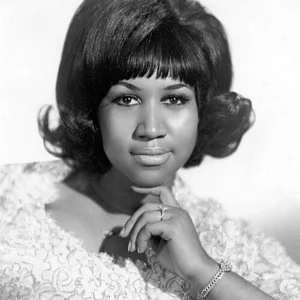

American singer nicknamed the “Queen of Soul,” Aretha Franklin is one of the most powerful voices of the 20th century. A committed artist, she contributed to the civil rights movement and left her mark on world music with songs that became anthems.
Aretha Franklin(1942 — 2018)
Aretha Franklin
États-Unis
9 min read
Frequently asked questions
Famous Quotes
« R-E-S-P-E-C-T, find out what it means to me.»
« Being a singer is a natural gift. It means I'm using to the highest degree possible the gift that God gave me to use.»
Key Facts
- Born on March 25, 1942, in Memphis, Tennessee
- Recorded her first gospel album at the age of 14
- Released ‘Respect’ in 1967, which became an anthem of the civil rights movement and feminism
- First woman inducted into the Rock and Roll Hall of Fame in 1987
- Died on August 16, 2018, in Detroit, leaving a global musical legacy
Works & Achievements
An iconic single, a cover of Otis Redding's song entirely reinvented by Aretha Franklin, “Respect” became a dual anthem: for the civil rights movement and for the emancipation of Black women. Reaching number 1 on the Billboard Hot 100, it is the song most closely associated with her name.
Her first album recorded at Atlantic Records, it marks Aretha Franklin's artistic rebirth. Produced by Jerry Wexler at Muscle Shoals, it showcases her voice in its full power and lays the foundation for the soul sound of the 1960s.
Written by Carole King and Gerry Goffin, this soul ballad is delivered with rare emotional intensity. It remains one of the most celebrated vocal performances in the history of American popular music.
Recorded over two evenings in a Los Angeles church, this live gospel album is the best-selling gospel record of all time. It bears witness to Aretha's spiritual roots and her extraordinary ability to transport her audience.
A radiant cover of the Burt Bacharach and Hal David song, this track became a worldwide standard thanks to Aretha Franklin's joyful rendition, showcasing her mastery of vocal arrangements and her innate sense of melody.
Written by Aretha Franklin herself, “Think” is a direct plea for freedom and dignity, delivered with burning conviction. The song was featured in the film *Blues Brothers* (1980), introducing it to a whole new generation of admirers.
Anecdotes
Aretha Franklin taught herself piano entirely by ear, without ever taking formal lessons. From the age of 5, she could reproduce on the keyboard any melody she heard on the radio. Her father, Reverend C.L. Franklin, a celebrated Detroit pastor, regularly invited gospel legends such as Clara Ward and Mahalia Jackson to their home, giving young Aretha an informal but exceptional musical education.
In 1967, Aretha recorded Otis Redding's "Respect" and turned it into something entirely new. She rewrote part of the song, added the now-famous spelling "R-E-S-P-E-C-T
and transformed a man's plea for his wife's love into an anthem of empowerment for Black women and the civil rights movement. The number-one hit on the Billboard Hot 100 instantly became one of the defining symbols of the fight for equality.
In 1987, Aretha Franklin became the first woman inducted into the Rock and Roll Hall of Fame, at a time when institutional recognition of Black female artists remained rare. The honor crowned a career spanning more than thirty years and acknowledged her foundational role in the history of American popular music.
On January 20, 2009, at the inauguration of Barack Obama — America's first Black president — Aretha Franklin sang "My Country, 'Tis of Thee" before millions of viewers. She wore a wide-brimmed gray hat adorned with an enormous bow, which became instantly iconic and is now preserved at the Smithsonian Institution in Washington. The moment symbolized the link between the civil rights struggle she had supported alongside Martin Luther King Jr. and Obama's historic election.
Aretha Franklin was renowned for her love of soul food — fried chicken, macaroni and cheese, biscuits — which she prepared herself and sometimes had delivered backstage at her concerts. She occasionally refused to take the stage until her culinary demands were met, giving rise to some colorful stories among tour organizers. In her eyes, this passion was a direct expression of her culture and her African American Southern roots.
Primary Sources
Music always felt natural to me, like breathing. I never really learned — I just remember always knowing how to play. The Church gave me everything: my voice, my faith, my strength.
I am deeply honored. I am my father's daughter, the Church's daughter, and the daughter of everyone who believed in me before it was obvious.
“Respect” was not just a song. It was a statement. Black women wanted to be respected — in their homes, in their communities, in this country.
Aretha Franklin has used her extraordinary talent to lift the human spirit and remind America of its highest aspirations for equality and dignity.
Singing that day was for everyone who marched, suffered, and dreamed. I was thinking of my father, of Martin Luther King Jr., of all those who never got to see it but who made it possible.
Key Places
Aretha Franklin's birthplace, born on March 25, 1942. Memphis is also the cradle of blues and rock'n'roll, an exceptional musical environment for a childhood steeped in both sacred and secular music.
Aretha grew up in Detroit, where her father led the New Bethel Baptist Church. This working-class city with a vibrant musical scene — the birthplace of Motown — shaped her artistic identity and her commitment to civil rights until her death in 2018.
Her father Reverend C.L. Franklin's church, where Aretha got her start as a gospel singer at the age of 8. It was here that she developed her unique vocal technique and her deep connection to spirituality.
It was at Atlantic Records' studios in New York that Aretha Franklin recorded her greatest hits beginning in 1967. Producers Jerry Wexler, Tom Dowd, and Arif Mardin gave her the freedom to express her full artistic potential.
On the steps of the Capitol, Aretha Franklin sang at Barack Obama's inauguration on January 20, 2009 — a historic moment witnessed by millions that symbolized the partial fulfillment of the struggle for civil rights.
Typical Objects

Aretha Franklin taught herself piano as a child and never parted with it. On stage and in the studio, she often accompanied her own singing, making the piano her instrument of choice alongside her voice.

The central tool of her art, Aretha Franklin was renowned for the way she commanded her vocal power in front of the mic. Atlantic Records gave her the finest equipment from 1967 onward to capture the full richness of her exceptional vocal range.

Aretha Franklin was famous for her lavish outfits and furs, symbols of a success hard-won in a segregated America. Her stage gowns asserted her dignity and African-American pride with deliberate elegance.

The daughter of a Baptist preacher, Aretha Franklin grew up in the church where the Bible and books of sacred songs were ever-present. Gospel remained the backbone of her delivery throughout her entire career.

The 45 rpm single was the primary vehicle for her music in the 1960s and 1970s. Jukeboxes and radio stations played her tracks across the country, making her voice a presence in every American home.

The gray hat adorned with a large bow that she wore at Barack Obama's inauguration in 2009 became an icon of American culture. It is now preserved in the collections of the Smithsonian Institution in Washington, D.C.
School Curriculum
Vocabulary & Tags
Key Vocabulary
Tags
Daily Life
Morning
Aretha Franklin rarely rose before 10 in the morning, preferring to work late into the night. She began her day with black coffee and a hearty breakfast — scrambled eggs, cornbread — a legacy of the Southern soul food tradition. She often devoted the early part of the morning to religious devotions, reading the Bible and praying, a habit inherited from her Baptist upbringing.
Afternoon
Afternoons were reserved for rehearsals and working sessions at the studio or the piano. Aretha Franklin could spend hours refining a song's arrangement, testing different vocal harmonies. She kept a close eye on recording sessions, imposing her artistic choices on producers with a quiet but firm authority.
Evening
Evenings revolved around concerts, late-night recording sessions, or family dinners at her home in Detroit. After a performance, she loved gathering with loved ones over a meal she often cooked herself. Her free evenings were sometimes enlivened by political discussions with activists from the civil rights movement.
Food
A devoted lover of traditional African American cuisine, Aretha Franklin regularly prepared large meals: fried chicken, macaroni and cheese, collard greens, sweet potato pie. For her, this passion for cooking was both a cultural and an emotional act — an affirmation of her roots as much as an everyday pleasure.
Clothing
Off stage, Aretha Franklin dressed comfortably — flowing dresses, flat shoes. On stage, however, she wore sumptuous outfits: embroidered gowns, furs, bold jewelry. Her wardrobe reflected a deliberate assertion of Black beauty and dignity in an America that denied them all too often.
Housing
Aretha Franklin spent most of her life in Detroit, in a large home in the affluent suburb of Bloomfield Hills. Her house was a gathering place for family, always alive with guests and visiting musicians. She remained deeply attached to Detroit even at the height of her fame, refusing to leave the city that had shaped her.