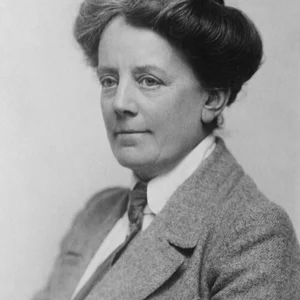

A pioneering British composer (1858–1944), Ethel Smyth was the first woman to have an opera performed at the Metropolitan Opera in New York. A suffragist activist, she composed the suffragette anthem 'The March of the Women' (1911).
Ethel Smyth(1858 — 1944)
Ethel Smyth
Royaume-Uni
8 min read
Frequently asked questions
Famous Quotes
« You have to believe in yourself, that's the secret.»
Key Facts
- 1858: born in Sidcup (Kent, England)
- 1906: imprisoned for her suffragist activities alongside Emmeline Pankhurst
- 1911: composed 'The March of the Women', anthem of the suffragette movement
- 1922: first woman to receive an honorary doctorate in music from the University of Oxford
- 1944: died in Woking (Surrey)
Works & Achievements
Hymn composed for the British suffragette movement, with lyrics by Cicely Hamilton. It became the official anthem of the WSPU and remains the best-known musical symbol of the fight for women's voting rights in the twentieth century.
Opera in three acts premiered in Leipzig, considered Smyth's masterpiece. The work depicts a community of wreckers in Cornwall; long neglected, it is gradually being rediscovered by contemporary opera houses.
Opera in one act premiered in Berlin, then performed at Covent Garden in London and at the Metropolitan Opera in New York in 1903. The first work by a woman composer to be staged at the Met, a historic milestone in the recognition of women in the operatic world.
Large-scale choral work for soloists, chorus, and orchestra, premiered at the Royal Albert Hall in London under the composer's own baton. Praised by Brahms himself, it earned Smyth international recognition and remains one of her most ambitious compositions.
Comic opera in two parts adapted from a short story by W.W. Jacobs, featuring a strong, independent woman who resists a man's unwanted advances. The work reflects Smyth's feminist convictions and her sharp sense of humour.
Autobiography in two volumes tracing her childhood, her studies in Leipzig, and her early career as a composer. A vivid and pointed account, it is a valuable source on the condition of women artists at the end of the nineteenth century.
Anecdotes
In 1912, imprisoned at Holloway Prison for smashing the windows of British ministers opposed to women's suffrage, Ethel Smyth refused to be silenced. She conducted 'The March of the Women' from her cell window by waving a toothbrush, while her fellow suffragettes sang in the courtyard below. Conductor Thomas Beecham, who came to visit her, watched in astonished silence at this improvised concert behind bars.
To gain admission to the Leipzig Conservatory, Ethel waged a long battle against her father, a general in the British Army who fiercely opposed a musical career for his daughter. She refused to eat or speak to him for weeks, until he finally relented. At 19, she set off for Germany at last, where she moved in the circles of Johannes Brahms and Clara Schumann.
When her opera 'Der Wald' premiered at the Metropolitan Opera in New York in 1903, Ethel Smyth became the first female composer to have her work staged at this temple of world opera. The triumph did not stop the male musical establishment from continuing to downplay her talent — which only deepened her commitment to feminism.
At the age of 71, Ethel Smyth fell passionately in love with Virginia Woolf, 27 years her junior. The writer, both touched and slightly overwhelmed by this ardour, devoted admiring pages to her in her private diary. Their intellectual friendship lasted until Woolf's death in 1941, only three years before the composer's own.
Struck by progressive deafness from the 1910s onward, Ethel Smyth nonetheless continued to compose and conduct her own works, relying on her inner musical memory. She declared that sometimes hearing music in her head was more beautiful than hearing it played badly. Her tenacity in the face of disability earned the admiration of her contemporaries and invited comparisons to Beethoven.
Primary Sources
I was possessed by music from my earliest childhood... The battles I had to fight to be taken seriously as a composer were battles every woman in any creative field would recognize as her own.
Women composers are told their music lacks virility. But what is virility in music if not intensity of feeling, power of conception, mastery of form? I have never understood why these qualities should be considered the monopoly of one sex.
Looking back on my career, I feel that the obstacles placed before me as a woman were as formidable as any artistic challenge. Yet it is precisely these struggles that sharpened both my will and my music.
The march is ready. I hope it will give women the courage they need to carry on this fight. Music can do what speeches cannot: go straight to the heart.
Key Places
Birthplace of Ethel Smyth on 23 April 1858, into an upper-middle-class military family. Her childhood in the Kent countryside shaped her love of nature and her resolutely independent character.
Ethel Smyth studied composition here from 1877, at the prestigious institution founded by Felix Mendelssohn. She rubbed shoulders with major figures of European music and gained the rigorous training that would underpin her international career.
Ethel Smyth was imprisoned here for two months in 1912 for her suffragist activism. It was from a window of this prison that she conducted 'The March of the Women' with a toothbrush — a scene that became one of the most iconic in the history of the movement.
The country house where Ethel Smyth spent much of her adult life and where she died on 8 May 1944. This retreat gave her the peace and quiet needed for composition and the space for her daily walks with her dogs.
In 1903, her opera 'Der Wald' was performed here, making Ethel Smyth the first female composer to have a work staged at this world-renowned institution — a historic milestone in the history of opera.
Ethel Smyth conducted several of her own works here, including the Mass in D in 1893. This great London concert hall came to symbolize the recognition she eventually won in her home country, after decades of struggle.
Typical Objects

Made legendary by the scene at Holloway Prison in 1912, where Smyth used it as a baton to conduct 'The March of the Women' from her cell window. This episode symbolizes her absolute refusal to capitulate in the face of oppression.

Ethel Smyth was one of the rare women of her era to conduct her own works in public. Her baton was both a professional tool and a symbol of her claim to occupy a central place in a musical world dominated by men.

Her composition notebooks, covered in corrections and annotations, bear witness to her artistic rigour. The score of 'The March of the Women' is held in several British archives and constitutes a historical document as much as a musical one.

Known for her deliberately unfeminine dress sense, Smyth favoured sturdy tweed outfits and sports hats, which stood in sharp contrast to the corsets and trailing gowns expected of women in polite Victorian society.

Her dogs were the constant companions of her long morning walks in the countryside. They appear in numerous accounts by those close to her as an inseparable part of her daily life and her affectionate character.

An enthusiastic fox hunter in her youth, Smyth practised this sport traditionally reserved for men and the aristocracy, reflecting her rebellious temperament towards gender conventions long before her suffragist activism.
School Curriculum
Vocabulary & Tags
Key Vocabulary
Tags
Daily Life
Morning
Ethel Smyth rose early and devoted the first hours of the day to composition, considering the morning her most productive working time. She would then set off on long country walks with her fox terriers — a habit she kept throughout her life, even when living in the city.
Afternoon
Afternoons were devoted to rehearsals, to the extensive correspondence she maintained with Virginia Woolf, Emmeline Pankhurst, and other intellectual figures, and to suffragist meetings during her years of activism. She might also revisit her scores or work on her numerous autobiographical writings.
Evening
In the evenings, Smyth frequented literary salons and concerts, or entertained artist and intellectual friends at home. A formidable conversationalist with strong opinions, she would drive discussions on music, politics, and women's rights well into the night.
Food
Smyth's diet was simple and hearty, typical of the British gentry: roasted meats, garden vegetables, bread, and cheese. An enthusiastic outdoorswoman who prized physical exercise, she paid little attention to gastronomic refinement, preferring frugality to sophistication.
Clothing
She favoured practical outfits that deliberately flouted the feminine dress codes of her era: tweed suits, sturdy walking shoes, wide-brimmed hats. Her consciously masculine style of dress was a form of daily manifesto against the constraints imposed on women.
Housing
Ethel Smyth lived mainly in English country houses, most notably at Coign, near Woking in Surrey. Her interiors reflected her priorities: a grand piano holding court in the drawing room, a well-stocked library, and a garden large enough for her walks with her dogs.