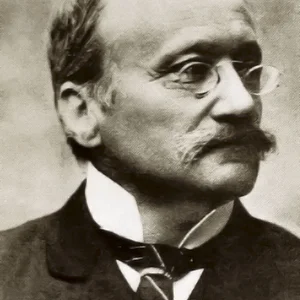

Arrigo Boito (1842-1918) was an Italian composer and librettist, a major figure of late Romantic opera. He is best known for the librettos he wrote for Verdi (Otello, Falstaff) and for his own opera Mefistofele.
Arrigo Boito(1842 — 1918)
Arrigo Boito
royaume d'Italie
8 min read
Frequently asked questions
Key Facts
- 1842: born in Padua
- 1868: premiere of his opera Mefistofele at La Scala in Milan
- 1879: beginning of his collaboration with Giuseppe Verdi
- 1887: libretto of Otello for Verdi
- 1893: libretto of Falstaff for Verdi
- 1918: died in Milan
Works & Achievements
An opera in a prologue, four acts, and an epilogue, freely inspired by Goethe's *Faust*. An ambitious masterpiece blending philosophy, fantasy, and lyricism, it is the only opera Boito signed under his own name.
A libretto adapted from Shakespeare's tragedy, considered one of the greatest opera libretti in history. Boito masterfully condensed Shakespeare's text while preserving and amplifying its dramatic power.
A comic libretto inspired by Shakespeare's *The Merry Wives of Windsor* and *Henry IV*, of exceptional lightness and literary virtuosity. Verdi's final masterpiece, composed at the age of 79.
Boito substantially revised the original libretto to allow Verdi to rework his 1857 opera; the new version, more dramatic and cohesive, is the one performed in opera houses around the world.
A libretto inspired by Victor Hugo's play *Angelo*, signed with an anagram of his name. Ponchielli's opera achieved international success and remains celebrated above all for its ballet "Dance of the Hours."
An opera about the Roman emperor Nero, to which Boito devoted more than fifty years without completing it. Premiered posthumously in 1924 in a version reconstructed by Toscanini, it remains the ultimate symbol of its author's absolute perfectionism.
A poetry collection that attests to Boito's literary talent beyond his role as a librettist. These Romantically inspired poems reveal his mastery of the Italian language and the depth of his inner world.
Anecdotes
At the premiere of Mefistofele at La Scala on March 5, 1868, the audience split violently into two camps: supporters and opponents booed and applauded so fiercely that performances had to be suspended after only two evenings. Humiliated, Boito spent several years profoundly reworking his opera before presenting it in Bologna in 1875, where it triumphed before an enthusiastic audience and earned him international recognition.
Boito used the anagram 'Tobia Gorrio' to sign certain libretti he did not wish to associate with his name as a composer. It was under this pseudonym that he wrote the libretto for La Gioconda for Amilcare Ponchielli in 1876, one of the most popular Italian operas in the repertoire, celebrated above all for its ballet 'Dance of the Hours'.
The relationship between Boito and Verdi began with an incident: in 1863, Boito had written in a poem of an Italian musical world where "the altar had been defiled
which Verdi took as a direct attack on his music. Despite this falling-out, the two men reconciled in 1879 through the mediation of publisher Giulio Ricordi, and their collaboration gave rise to Otello and Falstaff, widely regarded as the absolute masterpieces of the Italian operatic repertoire.
Boito devoted nearly fifty years of his life to his opera Nerone, working on it with an obsessive focus he could never bring to completion. At his death in 1918, he left behind dozens of notebooks and unfinished scores. The work was finally given its premiere posthumously in 1924 at La Scala, in a version reconstructed by conductor Arturo Toscanini.
Born to a miniaturist painter father and a Polish countess mother, Boito grew up in a cosmopolitan, multilingual world. His mother, Josephine Radolinska, herself an artist, introduced her sons to European literature. This dual cultural heritage gave Boito a deep love for the poetry of Goethe — which he read in German — and directly shaped the philosophical vision behind his opera Mefistofele.
Primary Sources
Now Iago is truly the devil we wanted — impenetrable and fascinating. The character has acquired a dramatic coherence that Shakespeare's play left in the shadows. Reread act two and tell me whether you are satisfied.
Art was my only law, my only homeland; I sought in the beauty of forms what others seek in faith or glory — a reason to live and to suffer.
There is something extraordinary in all of this: that you, at your age, are writing something at once so joyful and so powerful. It is something that has never been seen before and will in all likelihood never be seen again.
I have attempted to condense into a single drama both parts of Goethe's Faust, preserving the philosophical and poetic truth of the great original without sacrificing theatrical truth or the dramaturgical necessity of each act.
Key Places
Birthplace of Arrigo Boito, born on February 24, 1842. Padua was then under Austrian rule, and Boito grew up amid Italian nationalist aspirations that left a lasting mark on his patriotic sensibility.
Boito studied composition there from 1853 to 1861 and forged lasting friendships, notably with conductor Franco Faccio. The Conservatory was at the time the foremost center of musical training in Italy.
The venue for the premieres of *Mefistofele* (1868), *Otello* (1887), and *Falstaff* (1893); La Scala was Italy's most prestigious operatic stage, and to triumph there meant recognition at both national and international level.
Giuseppe Verdi's country estate, where Boito regularly stayed to work with the composer on their collaborations; it was here that the libretti for *Otello* and *Falstaff* took shape over long discussions.
It was in this theater that the revised version of *Mefistofele* triumphed in 1875, definitively erasing the failure of 1868 and launching Boito's opera onto a lasting international career.
Typical Objects

The central instrument of his compositional and musical work, Boito used the piano to test his melodies and harmonies, often performing the scores himself as they took shape.

Boito filled countless notebooks with poetic and musical drafts, particularly for his opera Nerone; his manuscripts, covered in crossings-out, bear witness to an obsessive perfectionism that prevented him from ever completing the work.

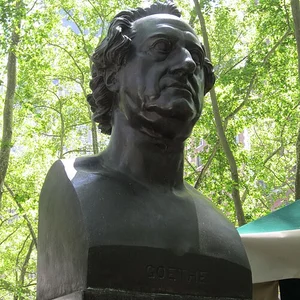
The German poet's masterpiece was the primary source of inspiration for Boito's Mefistofele; he read it in the original German and studied it in depth for several years before composing.

Boito, who was above all a poet, wrote his libretti by hand with careful attention to syllabic rhythm and literary quality, reading each verse aloud as he revised.

His library contained the major scores of the European operatic repertoire, which he studied to refine his mastery of operatic form — particularly those of Wagner and Gluck.

The devil in Mefistofele is portrayed in a black costume with a cape and feathered hat — a stage image that Boito himself helped design to give the character a commanding and unsettling visual presence.
School Curriculum
Vocabulary & Tags
Key Vocabulary
Daily Life
Morning
Boito rose relatively late, around nine o'clock, and devoted his mornings to reading and correspondence. An avid reader, he would go through the newspapers and literary press before settling at his desk to work on his poems or librettos, often annotating his sources extensively.
Afternoon
The afternoon was his prime time for musical work: seated at the piano, he would compose, revise, and test his melodies, sometimes to the point of exhaustion. When collaborating with Verdi, he spent hours aligning the poetic text with the musical line to refine their syllabic and dramatic accord.
Evening
Boito's evenings were often social affairs: he frequented the Milanese salons, literary cafés, and theater foyers where he met composers, singers, and critics. He regularly attended opera performances and took part in the lively artistic discussions that were at the heart of Milanese cultural life.
Food
Like many bourgeois Milanese artists of his era, Boito appreciated Lombard cuisine: risotto, osso buco, and polenta featured on his table. He was fond of wine at dinner parties and frequented cafés where he would sometimes spend hours conversing with his friends from the Scapigliatura.
Clothing
Boito had the elegance of a man of letters from the upper bourgeoisie of the nineteenth century: dark frock coat, waistcoat, and carefully knotted tie. He wore a neatly trimmed moustache and goatee, in keeping with Italian masculine fashion of the second half of the century.
Housing
Boito spent most of his life in a comfortable apartment in the center of Milan, surrounded by books, scores, and paintings. His considerable library bore witness to his literary and philosophical interests, which extended well beyond the world of music alone.