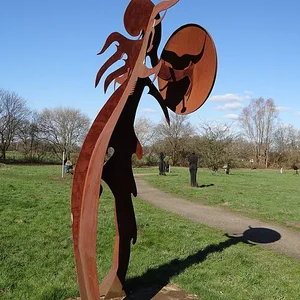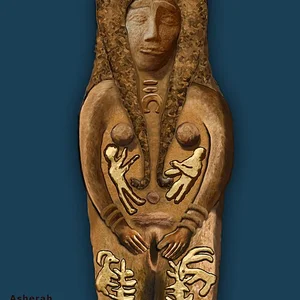

Asherah is a major mother goddess of the Canaanite and Syrian pantheon, venerated as queen of the heavens and consort of the god El. Her cult, attested as early as the 2nd millennium BCE, stretched from Phoenicia to Ugarit and influenced the religious practices of the ancient Near East, including in Israel.
Asherah
Ashera
9 min read
Frequently asked questions
Key Facts
- Attested in the cuneiform texts of Ugarit (present-day Syria) around 1400–1200 BCE
- Consort of the supreme god El in Canaanite mythology, mother of seventy gods
- Her symbol, the asherah, was a sacred pole or stylized tree erected near altars
- Mentioned in the Hebrew Bible (Old Testament) as an object of worship condemned by the prophets
- Inscriptions from the 8th century BCE (Khirbet el-Qom, Kuntillet Ajrud) associate her with Yahweh
Works & Achievements
A major mythological epic in six cuneiform tablets in which Asherah plays a pivotal role: she intercedes with El so that Baal may obtain his divine palace, and supports different divine factions depending on the episode. It is the most fully developed source on her mythological personality.
A Ugaritic epic featuring a legendary king of Canaan; Asherah appears here as a divine power capable of cursing or blessing rulers, illustrating her importance in the legitimation of royal authority.
A religious practice widespread throughout the Levant consisting of planting a pole or tree symbolizing the goddess near altars. Mentioned dozens of times in the Hebrew Bible, this cult is one of the most enduring traces of Asherah's veneration in the western Semitic world.
A collection of several thousand small clay female figurines found in the homes and burials of Israel and Judah, most likely representing Asherah in her role as protector of the household and of motherhood. This corpus is the most abundant archaeological manifestation of her popular cult.
Two major epigraphic assemblages attesting to the association of YHWH with “his Asherah” in the popular religious practices of Israelite and Judahite communities. These brief texts are primary historical documents for understanding the evolution of Hebrew monotheism.
Anecdotes
In the myths of Ugarit (in present-day Syria), Asherah is described as the “Lady of the Sea” and mother of seventy deities, including Baal and Anat. When Baal wished to obtain a divine palace, it was she who interceded with El, her sovereign husband, to have his request granted — illustrating her role as an indispensable mediator within the Canaanite pantheon.
The Hebrew Bible mentions the “Asherah pole” (in Hebrew: אֲשֵׁרָה) more than forty times — a sacred post or tree planted near altars. King Solomon himself is said to have tolerated her cult in Jerusalem, and the Book of Kings reports that Queen Jezebel kept four hundred prophets of Asherah at her court, before the prophet Elijah confronted them on Mount Carmel.
In 1975, archaeologists discovered at Kuntillet Ajrud, in the Sinai desert, inscriptions dating to the 8th century BCE bearing the formula “YHWH of Samaria and his Asherah.” This discovery stunned historians: it proves that some Israelites associated their national god with a divine wife, long before the consolidation of strict monotheism.
The Ugaritic tablets, discovered in 1929 at the site of Ras Shamra, reveal that Asherah bore the title “Athirat Yam” — “She Who Treads on the Sea.” This epithet evokes her mastery over the primordial waters and her cosmogonic role in the creation of the world according to Canaanite mythology.
King Josiah of Judah, around 621 BCE, carried out a sweeping religious reform described in the Second Book of Kings: he had the statue of Asherah in the Temple of Jerusalem burned and destroyed her altars throughout the kingdom. This turning point marks the assertion of strict monotheism in the religion of Israel, bringing centuries of coexisting cults to an end.
Primary Sources
Athirat perceived the approach of Baal, the approach of Baal and the stride of the Rider of the Clouds. She raised her eyes and saw. She dropped the spindle... and cried out to Baal: 'Why have you come, Baal? Why have you come, son of Dagan?'
«Now summon all Israel to meet me on Mount Carmel, along with the four hundred and fifty prophets of Baal and the four hundred prophets of Asherah who eat at Jezebel's table.»
«I bless you by YHWH of Samaria and by his Asherah.»
«The king commanded Hilkiah the high priest [...] to bring out of the Temple of YHWH all the vessels made for Baal, for Asherah, and for all the host of heaven.»
«Blessed be Uriyahu by YHWH, and by his Asherah he has saved him.»
Key Places
A Levantine port city where, in 1929, the richest mythological tablets concerning Asherah/Athirat were discovered. It is the primary documented center of her cult in the 2nd millennium BCE, and the Ugaritic texts portray her as the great queen of the pantheon.
A caravan waystation in the northern Sinai where 8th-century BCE inscriptions mention "YHWH and his Asherah." This discovery is one of the most direct pieces of evidence for a popular syncretic cult associating YHWH with a divine consort.
According to the Bible, a statue of Asherah was placed inside the Temple of Jerusalem itself, until its destruction ordered by King Josiah in 621 BCE. Its presence in this sacred site testifies to how deeply rooted her cult was, even at the highest levels of the state.
Capital of the northern Kingdom of Israel, where Queen Jezebel — of Phoenician origin — allowed the cult of Asherah to flourish alongside her four hundred prophets. The Kuntillet Ajrud inscriptions specifically mention "YHWH of Samaria."
A great Phoenician city where the cult of Asherah under the title "Lady of Sidon" was especially vibrant. Jezebel, who spread her worship throughout Israel, was a Sidonian princess, making Sidon a major conduit for the goddess's influence into the Hebrew kingdoms.
Typical Objects

A central cultic object, this wooden post (or carved tree) planted near altars symbolized the goddess. The Hebrew Bible repeatedly orders its destruction during religious reforms, testifying to its enduring popularity in the countryside.
Thousands of figurines depicting a woman with pronounced breasts, holding them in both hands, have been found in homes and tombs across Israel and Judah (8th–6th century BCE). Archaeologists widely associate them with the domestic cult of Asherah, protective goddess of motherhood.
These clay tablets inscribed in cuneiform script contain the major myths in which Asherah appears, notably the Baal Cycle where she intercedes with El. They are the richest documentary source for her mythology.
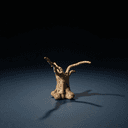
In the iconography of the ancient Near East, Asherah is often depicted as a tree of life flanked by goats browsing its branches or by lions. This motif, found on ivories, seals, and votive plaques, makes her the ultimate symbol of fertility and life.
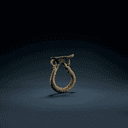
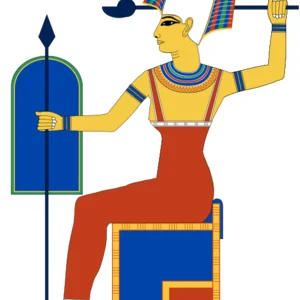
As the consort of El, the ruler of the gods, Asherah sits beside him in the Ugaritic texts. The throne symbolizes her heavenly sovereignty and her authority within the pantheon as mother of all the deities.
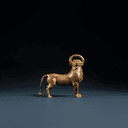
The emblematic animal of Asherah in several iconographic representations from the Levant and Egypt, the lion evokes her power and sovereign aspect. She is sometimes depicted standing on a lion, in the tradition of the great goddesses of the ancient Near East.
School Curriculum
Vocabulary & Tags
Key Vocabulary
Tags
Daily Life
Morning
In Canaanite and Israelite households, the beginning of the day might be placed under Asherah's protection. Before a small clay figurine representing the goddess, the mistress of the house would say a prayer or pour a libation of oil to protect her children, ensure fertility, and ward off illness.
Afternoon
In local sanctuaries (bamot), cult officiants maintained Asherah's sacred pole, watered the votive trees, and received offerings from pilgrims — oil, flour, lambs — to win the goddess's favor for harvests, births, and livestock.
Evening
The nocturnal rites in honor of Asherah, described with disapproval by the Hebrew prophets, took place on hilltops and under sacred trees at sunset: songs, ritual dances, and offerings of star-shaped cakes to the “queen of heaven” — a practice still attested at the time of the Babylonian exile according to the book of Jeremiah.
Food
Food offerings to Asherah included bread, cakes kneaded in her image and flavored with honey, olive oil, and wine. The book of Jeremiah (7:18; 44:19) describes entire families preparing these “cakes for the queen of heaven,” a practice the prophet condemns but which testifies to its deep roots in everyday life.
Clothing
In the iconography of the ancient Near East, Asherah is depicted nude or clothed in a long fringed robe, wearing a headdress shaped like a horn or solar disk — attributes common to the great goddesses. Her priestesses and attendants likely wore white linen ritual garments during official ceremonies in the major temples.
Housing
According to the texts from Ugarit, Asherah resides in a divine palace by the springs and the primordial sea, beside El, her husband. On earth, she was present in open-air sanctuaries (bamot), in the temples of the great Phoenician and Canaanite cities, and in the votive niches of ordinary homes, where her clay figurines stood as guardians of the hearth.
Historical Timeline
Period Vocabulary
Liens externes & ressources
Références
Œuvres
Cycle de Baal (épopée d'Ugarit, KTU 1.1–1.6)
XIVe–XIIe siècle av. J.-C.
Poème de Keret (épopée d'Ugarit, KTU 1.14–1.16)
XIVe–XIIe siècle av. J.-C.
Culte du poteau sacré (asherah)
IIe–Ier millénaire av. J.-C.
Corpus des figurines Pilier-Asherah
VIIIe–VIe siècle av. J.-C.
Inscriptions de Kuntillet Ajrud et de Khirbet el-Qom
VIIIe siècle av. J.-C.