 flip
flipHakata tonkotsu ramen — Fukuoka's street noodle
Hakata tonkotsu ramen — Fukuoka's street noodle
Why this dish? Fukuoka, Ayumi's hometown, is the world capital of tonkotsu ramen, served in the famous yatai (street stalls) along the Naka River. It is the iconic taste of her Hakata childhood, the street food that warms you after a night out.
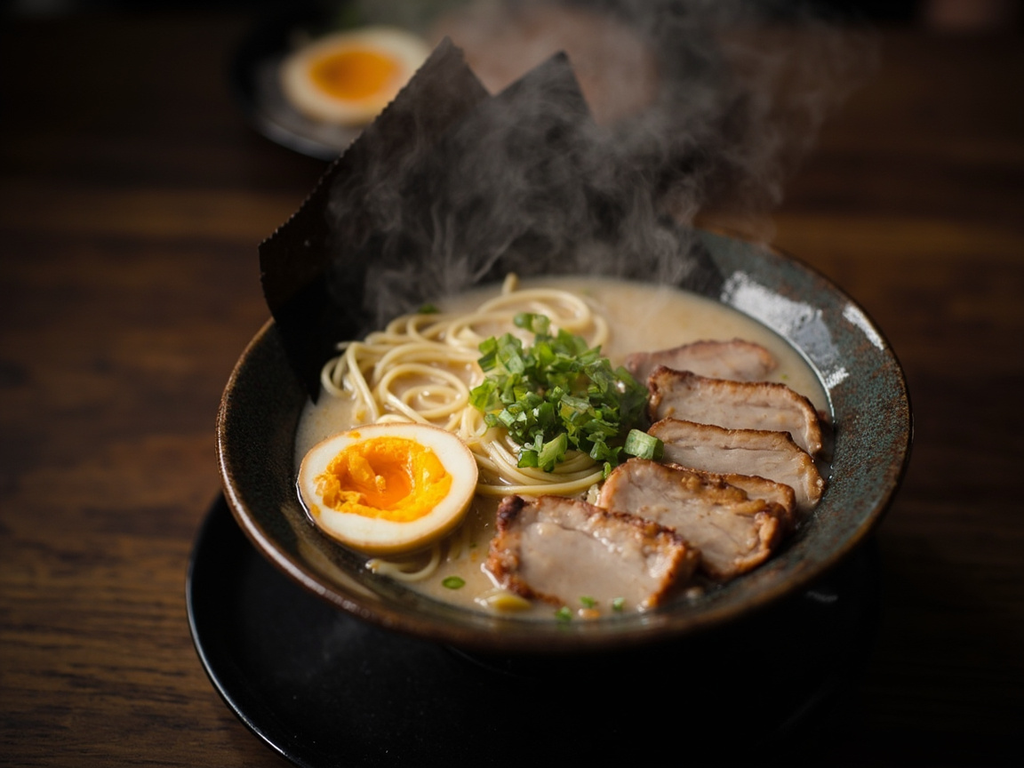
A bowl of thin noodles in a creamy white pork bone broth, boiled for hours until rich and deep. Topped with tender slices of braised pork (chāshū), scallions, seaweed, and a marinated egg. The pride of Hakata, served piping hot at a yatai counter.
When I was a kid in Hakata, the smell of the yatai in the evening, near the river, would catch you from afar. Tonkotsu, that white broth, you have to boil it for hours and hours until the bones give everything—it's not rushed, it's patient. And in our town, we like the noodles firm, you can even order an extra serving: kaedama, we call it! A bowl of that after the cold, and you come back to life.
- •Pork bones (femur, trotters) — enough for a large pot (signature tonkotsu broth)
- •Thin wheat noodles — one portion per bowl (starch)
- •Pork belly (chāshū) — a few slices (melting garnish)
- •Scallions, garlic, ginger — to taste (aromatics)
- •Marinated egg — half per bowl (garnish)
- •Nori seaweed — one sheet (umami garnish)
Hakata tonkotsu ramen — Fukuoka's street noodle
A bowl of thin noodles in a creamy white pork bone broth, boiled for hours until rich and deep. Topped with tender slices of braised pork (chāshū), scallions, seaweed, and a marinated egg. The pride of Hakata, served piping hot at a yatai counter.
Why this dish? Fukuoka, Ayumi's hometown, is the world capital of tonkotsu ramen, served in the famous yatai (street stalls) along the Naka River. It is the iconic taste of her Hakata childhood, the street food that warms you after a night out.
When I was a kid in Hakata, the smell of the yatai in the evening, near the river, would catch you from afar. Tonkotsu, that white broth, you have to boil it for hours and hours until the bones give everything—it's not rushed, it's patient. And in our town, we like the noodles firm, you can even order an extra serving: kaedama, we call it! A bowl of that after the cold, and you come back to life.
Ingredients (period version)
- Pork bones (femur, trotters) — enough for a large pot (signature tonkotsu broth)
- Thin wheat noodles — one portion per bowl (starch)
- Pork belly (chāshū) — a few slices (melting garnish)
- Scallions, garlic, ginger — to taste (aromatics)
- Marinated egg — half per bowl (garnish)
- Nori seaweed — one sheet (umami garnish)
Ingredients
- Marrow pork bones + pork trotter — 1.5 kg (tonkotsu broth)
- Thin ramen noodles — 2 portions (starch)
- Rolled pork belly (chāshū) — 300 g (garnish)
- Sliced scallions — 2 (aromatic)
- Eggs — 2 (soft-boiled, soy-marinated) (garnish)
- Soy sauce + salt (tare) — to taste (bowl seasoning)
Method
- Blanch the pork bones in boiling water for 10 min, rinse to remove impurities.
- Cover with fresh water and boil vigorously for 6 to 12 hours, topping up water, until the broth is white and creamy.
- Cook the chāshū separately (rolled pork belly braised in soy sauce), then marinate soft-boiled eggs.
- When serving, put a little tare (soy sauce + salt) in the bottom of the bowl, pour in the boiling broth.
- Cook the thin noodles very briefly (they should remain firm) and plunge them into the bowl.
- Top with chāshū slices, half egg, scallions, and nori; serve immediately.
How it was made : Tonkotsu ramen was born in Fukuoka/Kurume in the 1930s-40s. Legend has it that the milky broth was an accident: a cook let his pot boil too hard. The yatai, Hakata's mobile stalls, remain a living symbol of the city's nocturnal conviviality. The custom of kaedama (extra noodles) originated there because the thin noodles cook quickly.
The contemporary twist : Serve with an assortment of condiments on the side—red ginger, sesame seeds, freshly pressed garlic—to customize your bowl like at a yatai.
Ayumi Hamasaki · Charactorium