 flip
flipKatsudon — Breaded Pork Cutlet and Egg Rice Bowl
Katsudon — Breaded Pork Cutlet and Egg Rice Bowl
Why this dish? In Kitchen, the heroine Mikage rides through the night in a taxi to bring a katsudon to Yuichi: the dish becomes a gesture of love and healing. You cannot talk about food in Yoshimoto without this bowl, where eating is about reconnecting with the living.
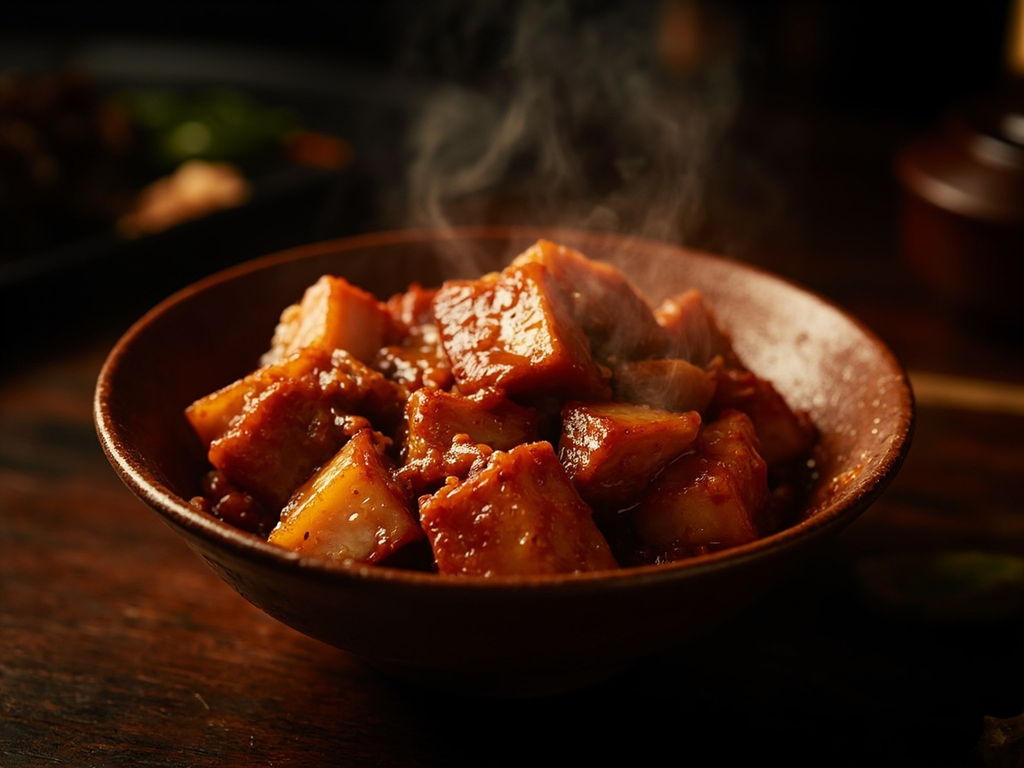
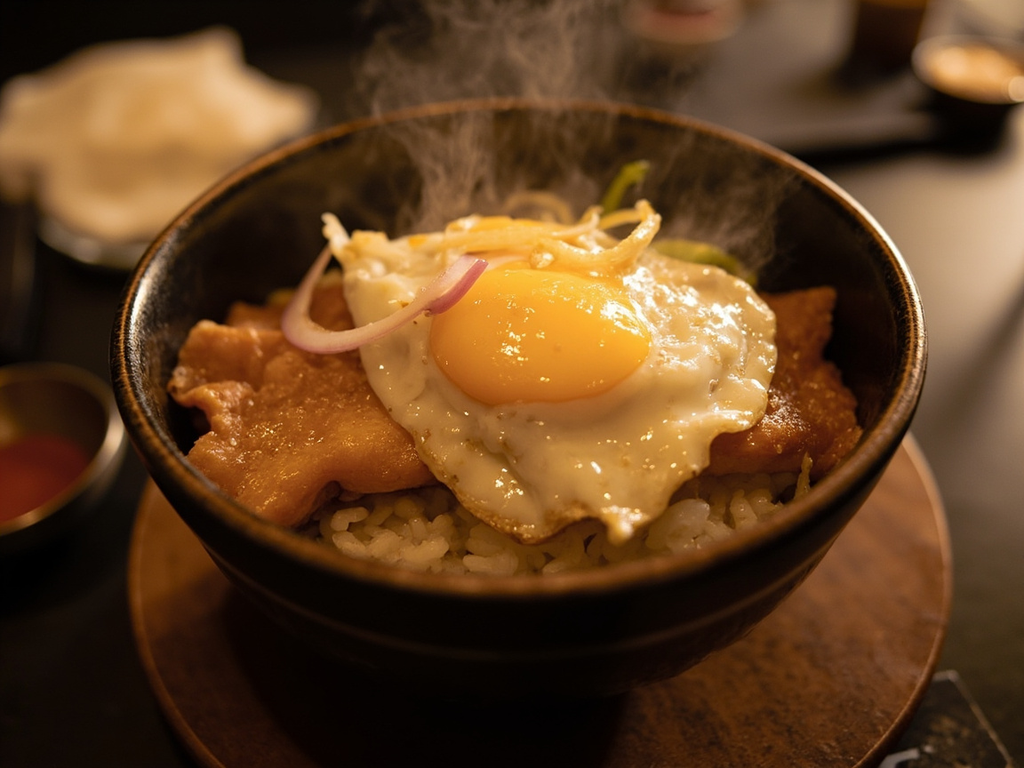
A breaded and fried pork cutlet simmered in a sweet-savory broth with onion, then topped with barely-set egg, all slid onto a bowl of hot rice. Absolute comfort, to be devoured while still steaming.
You eat it when you're at the end of your rope, when sadness has hollowed out a hole that no words can fill. I truly believe this: a hot bowl brought to someone can bring them back to life better than any sentence. The egg, especially, never let it harden — you cut the heat while it's still trembling, silky. Eating, sometimes, is just deciding to go on.
- •Pork loin slice — one per bowl (protein)
- •Panko breadcrumbs — as needed (breading)
- •Eggs — two per bowl (tender binder)
- •Onion — half (sweetness)
- •Dashi, soy sauce, mirin, sugar — in measured parts (sweet-savory broth)
- •Cooked white rice — one large bowl (base)
Katsudon — Breaded Pork Cutlet and Egg Rice Bowl
A breaded and fried pork cutlet simmered in a sweet-savory broth with onion, then topped with barely-set egg, all slid onto a bowl of hot rice. Absolute comfort, to be devoured while still steaming.
Why this dish? In Kitchen, the heroine Mikage rides through the night in a taxi to bring a katsudon to Yuichi: the dish becomes a gesture of love and healing. You cannot talk about food in Yoshimoto without this bowl, where eating is about reconnecting with the living.
You eat it when you're at the end of your rope, when sadness has hollowed out a hole that no words can fill. I truly believe this: a hot bowl brought to someone can bring them back to life better than any sentence. The egg, especially, never let it harden — you cut the heat while it's still trembling, silky. Eating, sometimes, is just deciding to go on.
Ingredients (period version)
- Pork loin slice — one per bowl (protein)
- Panko breadcrumbs — as needed (breading)
- Eggs — two per bowl (tender binder)
- Onion — half (sweetness)
- Dashi, soy sauce, mirin, sugar — in measured parts (sweet-savory broth)
- Cooked white rice — one large bowl (base)
Ingredients
- Pork loin cutlets — 2 (protein)
- Flour, 1 beaten egg, panko — for breading (breading)
- Frying oil — to a depth of 2 cm (cooking)
- Onion — 1 (sweetness)
- Dashi — 200 ml (broth)
- Soy sauce — 3 tbsp (salty umami)
- Mirin — 2 tbsp (roundness)
- Sugar — 1 tbsp (balance)
- Eggs — 4 (soft topping)
- Cooked Japanese rice — 2 large bowls (base)
Method
- Lightly flatten the cutlets, season with salt, then bread in flour, egg, and panko.
- Fry at 170 °C until a nice golden color, drain, cut into strips: this is tonkatsu.
- In a small pan, bring dashi, soy sauce, mirin and sugar to a simmer with the sliced onion until it softens.
- Place a sliced cutlet in the broth, pour the beaten eggs in a stream over the top.
- Cover, turn off the heat as soon as the egg is just set but still runny.
- Gently slide onto a bowl of hot rice and serve immediately.
How it was made : Katsudon was born in the early 20th century, an heir to tonkatsu — itself a Japanese adaptation of the Western breaded cutlet that arrived during the Meiji era. A dish of students and small eateries, it became loaded with symbolism of comfort and encouragement (it is traditionally offered before an exam, since katsu also means "to win").
The contemporary twist : You can serve it in a clear bowl to show the layers — rice, amber onions, cloudy egg — and sprinkle a little mitsuba or scallion for a green touch.
Sources : Banana Yoshimoto, Kitchen (1988)
Banana Yoshimoto · Charactorium