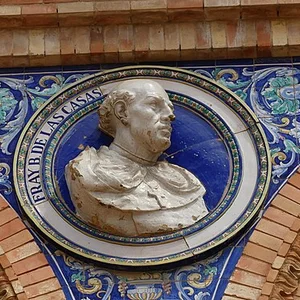

Spanish Dominican friar (1474–1566) who devoted his life to defending the rights of Indigenous peoples against the abuses of the conquistadors. He denounced the atrocities committed during the Spanish colonization of the Americas and argued for the humanity of Native peoples before the Spanish Crown.
Bartolomé de las Casas(1484 — 1566)
Bartolomé de las Casas
couronne de Castille, Empire espagnol
7 min read
Frequently asked questions
Famous Quotes
« The Indians received us as beings from Heaven, and we treated them as beasts.»
« All the peoples of the world are humans and the definition of human is the same for all.»
Key Facts
- 1502: Arrives in the Americas as a conquistador and encomendero (landowner with Indigenous labor)
- 1514: Takes holy orders and undergoes a moral reckoning over the atrocities committed against Indigenous peoples
- 1542: Writes his major work 'History of the Indies', documenting colonial abuses
- 1550: Valladolid Debate with Juan Ginés de Sepúlveda before King Charles V on the humanity of Indigenous peoples
- 1566: Dies in Valladolid after dedicating his life to improving the fate of Native populations
Works & Achievements
His most famous work, a striking indictment of the atrocities committed by the conquistadors. This text had considerable European resonance and lastingly influenced the debate on human rights.
A monumental history of Spanish colonization in three volumes, written over more than thirty years. It constitutes a major historical source on the first contacts between Europeans and Native Americans.
A comparative study of Amerindian civilizations and ancient societies, demonstrating that the peoples of the New World were as developed and rational as the Greeks and Romans.
A theological treatise arguing that the only legitimate method of evangelization is peaceful persuasion, never coercion or armed violence.
A collection of official documents addressed to the Spanish Crown throughout his lifetime, advocating for legislative reforms in favor of indigenous populations.
A series of propositions demonstrating the legal illegitimacy of the encomienda system and the war of conquest against Amerindian peoples.
Anecdotes
In 1502, Bartolomé de las Casas arrived in Hispaniola (present-day Haiti and the Dominican Republic) as a colonist and received an encomienda, a system that granted him Indigenous people to work his lands. It was by witnessing the mistreatment inflicted on the natives that he began his awakening.
In 1514, while preparing a sermon for Pentecost, Las Casas read a passage from the Book of Ecclesiasticus comparing the exploitation of the poor to murder. This moment triggered his radical conversion: he renounced his encomienda and devoted the rest of his life to the defense of Indigenous Americans.
In 1550–1551, Las Casas took part in the famous Valladolid Debate, facing theologian Juan Ginés de Sepúlveda. The latter argued that Indigenous Americans were inferior beings whom it was legitimate to subjugate through war. Las Casas argued for days that the natives were full human beings, endowed with reason and a soul.
Las Casas attempted a peaceful colonization experiment in Cumaná, Venezuela, in 1521. He wanted to prove that Indigenous Americans could be evangelized without violence, by sending Spanish peasants to live alongside them. The experiment ended tragically when conflicts broke out, but he never abandoned his ideals.
At over 80 years of age, Las Casas was still writing and pleading his cause before the Spanish court. He died in 1566 in Madrid, at the age of 92, having never ceased to defend the rights of Indigenous peoples, which earned him the title of 'Universal Protector of the Indians'.
Primary Sources
In these lands so gentle and so rich, the Spaniards entered like hungry wolves among tender lambs. For forty years, they have done nothing but massacre, torment, afflict and destroy these innocent peoples.
All the nations of the world are composed of men, and the definition of every man is that he is a rational being. All peoples possess understanding and will, and the free will that follows from them.
Las Casas describes in detail the Amerindian civilizations, their cities, their political organization and their knowledge, to demonstrate that they rival the great ancient civilizations.
Las Casas regularly submitted memorials to the Council of the Indies to denounce the abuses of the encomienda system and propose legislative reforms protecting indigenous populations.
Key Places
Las Casas's birthplace, a major departure port to the Americas and the nerve center of Spanish colonial trade.
The first land in the Americas where Las Casas lived as a colonist and later as a defender of the indigenous peoples. It was there that he became aware of the horrors of colonization.
Site of the famous 1550–1551 controversy where Las Casas debated Sepúlveda on the rights of Native Americans before an assembly of theologians and jurists.
Seat of Las Casas's bishopric. The city bears his name today as a tribute to his work on behalf of the indigenous populations of the region.
The city where Las Casas spent his final years, continuing to write and advocate at the royal court. He died there in 1566 at the Dominican convent of Atocha.
Typical Objects

The white robe and black scapular of the Dominican preaching friars, which Las Casas wore daily after joining the order in 1522.

His essential writing instruments, with which he produced thousands of pages of testimonies, memoirs, and treatises denouncing colonial abuses.

Symbol of his role as Bishop of Chiapas, a position he held from 1544 to 1550 that granted him spiritual authority to defend the Native Americans.

The many documents he carried for his pleas before the Spanish court and the Council of the Indies, serving as evidence of the atrocities committed in the colonies.

The daily prayer book of the Dominican friar, which he consulted several times a day for liturgical offices.

The official seal of the Diocese of Chiapas, used to authenticate decrees and ecclesiastical correspondence aimed at protecting indigenous populations.
School Curriculum
Vocabulary & Tags
Key Vocabulary
Tags
Époque
Mouvement
Daily Life
Morning
Las Casas rose before dawn to join his Dominican community for Matins and Lauds. After the morning Mass, he had a frugal meal of bread and broth. He then devoted the morning to writing his memoirs and treatises, working by daylight in his cell or the convent's scriptorium.
Afternoon
The afternoon was often given over to audiences and meetings with Amerindian caciques, colonists, or colonial authorities. As Bishop of Chiapas, he visited indigenous communities to witness their living conditions firsthand. He also dictated correspondence addressed to the Spanish court and the Council of the Indies.
Evening
In the evening, after Vespers and the communal meal, Las Casas withdrew for spiritual reading and the study of legal and theological texts. He prepared his arguments and reviewed testimonies gathered from indigenous populations. The day ended with Compline, the final prayer of the day.
Food
As a Dominican friar, Las Casas followed an austere diet. Meals at the convent consisted of bread, vegetables, broths, and fish. In the Americas, he discovered foods from the New World: maize, beans, squash, and tropical fruits. Meat was scarce and reserved for feast days.
Clothing
Las Casas wore the traditional Dominican habit: a long white tunic cinched with a leather belt, covered by a black scapular and a black cape (cappa) for outdoor travel. As a bishop, he added the pectoral cross and occasionally the mitre during official ceremonies.
Housing
Las Casas lived in Dominican convents, whether in Spain or in the colonies. His cell was austere: a simple bed, a writing desk, a chest for his manuscripts, and a few books. Colonial convents were built in stone, organized around a cloister with a central courtyard and fountain.
Historical Timeline
Period Vocabulary
Visual Style
Un style visuel inspiré de l'esthétique coloniale espagnole de la Renaissance, mêlant l'austérité des couvents dominicains aux couleurs vibrantes des Amériques tropicales, avec des jeux de clair-obscur évoquant la peinture du Siècle d'Or.
Sound Ambience
L'atmosphère sonore mêle la quiétude d'un couvent dominicain — chants grégoriens, plume grattant le parchemin, cloches — aux sons tropicaux du Nouveau Monde colonial, langues indigènes et bruits de marché.
Liens externes & ressources
Références
Œuvres
Brevísima relación de la destrucción de las Indias
1552
Historia de las Indias
1527-1561
Apologética historia sumaria
vers 1550-1559
De unico vocationis modo
vers 1537
Mémoires et requêtes au Conseil des Indes
1516-1566
Trente propositions juridiques
1552