 flip
flipCasabe — Cassava Bread of the Indies
Casabe — Cassava Bread of the Indies
Why this dish? Las Casas himself described casabe in his *Historia de las Indias*: this "bread" of yuca that the Taíno made and that the Spanish, lacking wheat, adopted on Hispaniola. It is the food he saw with his own eyes, ate, and that nourished the peoples he defended.
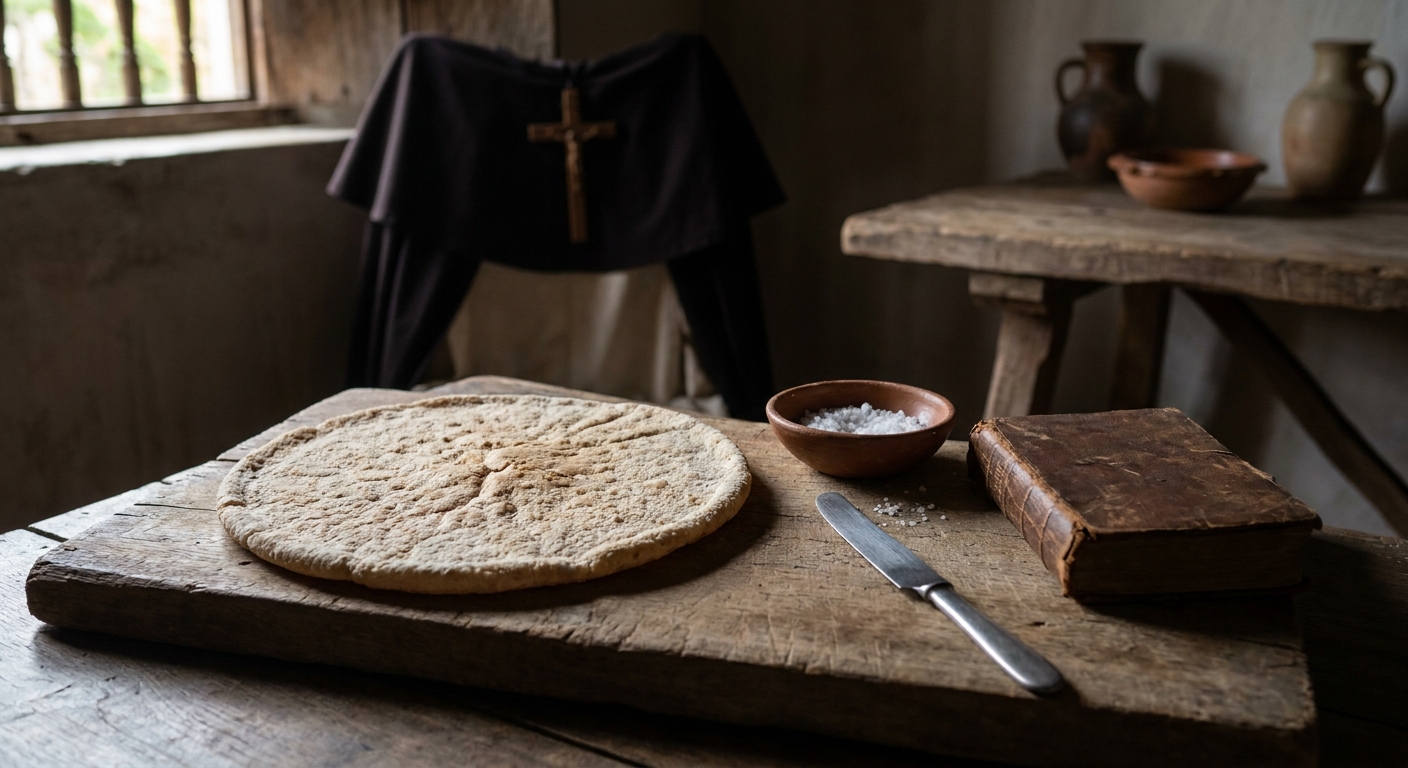
A large thin crisp flatbread made from grated bitter cassava, pressed to extract the juice, then cooked on a hot griddle. Without leavening, almost tasteless on its own, it keeps for months — hence its value as a reserve.
Here is the bread of this land, which the Indians call cazabe and which they know how to make better than any Castilian. They grate the yuca root, press out its juice with great care — for it is venomous and kills whoever drinks it raw — then spread the flour on a heated plate until it sets. I have eaten it many times for lack of wheat, and I tell you: these people whom they treat as barbarians make a bread that keeps entire moons without spoiling. Is this not the sign of a wise people, and not of a beast?
- •Yuca root (bitter cassava) — several large roots (sole base)
- •Sea salt — a pinch (colonial use) (optional seasoning)
Casabe — Cassava Bread of the Indies
A large thin crisp flatbread made from grated bitter cassava, pressed to extract the juice, then cooked on a hot griddle. Without leavening, almost tasteless on its own, it keeps for months — hence its value as a reserve.
Why this dish? Las Casas himself described casabe in his *Historia de las Indias*: this "bread" of yuca that the Taíno made and that the Spanish, lacking wheat, adopted on Hispaniola. It is the food he saw with his own eyes, ate, and that nourished the peoples he defended.
Here is the bread of this land, which the Indians call cazabe and which they know how to make better than any Castilian. They grate the yuca root, press out its juice with great care — for it is venomous and kills whoever drinks it raw — then spread the flour on a heated plate until it sets. I have eaten it many times for lack of wheat, and I tell you: these people whom they treat as barbarians make a bread that keeps entire moons without spoiling. Is this not the sign of a wise people, and not of a beast?
Ingredients (period version)
- Yuca root (bitter cassava) — several large roots (sole base)
- Sea salt — a pinch (colonial use) (optional seasoning)
Ingredients
- Ready-to-use cassava flour (tapioca/yuca) — 300 g (base (raw bitter cassava is dangerous: use commercially treated flour))
- Water — a little, to moisten (binder)
- Fine salt — 1 pinch (seasoning)
Method
- For safety, NEVER use raw bitter cassava: start with commercially treated cassava/yuca flour.
- Lightly moisten the cassava flour with a little salted water so it clumps into moist crumbs, then sift.
- Spread a thin even layer in a hot non-stick pan, without fat.
- Press with a spatula to form a compact disc; cook 4-5 minutes until grains fuse together.
- Flip in one piece and cook the other side until the flatbread is dry and lightly golden. Let cool: it hardens and becomes crisp.
How it was made : The Taíno grated bitter yuca, pressed the pulp in a *cibucan* (woven tube) to expel the toxic juice (hydrocyanic acid), then cooked the flour on the *burén*, a clay disc. Casabe, nearly imperishable, was adopted as a travel and reserve bread by the Spanish throughout the Caribbean.
The contemporary twist : Today it is served rubbed with garlic and oil, or crumbled into crunchy chips — a nod to the very first "gluten-free bread" of the Atlantic world.
Sources : Bartolomé de las Casas, *Historia de las Indias* (16th c.), descriptions of cazabe making
Bartolomé de las Casas · Charactorium