 flip
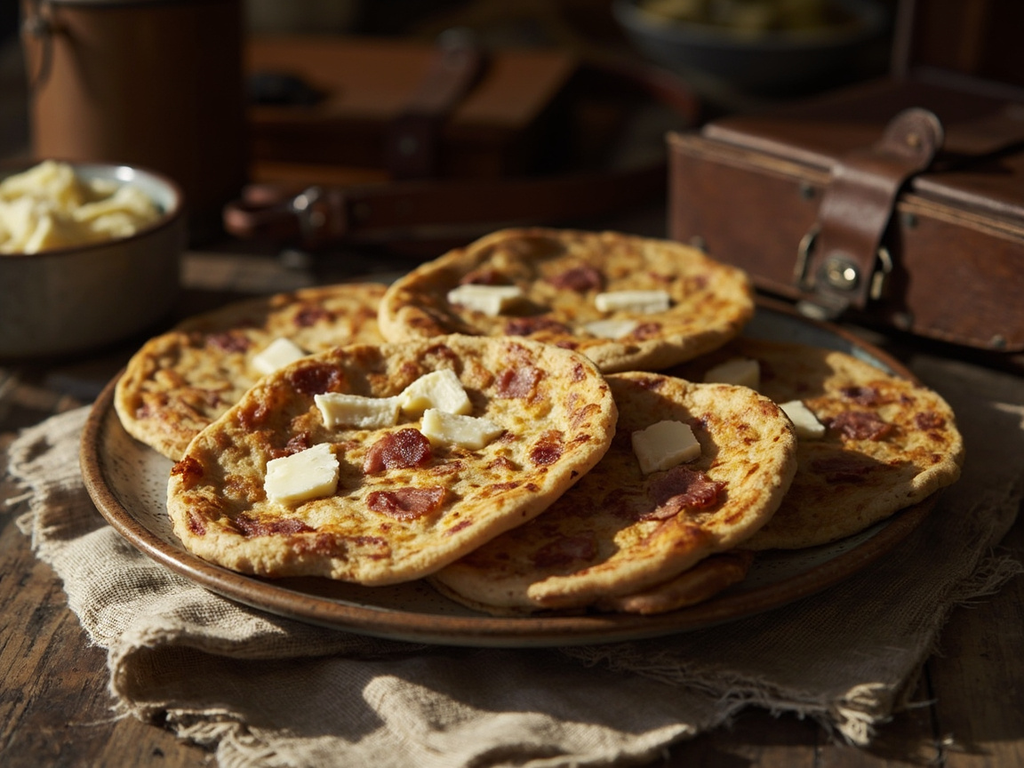
flipSpelt Griddle Cakes with Bacon and Fresh Cheese (Travel Bread)
Spelt Griddle Cakes with Bacon and Fresh Cheese (Travel Bread)
Why this dish? Basine's life is made of long roads: from Thuringia to Tournai to join Childeric, across a fragmented Gaul after the fall of Rome. On these paths, one carries a dense and nourishing bread, loaded with bacon and cheese, which keeps for days without spoiling. The snack of queens on the move as of warriors on campaign.
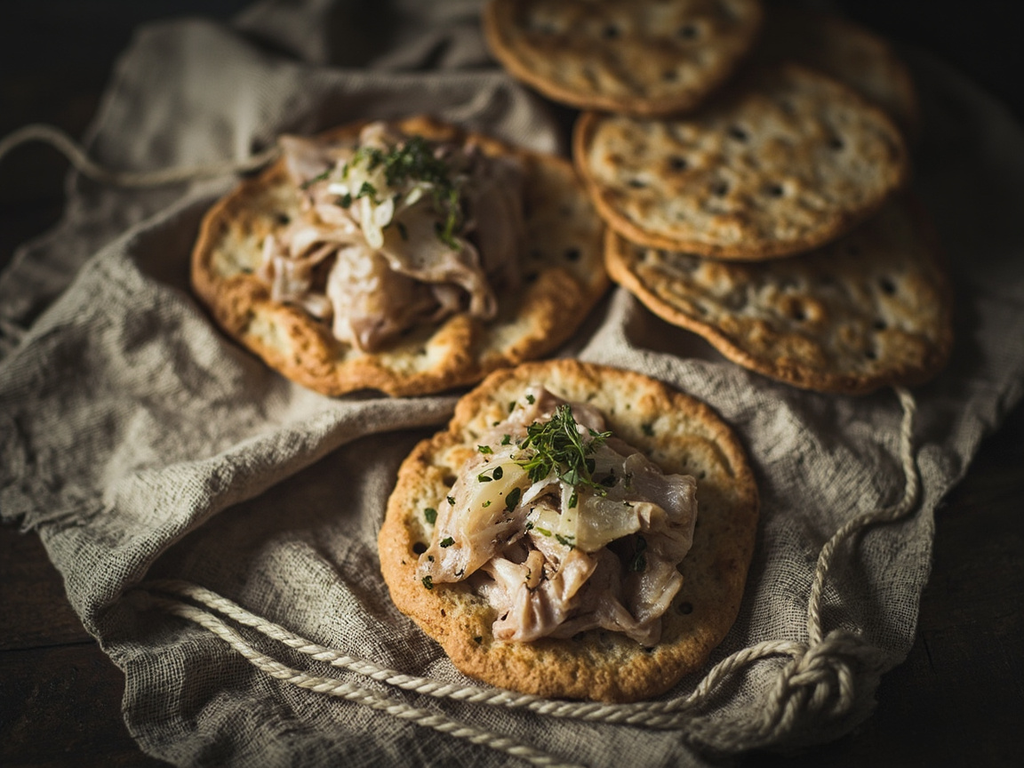
Flat, compact spelt cakes, enriched with melted bacon and fresh cheese, cooked on a stone. Easy to transport, they sustain travelers on the long roads of Frankish Gaul.
If you must take the road, never leave with an empty belly or empty hands. I have traveled far from the lands of Thuringia, and I know what keeps a body in the saddle: these tight spelt cakes, in which we have melted a little bacon and crumbled cheese from our ewes. We cook them on the hot stone, we let them dry, and they travel in the satchel for several days without turning. Bite into them when the sun lowers: you will thank the woman who kneaded them.
- •Spelt flour — two bowls (base)
- •Bacon — a few melted lardons (fat and flavor)
- •Fresh ewe's milk cheese — a handful (binder and flavor)
- •Water — as needed (dough hydration)
- •Salt — a pinch (seasoning)
Spelt Griddle Cakes with Bacon and Fresh Cheese (Travel Bread)
Flat, compact spelt cakes, enriched with melted bacon and fresh cheese, cooked on a stone. Easy to transport, they sustain travelers on the long roads of Frankish Gaul.
Why this dish? Basine's life is made of long roads: from Thuringia to Tournai to join Childeric, across a fragmented Gaul after the fall of Rome. On these paths, one carries a dense and nourishing bread, loaded with bacon and cheese, which keeps for days without spoiling. The snack of queens on the move as of warriors on campaign.
If you must take the road, never leave with an empty belly or empty hands. I have traveled far from the lands of Thuringia, and I know what keeps a body in the saddle: these tight spelt cakes, in which we have melted a little bacon and crumbled cheese from our ewes. We cook them on the hot stone, we let them dry, and they travel in the satchel for several days without turning. Bite into them when the sun lowers: you will thank the woman who kneaded them.
Ingredients (period version)
- Spelt flour — two bowls (base)
- Bacon — a few melted lardons (fat and flavor)
- Fresh ewe's milk cheese — a handful (binder and flavor)
- Water — as needed (dough hydration)
- Salt — a pinch (seasoning)
Ingredients
- Spelt flour — 300 g (base)
- Lardons (or diced smoked pork belly) — 100 g (fat and flavor)
- Fresh ewe's milk cheese (or brousse) — 120 g (binder and flavor)
- Warm water — about 120 ml (hydration)
- Salt — 1 tsp (seasoning)
Method
- Cook the lardons dry until they render their fat and brown. Reserve lardons and fat.
- In a bowl, mix the spelt flour and salt. Incorporate the warm bacon fat, crumbled fresh cheese and lardons.
- Add water little by little and knead until you get a firm, homogeneous dough.
- Divide into balls and flatten into thick cakes about 1 cm thick.
- Cook in a very hot pan (or on a stone/griddle) for 4 to 5 minutes per side, until golden and cooked through.
- Let cool and dry on a rack: they keep this way for several days and are easily transported.
How it was made : Dense cakes cooked on stone or under ashes precede leavened bread and are suitable for travel, frequent in a Frankish world where the aristocracy and armies were itinerant. Spelt, a rustic hulled wheat, was common in northern Gaul, and salted bacon was among the rare means of preserving pork and carrying protein on the road.
The contemporary twist : Wrap two in tied kraft paper for a 'Merovingian traveler's snack' to take on a hike — robust, salty, perfect at the top of a hill.
Sources : Massimo Montanari, La faim et l'abondance · Bruno Dumézil, Les royaumes barbares en Occident
Basina of Thuringia · Charactorium