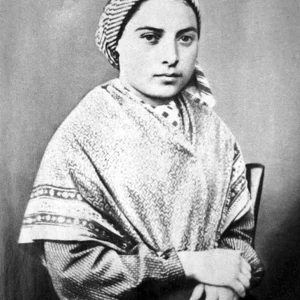

Bernadette Soubirous was a young French miller's daughter who claimed to have experienced eighteen apparitions of the Virgin Mary at the grotto of Massabielle, in Lourdes, in 1858. She became a nun with the Sisters of Charity of Nevers and was canonized in 1933.
Bernadette Soubirous(1844 — 1879)
Bernadette Soubirous
France
6 min read
Frequently asked questions
Famous Quotes
« I was charged to tell you, not to make you believe it.»
Key Facts
- Born on 7 January 1844 in Lourdes into a poor family of millers
- Claimed to have seen the Virgin Mary during 18 apparitions at the grotto of Massabielle between 11 February and 16 July 1858
- Reported the phrase “Que soy era Immaculada Councepciou” (“I am the Immaculate Conception”) on 25 March 1858
- Entered the Sisters of Charity of Nevers in 1866 and died there on 16 April 1879
- Beatified in 1925 and then canonized by Pius XI on 8 December 1933
Works & Achievements
Bernadette's steady, precise testimony before the civil and religious authorities sparked the inquiry that would lead to the recognition of the apparitions.
Digging into the ground as the apparition had directed her, Bernadette uncovered the spring to which healings would be attributed, the starting point of the pilgrimage.
The reporting of these words, tied to the dogma proclaimed in 1854, played a decisive role in the credibility the Church granted to the apparitions.
As an infirmary sister and sacristan, Bernadette offered a model of humility and service that would be highlighted at her beatification.
Born of her testimony, the sanctuary became one of the largest Catholic pilgrimage sites in the world, welcoming millions of visitors each year.
Anecdotes
On 11 February 1858, Bernadette, aged 14, was gathering dead wood with her sister and a friend near the grotto of Massabielle when she said she saw for the first time a “lady” dressed in white. Asthmatic and illiterate, she spoke only the Bigorre dialect at the time and did not know French.
During one of the apparitions, Bernadette said she was told to dig into the ground: a spring then welled up at the spot, and people would soon attribute healings to it. This spring at Lourdes still draws millions of pilgrims every year.
On 25 March 1858, when asked about the lady's identity, Bernadette reported that she had answered in dialect “Que soy era Immaculada Councepciou” (“I am the Immaculate Conception”). Bernadette, unaware of the meaning of this recent theological expression (a dogma proclaimed in 1854), repeated it without understanding it, which struck the religious authorities.
Fleeing fame and public curiosity, Bernadette entered the Sisters of Charity of Nevers in 1866, where she took the name Sister Marie-Bernard. There she lived humbly as a nurse and sacristan, repeating: “I will be good for making relics” and “The more wretched one is, the greater one's right to mercy.”
In fragile health all her life, Bernadette died of tuberculosis in 1879 at the age of 35. When her body was exhumed in 1909, and again in 1919 and 1925, the nuns described a remarkably well-preserved body; today it is displayed in a reliquary shrine at Nevers.
Primary Sources
Police Commissioner Jacomet questions Bernadette firmly from the very first apparitions to catch her out, but she maintains her account without variation.
“Que soy era Immaculada Councepciou” — “I am the Immaculate Conception,” words reported by Bernadette in the Bigourdan dialect.
At the conclusion of the canonical inquiry, the bishop officially recognizes that “the Immaculate Virgin, Mother of God, truly appeared to Bernadette Soubirous.”
The Sisters of Nevers describe the humility and patience of Sister Marie-Bernard during her years of illness at the Saint-Gildard convent.
Key Places
Town in the Hautes-Pyrénées where Bernadette was born into a family of millers; her family lived in poverty and for a time inhabited the « cachot », a former disused prison.
Site of the eighteen apparitions of 1858, on the bank of the Gave de Pau; it became the heart of the Sanctuary of Lourdes and one of the greatest places of pilgrimage in the world.
Bernadette was schooled there and treated for her asthma; she learned to read and write French there before entering religious life.
Mother house of the Sisters of Charity of Nevers where Bernadette lived from 1866 until her death as Sister Marie-Bernard; her body is preserved there today in a reliquary shrine.
Typical Objects

Bernadette held a rosary in her hands during the apparitions and told its beads as she recited the Rosary prayer. It became the object most closely associated with her image.

A traditional garment of the women of the Bigorre region, this large hooded cape worn by Bernadette became a distinctive sign of her humble peasant condition.

Bernadette held a lit candle during certain apparitions, a gesture that pilgrims have repeated ever since at the torchlight processions of Lourdes.

The water that gushed from the spring Bernadette said she discovered by digging in the ground is collected by pilgrims, who attribute healing powers to it.

On entering the convent, Bernadette put on the black habit and the cornette of the Sisters of Charity, leaving behind her peasant clothes.

Like the poor children of her time, Bernadette wore wooden clogs, and sometimes even went barefoot in the cold during her visits to the grotto.
School Curriculum
Vocabulary & Tags
Key Vocabulary
Daily Life
Morning
A poor child of Lourdes, Bernadette would rise early to help with household chores and tend the sheep. Being asthmatic, she often struggled to breathe in the damp cold of the Pyrenees.
Afternoon
She gathered dead wood, fetched water, and gradually learned catechism and reading with the Sisters. At the convent of Nevers, her afternoons were devoted to caring for the sick and maintaining the chapel.
Evening
In the evening, the family would recite the rosary by candlelight in the single room of the “cachot.” As a nun, Bernadette would withdraw for prayer and rest, her health slowly declining.
Food
The Soubirous family, who were very poor, lived mainly on bread—sometimes stale—soup, and corn porridge (millas). Meat was rare and periods of famine frequent.
Clothing
A little peasant girl from Bigorre, Bernadette wore a simple dress, a shawl, the white woolen capulet, and wooden clogs. At the convent, she took on the black habit and cornette of the Sisters of Charity.
Housing
Her family first lived at the Boly mill, then, having fallen into ruin, in a damp and unhealthy room called “le cachot,” a former jail. At Nevers, she lived in the plain buildings of the Saint-Gildard convent.
Historical Timeline
Period Vocabulary
Liens externes & ressources
Références
Œuvres
Le récit des apparitions de Lourdes
1858
La découverte de la source de Massabielle
25 février 1858
La formule « Je suis l'Immaculée Conception »
25 mars 1858
Sa vie religieuse à Nevers
1866-1879
Le sanctuaire de Lourdes
à partir de 1862