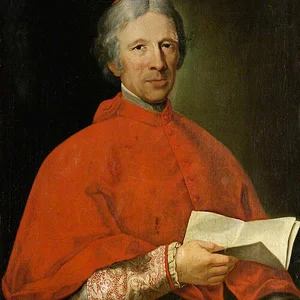

Charles Erskine (1739-1811) was a Scottish cardinal in the service of the Holy See. A diplomat of the Catholic Church, he acted as an intermediary between Rome and the European powers during the Napoleonic era.
Charles Erskine de Kellie(1739 — 1811)
Charles Erskine de Kellie
Royaume-Uni de Grande-Bretagne et d'Irlande
8 min read
Frequently asked questions
Key Facts
- Born in 1739 in Scotland into the Erskine de Kellie family, a Catholic noble family
- Ordained a priest and entered the service of the Roman Curia in the 18th century
- Created cardinal by Pope Pius VI or Pius VII in the context of tensions with Napoleonic France
- Served as a diplomatic agent of the Holy See to the British powers
- Died in 1811 in Rome
Works & Achievements
Erskine served as the Holy See's principal unofficial representative to the British government for nearly a decade. This mission made it possible to maintain discreet relations between Rome and London during the turbulent context of the Revolutionary Wars.
Although the direct negotiations were led by Cardinal Consalvi, Erskine contributed to the preliminary discussions through his European diplomatic networks, helping to facilitate the rapprochement between Napoleon and Pius VII.
As *avvocato concistoriale*, Erskine spent decades drafting legal opinions for the Roman ecclesiastical tribunals, contributing to the practice of canon law during a period of major upheaval.
A wide-ranging body of letters and dispatches exchanged with the British, French, and other governments, constituting a valuable source for the history of relations between the Catholic Church and the European states during the Napoleonic era.
Anecdotes
In 1793, as the French Revolution was upending Europe, Pope Pius VI entrusted Charles Erskine with a delicate mission: to travel to London and serve as an unofficial intermediary between the Holy See and the British government. The son of an exiled Scottish Jacobite family, Erskine spoke fluent English and understood the British Protestant mindset, making him an ideal diplomat for navigating hostile territory.
Born in Volterra in 1739 to Scottish noble parents who had fled following the defeat of the Stuarts, Charles Erskine grew up immersed in Italian culture while maintaining a proud Scottish identity. He studied at the Pontifical Scots College in Rome, which trained Catholic priests destined to work in predominantly Protestant countries — a formation that left a deep mark on his entire diplomatic career.
In 1800, during the conclave that would elect Pius VII, Erskine played a discreet but influential role. His knowledge of the various European powers' positions and his connections within Roman diplomatic circles made him a valuable adviser at a moment when the Church needed to reposition itself in the face of Napoleon Bonaparte, who had been master of France since the coup of 18 Brumaire.
When Napoleon set out to negotiate the Concordat of 1801 to reconcile revolutionary France with the Catholic Church, Erskine was involved in the preliminary negotiations. His appointment as cardinal in 1803 by Pius VII rewarded his services and symbolized recognition of his role in this historic rapprochement between Rome and Paris.
At his death in 1811, Charles Erskine left behind an atypical career: never a bishop, yet a cardinal; born of exiled parents, he had served one of the most powerful institutions in the world. His trajectory illustrates how the Catholic Church knew how to deploy figures from persecuted minorities for its most sensitive diplomatic missions.
Primary Sources
Erskine's letters from London, held in the Vatican Secret Archives, bear witness to his role as intermediary: he reports on the British government's attitude toward Catholicism and the prospects for an unofficial rapprochement between London and Rome.
The Supreme Pontiff Pius VII, recognizing the services rendered by Charles Erskine to the cause of the Holy See during particularly difficult times, created him Cardinal-Deacon in recognition of his zeal and unwavering fidelity to the Roman Church.
Ercole Consalvi mentions Erskine as one of the prelates who facilitated communications between the Holy See and the northern powers during the years of crisis, highlighting his discretion and his thorough knowledge of English affairs.
Charles Erskine, son of Sir Henry Erskine and Lady Euphemia Douglas, born in Volterra in 1739, is listed among the students of the Pontifical Scots College in Rome, where he received his training in canon law and theology before entering the service of the Curia.
Key Places
A medieval hilltop town in Tuscany and the birthplace of Charles Erskine in 1739. His parents, Jacobite Scottish nobles in exile, had settled there far from the Protestant England that had driven them out.
An institution founded to train Catholic Scottish priests destined to minister in a predominantly Protestant country. Erskine received a formation in canon law there that oriented his entire career toward ecclesiastical diplomacy.
The administrative and governmental centre of the Holy See, where Erskine served first as *avvocato concistoriale* and then as a cardinal after 1803. He spent most of his adult life there in the service of Popes Pius VI and Pius VII.
The capital of the United Kingdom, to which Erskine was sent on mission by the Holy See from 1793 onwards. His knowledge of the British language and culture made him the ideal intermediary between Rome and an officially Protestant country.
The city where the major negotiations between Napoleon and the Holy See took place, culminating in the Concordat of 1801. Erskine, in close contact with Roman diplomatic circles, followed these historic proceedings very attentively.
Typical Objects

Official documents sealed with the papal seal, given to Erskine to authenticate his diplomatic mission to European governments. Without these letters, no official counterpart could have dealt with him as a representative of the Holy See.

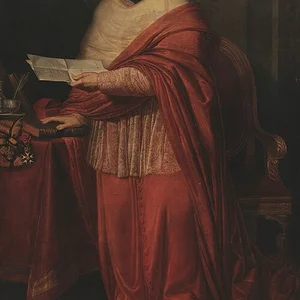
The distinctive scarlet silk headgear and vestment of Catholic Church cardinals, solemnly bestowed upon Erskine at his creation as a cardinal in 1803. Wearing this habit represented the crowning achievement of a lifetime in the service of Rome.

The book of liturgical prayers that every Catholic priest is required to recite daily according to the Canonical Hours. For a cardinal such as Erskine, this ritual structured his day between spiritual obligations and diplomatic duties.

The great collection of Catholic Church law and a foundational text for any canon lawyer. Erskine, trained as an *avvocato concistoriale*, had mastered this work, which governed relations between the Church and secular states.

A personal seal engraved with Erskine's heraldic arms, combining symbols of his noble Scottish family with the insignia of his ecclesiastical dignity. Indispensable for sealing official correspondence and guaranteeing its authenticity.

A secret code used to encrypt the most sensitive messages exchanged between Erskine and the Vatican Secretariat of State. At a time when letters could be intercepted by the intelligence services of belligerent powers, the cipher was an indispensable precaution.
School Curriculum
Vocabulary & Tags
Key Vocabulary
Daily Life
Morning
Charles Erskine began each day with the recitation of the canonical Hours — Lauds and Prime — from his Roman breviary. A priest above all else, he celebrated or attended Mass daily before turning to the voluminous diplomatic correspondence that arrived from European chancelleries.
Afternoon
Afternoons were devoted to audiences and legal consultations. In Rome, he received representatives of foreign states or attended the Curia for meetings of ecclesiastical commissions. During his London mission, he frequented the salons of English and Irish aristocratic Catholic families — invaluable networks of information and influence.
Evening
Evenings were spent drafting confidential dispatches for the Vatican Secretariat of State. Erskine wrote in Latin, Italian, or English depending on his recipients, sometimes encoding the most sensitive messages to prevent interception. He closed his nights with Compline, the final liturgical prayer of the day.
Food
As a Catholic priest who respected liturgical rules, Erskine observed the days of abstinence and fasting set by the Church. In Rome, his table reflected Tuscan and Roman cuisine — pasta, vegetables, meats roasted in wine. In England, he had to adapt to the markedly different British cuisine while maintaining his Lenten practices.
Clothing
In daily life, Erskine wore the black cassock of a priest with the violet ornaments of a prelate, then red ones after his appointment as cardinal in 1803. For official ceremonies, the full cardinal's attire — red silk cassock, rochet, mantelletta, and biretta — signalled his dignity. On mission in Protestant countries, he could adopt more discreet dress to avoid provoking hostility.
Housing
In Rome, Erskine resided in an apartment within an ecclesiastical palace in the historic centre, surrounded by books of canon law and diplomatic files. During his London mission, he lodged in the Catholic quarters of the city, often with noble families or influential members of the expatriate Irish community.
Historical Timeline
Period Vocabulary
Liens externes & ressources
Références
Œuvres
Mission diplomatique à Londres
1793-1801
Contribution aux négociations du Concordat de 1801
1800-1801
Consultations juridiques canoniques pour la Curie romaine
vers 1765-1803
Correspondance diplomatique avec les chancelleries européennes
1793-1811