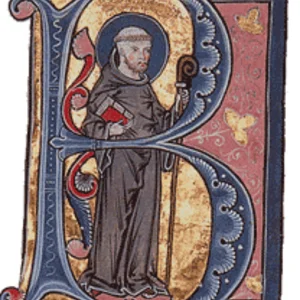

A French Cistercian monk, founder and abbot of the Abbey of Clairvaux, he was one of the most influential spiritual figures of the 12th century. A monastic reformer and preacher, he preached the Second Crusade and was canonized and later proclaimed a Doctor of the Church.
Bernard of Clairvaux(1091 — 1153)
Bernard of Clairvaux
Royaume de France
6 min read
Frequently asked questions
Famous Quotes
« The road to hell is paved with good intentions»
Key Facts
- Born around 1090 in Fontaine-lès-Dijon in Burgundy
- Founds the Abbey of Clairvaux in 1115 and becomes its first abbot
- Helps draft the rule of the Order of the Temple (1129)
- Preaches the Second Crusade at Vézelay in 1146
- Dies in 1153, canonized in 1174 and proclaimed a Doctor of the Church in 1830
Works & Achievements
Bernard creates and organizes an abbey that spreads throughout Europe: at his death, Clairvaux had dozens of daughter abbeys.
A text criticizing the luxury of Cluny Abbey and defending Cistercian austerity, which became a manifesto of monastic reform.
A major treatise of spirituality describing the degrees by which the soul rises toward the love of God.
A work in praise of the Templars, written to support this new religious knighthood whose rule Bernard had helped to draft.
A series of 86 sermons, his spiritual masterpiece, meditating on the union of the soul with God through the biblical text.
A treatise addressed to Pope Eugene III, a former monk of Clairvaux, on the duties and dangers of the papal office.
A preaching campaign across France and Germany that mobilized kings and knights for the crusade.
Anecdotes
In 1113, Bernard did not enter the abbey of Cîteaux alone: at 22, he had already convinced around thirty relatives to follow him, including several of his brothers and his uncle. Tradition holds that he had such a talent for persuasion that mothers hid their sons when he passed by, fearing he would lead them off to the monastery.
In 1115, his superiors sent the young Bernard to found a new abbey in a deserted valley of Champagne, at first nicknamed the “Valley of Wormwood.” He renamed it Clairvaux, the “clear valley,” and became its abbot: he would remain there for nearly forty years and make it one of the greatest spiritual centers in Europe.
At Easter 1146, before King Louis VII of France and an immense crowd gathered at Vézelay, Bernard preached the Second Crusade with such fervor that, it is said, the cloth crosses being handed out ran short: he is reported to have torn up his own habit to make more.
Bernard was an adviser to popes to such a degree that one of his former monks from Clairvaux became pope under the name Eugene III in 1145. Bernard then wrote him a treatise, the *De consideratione*, to remind him to remain humble despite his office.
Nicknamed the *Doctor mellifluus* (the honey-sweet doctor) for the gentleness of his sermons, Bernard was canonized in 1174, barely twenty-one years after his death, and later proclaimed a Doctor of the Church in 1830.
Primary Sources
The cause of loving God is God himself; and the measure of that love is to love him without measure.
A new knighthood has appeared on earth, one that wages a twofold combat: against enemies of flesh and blood, and against the spiritual powers of evil.
Remember above all that you are a man, and so remain in the presence of yourself as in the presence of all.
May my soul love ardently, for it was made to love; nothing else can satisfy its desire but the one who created it.
What good are these ridiculous monsters carved in the cloisters, this deformed beauty and beautiful deformity, before the eyes of the brothers as they read?
Key Places
Village in Burgundy where Bernard was born in 1091 into a family of minor nobility.
Birthplace of the Cistercian order, which Bernard entered in 1113 as a young monk before being sent to found a new abbey.
Abbey founded by Bernard in 1115 in the Aube region, which he led as abbot until his death there in 1153.
Burgundian town where Bernard preached the Second Crusade in 1146 before King Louis VII.
City where the council that recognized the Order of the Templars was held in 1128, an effort to which Bernard contributed.
Seat of the council of 1140 where Bernard confronted the theologian Peter Abelard, whose ideas were condemned.
Liens externes & ressources
Références
Œuvres
Fondation de l'abbaye de Clairvaux
1115
Apologia ad Guillelmum
vers 1125
De diligendo Deo (De l'amour de Dieu)
vers 1126
De laude novae militiae
vers 1130
Sermons sur le Cantique des cantiques
1135-1153
De consideratione
vers 1149-1153
Prédication de la deuxième croisade
1146