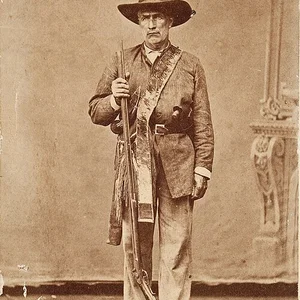

American outlaw of the Wild West, famous for his skill as a gunfighter and his involvement in the Lincoln County War. Killed at age 21 by Sheriff Pat Garrett, he became a legendary figure of the conquest of the American West.
Billy the Kid(1859 — 1881)
Billy the Kid
États-Unis
6 min read
Frequently asked questions
Key Facts
- Born in 1859, probably in New York, under the name Henry McCarty
- Took part in the Lincoln County War (New Mexico) in 1878
- Escaped from jail in Lincoln in April 1881 after being sentenced to death
- Killed on July 14, 1881, at Fort Sumner by Sheriff Pat Garrett, at age 21
- Renowned for the number of killings attributed to him (the legend of the “21 men”)
Works & Achievements
Fighting on the side of the Regulators, Billy played a notable role in this armed conflict, which pushed him permanently into a life on the run.
This correspondence, preserved to this day, is one of the few written records left by Billy himself, and is invaluable to historians.
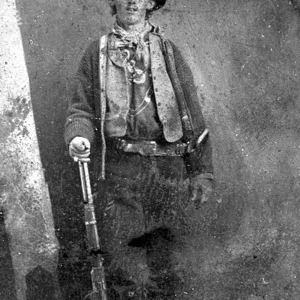
The only certified photograph of Billy the Kid, it has become one of the most famous and most sought-after images of the American West.
This spectacular escape, carried out while he was sentenced to death and shackled, sealed his reputation as an elusive outlaw.
Novels, newspapers and later films turned Billy into a global icon of the western, far beyond the historical reality.
Anecdotes
Born Henry McCarty, he went by several names during his short life, including William H. Bonney, under which he became famous. This shuffling of identities has greatly complicated the work of historians and fed the legend surrounding him.
His very first arrest, around age 15 in Silver City, was for stealing laundry from a washhouse. According to accounts of the time, he supposedly escaped from the local jail by climbing up the chimney flue.
During the Lincoln County War (1878), he joined the “Regulators,” an armed group formed after the murder of his employer, the English rancher John Tunstall. This conflict actually pitted two groups of merchants against each other in a struggle for commercial control of the region.
In 1879, he exchanged several letters with the governor of New Mexico, Lew Wallace — who was also the author of the novel “Ben-Hur” — to negotiate an amnesty in exchange for his testimony. The deal fell through and Billy went back on the run.
It is often repeated that he killed 21 men, one for each year of his life. Historians actually put the number at between four and nine: the legend greatly inflated his body count after his death, especially thanks to the book by Sheriff Pat Garrett.
Primary Sources
I will keep the appointment I made but be Sure and have men come that you can depend on. I am not afraid to die like a man fighting but I would not like to be killed like a dog unarmed.
$500 Reward. I will pay $500 reward to any person or persons who will capture William Bonny, alias The Kid, and deliver him to any sheriff of New Mexico.
I don't blame you for writing of me as you have. You had to believe others' stories; but then I don't know as anyone would believe anything good of me anyway.
Biography written by the sheriff who shot him, largely the source of the outlaw's legend, blending verifiable facts with exaggerations.
Key Places
Mining town where young Henry grew up with his mother and was first arrested. This is where his slide into delinquency began.
Scene of the Lincoln County War and the famous five-day battle of 1878. Billy was imprisoned here and made his escape in 1881.
Seat of the court where Billy was tried and sentenced to hang in April 1881 for the murder of Sheriff Brady.
Site of a stone cabin where Pat Garrett and his men captured Billy and his gang in December 1880 after a siege.
Former military post where Pat Garrett shot Billy down on July 14, 1881. The outlaw is buried here, and his grave still draws curious visitors.
Typical Objects

Iconic six-shot revolver of the American West, nicknamed the “Peacemaker.” It was the typical handgun of the outlaws and sheriffs of the era.

Lever-action rifle famous for its rate of fire, nicknamed “the gun that won the West.” Billy appears holding such a weapon in his only authenticated photograph.

Small photograph on an iron plate taken around 1879-1880, the only authenticated image of the outlaw. Long shown reversed, it wrongly led people to believe he was left-handed.

Wide leather belt fitted with loops for ammunition and a holster for the revolver. Essential for the cowboy and the outlaw alike to carry their cartridges.

Wide-brimmed headgear that protected against the sun and the dust of the plains. A central element of the silhouette of the Western horseman.

Working mount and horn saddle, essential for crossing the vast territories of New Mexico and fleeing pursuers.

Cards used in saloons for the gambling games that were very popular on the frontier. Billy was reputed to be a good player, especially at monte.
School Curriculum
Vocabulary & Tags
Key Vocabulary
Tags
Daily Life
Morning
On horseback from dawn, Billy lived the life of a ranch hand (cowboy): watching over the cattle, mending fences, and moving the herds across the arid plains. During his years on the run, mornings were mostly spent breaking camp and moving to a new hideout.
Afternoon
Afternoons were spent in the saddle, covering long distances under a scorching sun, or working on the friendly ranches that sheltered him. He was constantly on the move to escape his pursuers.
Evening
In the evening, he frequented the saloons and the dances (*bailes*) of the Spanish-speaking villages where he was warmly welcomed, playing cards, dancing, and speaking fluent Spanish. These networks of friends supplied him with food, shelter, and information.
Food
Food on the frontier was rough: beef, beans, corn cakes (tortillas), strong coffee, and hardtack biscuits. Among his Spanish-speaking friends, he enjoyed the spicy Mexican cuisine of New Mexico.
Clothing
He dressed like the riders of the West: a dark shirt, a vest, wool trousers, boots, a wide-brimmed hat, and a cartridge belt. His only photograph shows him in worn working clothes, without any movie-star elegance.
Housing
With no fixed home during his outlaw years, he slept in ranches, isolated cabins, or out under the stars around a campfire. He relied on the hospitality of the rancher families and villagers who supported him.
Historical Timeline
Period Vocabulary
Liens externes & ressources
Références
Œuvres
Participation à la guerre du comté de Lincoln
1878
Lettres au gouverneur Lew Wallace
1879
Ferrotype authentifié
vers 1880
Évasion de la prison de Lincoln
1881