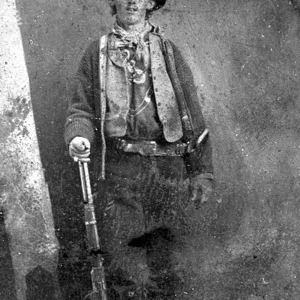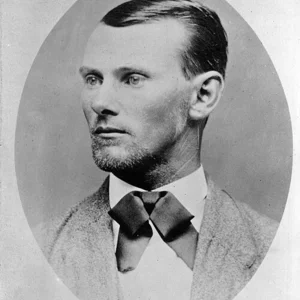

American outlaw, a former Confederate guerrilla who became the leader of the James-Younger gang. A robber of banks and trains across the Midwest after the American Civil War, he was assassinated in 1882 and became a legendary figure of Western folklore.
Jesse James(1847 — 1882)
Jesse James
États-Unis
7 min read
Frequently asked questions
Key Facts
- Born on September 5, 1847, in Kearney, Missouri
- Fought as a Confederate guerrilla (bushwhacker) during the Civil War (1861-1865)
- Formed the James-Younger gang with his brother Frank and the Younger brothers, carrying out a string of bank robberies from 1866 and train robberies from 1873
- The failed Northfield raid in Minnesota in 1876 broke up the gang
- Assassinated on April 3, 1882, in St. Joseph, Missouri, by Robert Ford, a member of his own gang
Works & Achievements
Considered the first daylight bank robbery during peacetime in the United States; Jesse's exact involvement is still debated by historians.
The killing of the cashier made the front pages and turned Jesse and Frank James into outlaws wanted across Missouri.
By derailing a locomotive, the gang launched the train attacks that became its trademark and captured the public's imagination.
At the head of a band of former Confederate guerrillas, Jesse orchestrated a decade of bank, train, and stagecoach robberies across the Midwest.
This botched attempt in Minnesota turned into a disaster: several members were killed or captured, sounding the death knell of the original James-Younger Gang.
Ballads, dime novels, and later cinema made Jesse James a global icon of the Wild West, lastingly blurring the line between the real criminal and the folk hero.
Anecdotes
During the Civil War
Jesse joined the Confederate guerrillas (
bushwhackers
) of
Bloody Bill" Anderson at the age of sixteen, while his brother Frank rode with Quantrill's band. These years of merciless ambushes in Missouri shaped the man who would later turn to outlawry.
In December 1869, Jesse and Frank robbed a bank in Gallatin, Missouri. There Jesse shot the cashier John Sheets, believing he was killing Samuel Cox, the officer who had killed his former guerrilla leader "Bloody Bill" Anderson. This bloody case of mistaken identity made the front pages and launched his reputation as an outlaw.
On the night of January 25–26, 1875, agents of the Pinkerton agency hurled an incendiary device into the family farmhouse. The explosion killed his half-brother Archie, about eight years old, and maimed his mother's hand, which had to be amputated. The tragedy turned part of public opinion in favor of the James family, now seen as persecuted victims.
The journalist John Newman Edwards, a former Confederate officer, published fiery articles in his newspapers portraying Jesse as a Robin Hood–style avenger. In reality, there is no proof that he ever shared his loot with the poor: his legend owes a great deal to this press propaganda.
On April 3, 1882, Jesse was living under the false name of Thomas Howard in Saint Joseph. As he had climbed onto a chair to dust a picture frame hanging on the wall, a member of his gang, Robert Ford, shot him in the back of the head to collect the reward promised by the governor. His death by treachery immediately inspired a famous popular ballad.
Primary Sources
Jesse had a wife to mourn for his life, three children, they were brave. But that dirty little coward that shot Mr. Howard has laid poor Jesse in his grave.
Official document by which the governor of Missouri, backed by the railroad companies, offers a reward of 5,000 dollars for the arrest and delivery of Frank and Jesse James, and an equivalent sum for their conviction.
A lengthy article by the pro-Confederate journalist that romanticizes the exploits of the James-Younger gang and shapes the heroic, chivalrous image of the outlaws, giving rise to their legend.
A letter in which Jesse, through the newspaper close to former Confederates, proclaims his innocence of the robberies attributed to him and presents himself as a victim of persecution by the Reconstruction authorities.
Key Places
Family farm in Clay County where Jesse was born and raised, and the scene of the deadly Pinkerton raid in 1875. He was first buried here before being reinterred.
Town where the 1866 robbery of the Clay County Savings Association took place, often described as the first daylight bank holdup in peacetime in the United States.
Site of the 1869 robbery in which Jesse killed the cashier John Sheets. This episode propelled the James brothers to the rank of notorious criminals.
Site of the gang's first train robbery in 1873, carried out by derailing a Rock Island company train.
Town where the James-Younger gang suffered a catastrophic failure in 1876 while attempting to rob the First National Bank, marking the end of the gang.
Town where Jesse lived under the name Thomas Howard and where he was assassinated by Robert Ford on April 3, 1882.
Typical Objects

Iconic Wild West handgun, used by guerrillas and later by robbers. Bushwhackers often carried several revolvers on their belts to multiply their shots.

Break-action revolver renowned for its fast reloading, prized by Western outlaws. Jesse owned one at the time of his death.

A loose shirt with large pockets, often embroidered by the women of the family, worn by Missouri bushwhackers during the Civil War. It served as both combat dress and a rallying sign.

A fast, hardy mount, indispensable for carrying out raids and escaping the posses sent after them. Mastery of the horse was a direct legacy of their years of guerrilla warfare.

Printed posters and official proclamations promising a bounty to whoever captured the James brothers. They contributed as much to hunting them down as to amplifying their fame.

A simple grain or canvas sack into which robbers swept up the money from banks, trains, and stagecoaches. A mundane object that became a symbol of Western outlawry.

After his death, Jesse's body was photographed and put on display, and the pictures sold as souvenirs. These macabre images immediately fed his legend.
School Curriculum
Vocabulary & Tags
Key Vocabulary
Tags
Daily Life
Morning
During his times on the run, mornings were spent breaking camp, tending the horses and watching the roads. Between jobs, living under a false identity, Jesse instead led the quiet life of a farmer or a respectable man rising early with his family.
Afternoon
Afternoons were divided between scouting the banks and trains to rob, long rides across the plains of Missouri, and cleaning the weapons. During quiet periods, he busied himself with household chores or small businesses so as not to arouse suspicion.
Evening
In the evening, the gang would gather at friendly farms or hideouts to plan their jobs and divide the loot. Led by former Confederate fighters, it relied on a broad network of sympathizers who shielded them from pursuit.
Food
The food was that of the Missouri frontier: salt pork, corn in all its forms (cornbread, mush), beans, game and strong coffee. On the road, the men ate whatever they could carry or get from the farms that helped them.
Clothing
Jesse wore the ordinary clothes of Western men: a shirt, a vest, wool trousers, boots and a wide-brimmed hat. During holdups, the gang sometimes concealed their faces and carried several revolvers on their belts, a legacy of their years of guerrilla warfare.
Housing
A wanted man, Jesse moved house constantly: the farms of relatives, houses rented under false names in Nashville and later in St. Joseph. He lived this permanent double game between the peaceful home he showed his neighbors and the secrecy of the outlaw.
Historical Timeline
Period Vocabulary
Liens externes & ressources
Références
Œuvres
Braquage de la banque de Liberty
1866
Braquage de Gallatin
1869
Premier braquage de train du gang à Adair
1873
Direction du gang James-Younger
1866-1876
Raid de Northfield
1876