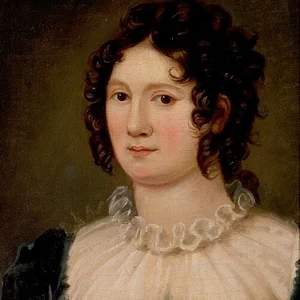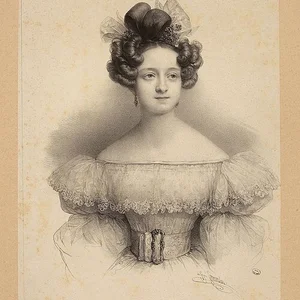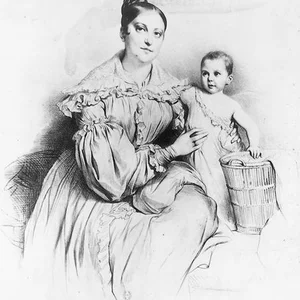

A woman of the French bourgeoisie whom Gustave Flaubert met at Trouville in 1836, when he was fifteen years old. This encounter left a lasting mark on the writer: she inspired the character of Madame Arnoux in Sentimental Education.
Élisa Schlésinger(1810 — 1888)
Élisa Schlésinger
France
5 min read
Frequently asked questions
Key Facts
- Met the young Gustave Flaubert at Trouville in 1836
- Inspired the character of Madame Arnoux in Sentimental Education (published in 1869)
- A figure of a platonic and lasting love that shaped Flaubert's work
Works & Achievements
Élisa was the model for the character of Marie Arnoux, the unattainable wife loved by Frédéric Moreau, the central figure of the novel.
An early work of Flaubert's youth in which he recounts, thinly veiled, his dazzled encounter at Trouville.
An early work by Flaubert fed by the same sentimental stirrings, prolonging the idealized image of Élisa.
Alongside her husband Maurice, Élisa took part in the life of a house that promoted the greatest Romantic composers of the era.
Anecdotes
In the summer of 1836, on the beach at Trouville, the young Gustave Flaubert, aged fifteen, saw Élisa Schlésinger retrieve a cloak being carried off by the tide. This fleeting image overwhelmed him: he would keep the memory of it all his life and make it the opening scene of *Sentimental Education*.
Élisa was married to Maurice Schlésinger, a turbulent and debt-ridden Parisian music publisher who released works by Chopin, Berlioz, and Liszt. Her marital situation was complicated: she lived with Maurice even before her first husband, Émile Judée, had been officially set aside.
Flaubert and Élisa kept up a correspondence and met again on several occasions over the decades, but their relationship most likely remained platonic. The writer held for her a tenderness mingled with melancholy that nourished his entire body of work.
The character of Madame Arnoux, in *Sentimental Education* (1869), is largely inspired by Élisa: the unattainable wife of an art dealer, the object of an ideal and never-consummated love of the hero Frédéric Moreau.
Toward the end of her life, Élisa Schlésinger was committed to an institution in Germany, stricken with mental illness. She died in Mannheim in 1888, far from the France where her figure had left its mark on the imagination of one of the greatest French novelists.
Primary Sources
It was like a vision: she was sitting in the middle of the bench, all alone; or at least he could not make out anyone else, in the dazzling light cast by her eyes.
I do not know what feeling of bliss intoxicated me as I gazed upon this woman, and I watched her; it seemed to me that I had known her elsewhere, and that in this young woman I was finding her again.
In his letters Flaubert speaks of “the great passion of my youth” and of the vivid memory of Trouville, which returns like an obsession over the years.
Key Places
Norman seaside resort where Flaubert, aged fifteen, met Élisa Schlésinger during the summer of 1836. The founding place of his great youthful emotion.
City where the Schlésinger couple lived, at the heart of the musical and literary effervescence of the July Monarchy and the Second Empire.
German city where Élisa Schlésinger, suffering from mental illness, was committed and died in 1888.
Estate near Rouen where Flaubert wrote *Sentimental Education*, transposing the memory of Élisa into the character of Madame Arnoux.
Typical Objects

A luxurious piece of cloth that middle-class women draped over their shoulders while strolling. On the beach at Trouville, a garment swept away by the waves fixed the image of Élisa in Flaubert's memory.

A small sunshade that middle-class women carried to preserve the paleness of their complexion. An indispensable accessory for summer strolls along the seaside.

A printed leaf that Maurice Schlésinger's publishing house distributed throughout Europe. These scores introduced Chopin, Berlioz and Liszt to the Parisian public.

The medium of the correspondence that Élisa and Flaubert exchanged over the decades. Mail was the main link between distant loved ones in the 19th century.

A woman's outfit with a wide skirt held up by a frame, emblematic of the middle-class fashion of the Second Empire. A symbol of respectability and refinement.

A horse-drawn open vehicle used by the middle class for strolls and travel around the city. A place of sociability and display in 19th-century Paris.
School Curriculum
Vocabulary & Tags
Key Vocabulary
Daily Life
Morning
The morning of a middle-class Parisian woman began with a long toilette assisted by a servant: hairstyling, corset and a carefully chosen dress. She would then read her mail and plan the day's visits and shopping.
Afternoon
The afternoon was devoted to walks, social calls and, in summer, sea bathing at Trouville. Élisa, married to a music publisher, also frequented the salons where the piano was played.
Evening
Evenings were often spent at the theatre, the opera or at receptions where artists and composers mingled. The Schlésingers, at the heart of the musical world, entertained and went out a great deal.
Food
The middle-class table of the 19th century was abundant: meats in sauce, pastries, fruit and coffee. Meals, governed by strict etiquette, were as much occasions for socialising and social display.
Clothing
Élisa wore the refined outfits of the bourgeoisie: dresses with full skirts, a cashmere shawl, a parasol and a bonnet. Fashion evolved from the cinched waist of the 1830s to the fullness of the crinoline under the Second Empire.
Housing
The couple lived in a middle-class Parisian apartment, carefully furnished and equipped with a piano, an indispensable instrument in a household tied to the musical world. Summer drew the family back to the Normandy seaside resorts.
Historical Timeline
Period Vocabulary
Liens externes & ressources
Références
Œuvres
Inspiration de Madame Arnoux (L'Éducation sentimentale)
1869
Inspiration des Mémoires d'un fou
1838
Inspiration de Novembre
1842
Soutien à la maison d'édition musicale Schlésinger
1834-1846