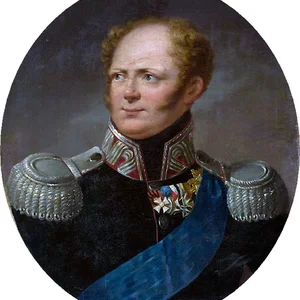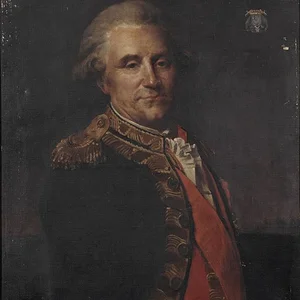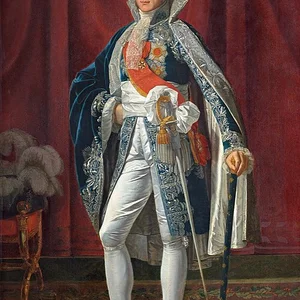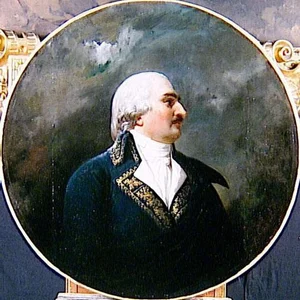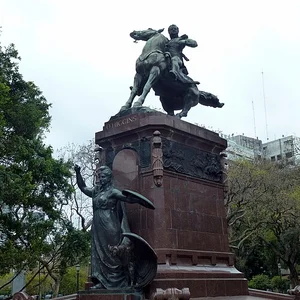

Prussian field marshal and a leading figure of the Napoleonic Wars. Nicknamed “Marschall Vorwärts” (Marshal Forward), he played a decisive role in Napoleon's defeat at Waterloo in 1815 by rallying his troops to support Wellington's British forces.
Blücher
Blücher
6 min read
Frequently asked questions
Key Facts
- Born in 1742 in Rostock, died in 1819; joined the Prussian army and rose to the rank of field marshal.
- Fought at the Battle of Leipzig (the “Battle of the Nations”) in 1813 against Napoleon.
- Commanded the Prussian army during the 1814 campaign in France.
- Arrived as decisive reinforcement at Waterloo on 18 June 1815, sealing Napoleon's defeat.
- Raised to the rank of Prince of Wahlstatt in 1814 for his services.
Works & Achievements
After the collapse at Jena, Blücher leads a fighting retreat all the way to Lübeck before surrendering for lack of ammunition, earning a reputation as a commander who never gives up.
At the head of this army, Blücher wins the victory of the Katzbach against the French, restoring the confidence of the coalition forces.
Blücher contributes decisively to Napoleon's greatest defeat on German soil, driving the French back beyond the Rhine.
Despite several setbacks against Napoleon, Blücher keeps up the pressure and takes part in the Allies' victorious march on Paris.
His decision to march toward Wellington despite the defeat at Ligny and the exhaustion of his troops secures the Allied victory and Napoleon's final downfall.
Anecdotes
Nicknamed *Marschall Vorwärts* (“Marshal Forward”) by his own soldiers, Blücher earned this moniker through his eagerness to always attack. During the campaign of **1813-1814**, his rallying cry was precisely “Forward!”, even when prudence would have counseled waiting.
At the Battle of Ligny, two days before Waterloo, his horse was killed under him and the old marshal, aged **72**, lay pinned beneath the animal, trampled by the cavalry charging back and forth. His aides pulled him out semi-conscious; he had himself rubbed down with alcohol and resumed command the next day.
Blücher fiercely hated **Napoleon** and Imperial France; after the Allies entered Paris in **1814**, he is said to have wanted to blow up the Pont d'Iéna, whose name celebrated the Prussian defeat of **1806**. The intervention of **Wellington** and the King of France prevented its demolition.
His lightning march toward the field of Waterloo on **18 June 1815**, despite roads soaked by rain, sealed Napoleon's defeat: the arrival of the Prussians on the French right flank turned an undecided battle into a rout.
A rough man, an inveterate gambler and smoker, Blücher sometimes suffered from spectacular bouts of melancholy: he was for a time reportedly convinced that he was pregnant with an elephant. This never stopped him from becoming, on the battlefield, the most combative of the Prussian commanders once again.
Primary Sources
Blücher assured Wellington that he would come to his aid with his entire army, and that nothing would prevent him from doing so.
I must not omit to mention, in the warmest terms, the assistance I received from General Blücher and the Prussian army.
The old marshal, barely recovered from his fall at Ligny, insisted on marching toward Wellington, repeating that he had given his word.
Key Places
Port city in Mecklenburg, in northern Germany, where Blücher was born in 1742.
Site of the “Battle of the Nations” in October 1813, the largest battle of the Napoleonic Wars, where Blücher commanded the Army of Silesia.
Belgian village where Blücher was defeated and wounded on 16 June 1815, two days before Waterloo, yet managed to save his army.
Battlefield south of Brussels where the arrival of Blücher's Prussians on 18 June 1815 sealed Napoleon's final defeat.
Silesian estate given to Blücher as a reward, where he died in 1819. The village lies in present-day Poland.
Typical Objects

The favored weapon of cavalry officers like Blücher, who led many charges at the head of his men. Its curved blade was suited to mounted combat.

A dark blue tunic adorned with braids and decorations, marking the highest rank in the army. Blücher became Generalfeldmarschall in 1813.

A Prussian military decoration created in 1813 during the Wars of Liberation. Blücher received an exceptional distinction, the so-called “Blücher Star,” placed above the Iron Cross.

A central piece of artillery in the Napoleonic battles, decisive at Leipzig as at Waterloo. The Prussian armies fielded hundreds of them.

An everyday object of the old marshal, an inveterate smoker, common among the Prussian officers of the time. The long-stemmed pipe with a porcelain bowl was typically German.

An indispensable tool of military planning, on which Blücher and his chief of staff Gneisenau coordinated the marches. Prussian speed relied on these surveys.
School Curriculum
Vocabulary & Tags
Key Vocabulary
Tags
Daily Life
Morning
In the field, Blücher rose early to inspect the bivouacs and receive reports from his chief of staff, Gneisenau. The morning was devoted to setting the order of march and studying maps of the terrain.
Afternoon
The afternoon might be taken up by the army's movements or by the battle itself, with Blücher insisting on being present on the front line to lead his men forward with the cry of "Forward!".
Evening
In the evening, under his tent or in a requisitioned billet, he dictated his dispatches, played cards, and smoked his pipe with his officers, fostering the esprit de corps of those around him.
Food
A general's everyday fare on campaign mixed ration bread, meat, soups, and beer or wine depending on local resources. Blücher gladly shared the soldier's rough table while enjoying good food whenever it was to be had.
Clothing
He wore the dark blue uniform of the Prussian army, adorned with a field marshal's braid and his many decorations, including the Iron Cross. On campaign, a great coat protected him from the cold and rain.
Housing
In the field, Blücher lodged under canvas or in requisitioned houses and farms along the line of march. In peacetime, he resided at his estate of Krieblowitz in Silesia.
Historical Timeline
Period Vocabulary
Liens externes & ressources
Références
Œuvres
Défense de Lübeck
1806
Commandement de l'armée de Silésie
1813
Bataille de Leipzig (bataille des Nations)
1813
Campagne de France
1814
Bataille de Waterloo
1815