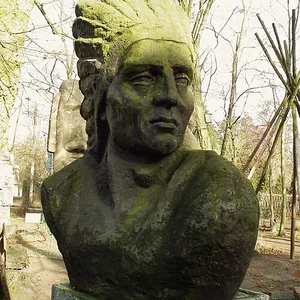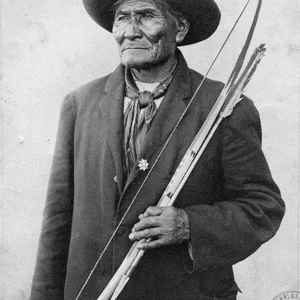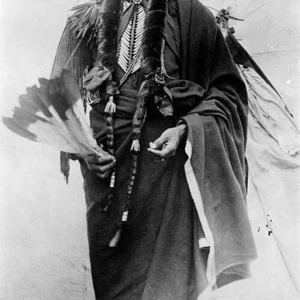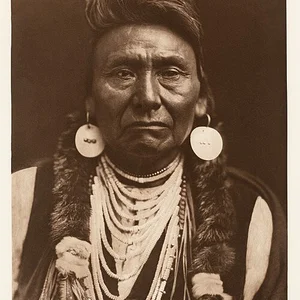

Chief of the Nez Perce Native American tribe. In 1877, he led his people on a desperate retreat of nearly 1,700 km to escape the U.S. Army and reach Canada, before surrendering just a few kilometers from the border.
Chief Joseph(1840 — 1904)
Chief Joseph
États-Unis
7 min read
Frequently asked questions
Famous Quotes
« I will fight no more forever.»
Key Facts
- Born around 1840 in the Wallowa Valley (in present-day Oregon)
- Refused in 1877 to surrender the ancestral lands of the Nez Perce to the U.S. Army
- Led a retreat of about 1,700 km toward Canada in 1877, repeatedly evading the troops
- Surrendered in October 1877 near the Bear Paw Mountains, some sixty kilometers from the Canadian border
- Died in 1904 on a reservation in the state of Washington
Works & Achievements
A flight of nearly 1,700 km across mountains and rivers to escape the army. This epic, marked by a series of battles, captured the attention of the American public.
A brief speech ending with “I will fight no more forever”, which became one of the most frequently quoted Native American texts. It symbolizes the tragic end of Nez Perce resistance.
A text published in the North American Review in which Joseph sets out his people's point of view and demands equal rights. It is a rare Native American testimony to be widely circulated at the time.
A diplomatic effort with President Hayes and federal officials to secure his people's return. It brought his cause to attention beyond the West.
During the deportation to Indian Territory and then to Colville, Joseph worked to protect the survivors and preserve their cohesion. His role was above all political and moral.
Until his death, Joseph made repeated requests to bring his people back to their ancestral lands. This claim went unanswered but left a lasting mark on memory.
Anecdotes
Chief Joseph's real name in the Nez Perce language was Hin-mah-too-yah-lat-kekt, which means “Thunder Rolling Down the Mountain.” The name “Joseph” came from the missionaries who had baptized his father, nicknamed “Old Joseph.”
In October 1877, after a flight of nearly 1,700 km, Joseph surrendered to the army just about sixty kilometers from the Canadian border. His words, reported by Lieutenant Charles Wood, have remained famous: “From where the sun now stands, I will fight no more forever.”
American newspapers nicknamed him the “Red Napoleon,” believing he was a military genius. In reality, the decisions of war were made collectively by several chiefs such as Looking Glass and White Bird; Joseph mainly watched over the families, the elderly, and the herds during the retreat.
In 1879, Joseph traveled to Washington to plead the cause of his people. There he met President Rutherford Hayes and had a piece published in a major magazine in which he called for equality: “Treat all men alike.”
The Nez Perce were renowned for breeding Appaloosa horses, recognizable by their spotted coats. When they surrendered, the army confiscated and scattered a large part of these herds, which nearly drove the breed to extinction.
Joseph died in 1904 on the Colville Reservation, far from his native Wallowa Valley, where he was never allowed to return. The reservation's doctor reportedly wrote that he had died “of a broken heart.”
Primary Sources
I am tired of fighting. Our chiefs are killed... It is cold and we have no blankets... Hear me, my chiefs, I am tired; my heart is sick and sad. From where the sun now stands, I will fight no more forever.
Let me be a free man—free to travel, free to stop, free to work, free to trade where I choose, free to follow the religion of my fathers, free to think and speak and act for myself.
Always remember that your father never sold his country. You must stop your ears whenever you are asked to sign a treaty selling your homeland.
Treat all men alike. Give them all the same law. Give them all an even chance to live and grow.
Key Places
Homeland of Joseph and his band, in northeastern Oregon. He spent his whole life defending his right to return there, but never obtained it.
Site of the first battle of the 1877 war, in June. There the Nez Percé inflicted a heavy defeat on the U.S. Army.
Site of a surprise attack by the army on the Nez Percé encampment in August 1877. Many women and children were killed there.
Site of the final clash and of Joseph's surrender in October 1877, about sixty kilometers from the Canadian border.
Capital where Joseph traveled in 1879 to plead the cause of his people and met President Hayes.
Reservation in Washington State where Joseph was assigned after his exile, far from the Wallowa. He died there in 1904.
Typical Objects

A spotted-coat horse that the Nez Perce bred with great care. It carried them on the move, supported buffalo hunting, and transported families during the long retreat of 1877.

A long-stemmed pipe used during councils and ceremonies. Smoking the calumet sealed agreements and solemn words exchanged between chiefs.

A flat bag finely woven from plant fibers, a craft for which Nez Perce women were renowned. It was used to store and carry camas roots and other provisions.

A head ornament made of eagle feathers, a sign of prestige and responsibility. Each feather could stand for a notable deed or a role within the community.

A Winchester- or Henry-type carbine, sometimes captured from the enemy, used by Nez Perce warriors. Its rate of fire allowed them to hold their own against the army in several battles.

Garments made of deer or elk hide, adorned with glass beads and shells. They protected against the climate while displaying the skill and status of the wearer.

The bulb of a wet-meadow plant, slow-cooked in earthen ovens. It was one of the staple foods of the Nez Perce, harvested every summer during great gatherings.
School Curriculum
Vocabulary & Tags
Key Vocabulary
Tags
Daily Life
Morning
In a village beside a river, the day began early. The men checked the horses and prepared for fishing or hunting, while the women rekindled the fire and went to fetch water.
Afternoon
The afternoon was devoted to work according to the season: fishing for salmon, harvesting camas roots in the meadows, or tanning hides. Chiefs like Joseph held council to settle the affairs of the community.
Evening
In the evening, families gathered around the fire to share a meal. The elders told stories and passed on their experience to the youngest, keeping alive the oral memory of the people.
Food
Their diet was based on salmon caught in the rivers, camas and kouse roots, wild berries, as well as game such as deer, elk, and bison hunted beyond the Rockies. Provisions were dried for the winter.
Clothing
People wore clothing made of deerskin or elk hide, often decorated with beads and shells. The women also wove hats and bags from plant fibers; in winter, furs and blankets provided protection from the cold.
Housing
The Nez Perce spent the winter in long houses covered with mats, set up near the rivers. When traveling and hunting bison, they raised tipis made of hides that were easy to take down.
Historical Timeline
Period Vocabulary
Liens externes & ressources
Références
Œuvres
La retraite des Nez-Percés
juin-octobre 1877
Discours de reddition aux Bear Paw
5 octobre 1877
« An Indian's View of Indian Affairs »
1879
Voyage de plaidoyer à Washington
1879
Le maintien de l'unité de sa bande en exil
1877-1885
Combat pour le retour dans la Wallowa
1885-1904