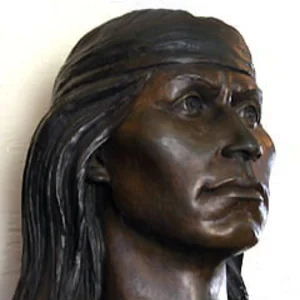

An Apache chief of the Chiricahua band, Cochise led the armed resistance against the U.S. Army in the Southwest for more than ten years. A major figure of the Apache Wars, he finally made peace in 1872.
Cochise(1812 — 1874)
Cochise
États-Unis
7 min read
Frequently asked questions
Key Facts
- Around 1861: the so-called Bascom Affair triggers his entry into war against the U.S. Army
- 1861-1872: he wages roughly eleven years of guerrilla warfare against American troops in present-day Arizona
- 1872: he negotiates peace with General Oliver Otis Howard, thanks to the mediation of Thomas Jeffords
- 1872: a Chiricahua reservation is created for his people in southeastern Arizona
- 1874: he dies of illness in the Dragoon Mountains
Works & Achievements
More than ten years of guerrilla warfare waged against the U.S. Army in the Southwest, which made Cochise one of the leading figures of the Apache Wars.
An ambush set with Mangas Coloradas against the California Column; one of the largest confrontations of the Apache Wars.
The establishment of an impregnable refuge from which Cochise directed his resistance without ever being captured.
An agreement negotiated with General Howard, ending the war and creating a reservation on the ancestral Chiricahua lands.
Securing a territory for his people with his friend Thomas Jeffords as agent, a condition set by Cochise himself.
Anecdotes
In 1861, Lieutenant George Bascom falsely accused Cochise of having kidnapped a young boy and summoned him under a flag of truce. Realizing it was a trap, Cochise slashed through the canvas of the army tent with a knife and escaped under a hail of bullets. This episode, known as the “Bascom Affair,” set off more than ten years of war.
Cochise made his refuge in a maze of rocks in the Dragoon Mountains of Arizona, from where his warriors could watch the plain and vanish in an instant. The place was so impregnable that American soldiers never managed to dislodge him from it: it is still called the “Cochise Stronghold” today.
In July 1862, at Apache Pass, Cochise and his father-in-law Mangas Coloradas ambushed the California Column. The Apaches were caught off guard by a weapon new to them: howitzer cannons. Cochise reportedly said that his men could have defeated the soldiers “if it had not been for those wagons that shoot twice” (the cannons).
The peace of 1872 was achieved thanks to a rare friendship: that between Cochise and the mail carrier Thomas Jeffords, who had dared to enter the Apache camp alone and unarmed to negotiate the safety of his riders. Cochise agreed to deal with General Howard only on the condition that Jeffords become the agent of his reservation.
At his death in 1874, the Chiricahuas secretly buried Cochise in a crevice of the Dragoon Mountains, along with his horse and his weapons. They then galloped horses over the grave to erase every trace: the exact location remains unknown to this day.
Primary Sources
When I was young I walked all over this country, east and west, and saw no other people than the Apaches. After many summers I came back and found another race of people had come to take this land.
Cochise said to me: “No one wants peace more than I do.” He kept his word, and as long as he lived the truce was never broken on his account.
Give me this land, that of the Chiricahuas, and let Jeffords be our agent: then the peace will hold.
The Apaches held the heights and the springs; without the use of artillery, the column's passage would have been very costly in lives.
Key Places
Mountain range in southeastern Arizona, the heartland of the Chiricahua Apache and the region where Cochise was born. A natural stronghold of peaks and canyons.
A strategic pass between two mountain ranges, with springs of water rare in the desert. Site of the Bascom affair (1861) and the battle of 1862.
American fort built in 1862 at Apache Pass to control its springs and fight Cochise. A symbol of the military presence in Apacheria.
A natural fortress of rocks where Cochise made his impregnable camp and where he was secretly buried in 1874. Its name directly honors the Apache chief.
A key town in the Arizona Territory, base for settlers and American authorities. A center of tensions, near the Camp Grant Massacre (1871).
Typical Objects

A short, powerful bow paired with arrows tipped in stone or salvaged metal. A silent weapon ideal for hunting and ambushes in mountainous terrain.

Firearms acquired through trade, raids, or taken from the enemy. Cochise and his warriors armed themselves with these against the U.S. Army.

The spear was used for close combat and hunting big game, the knife for everything else. It was with a blade that Cochise slashed through the tent during the Bascom affair.

Soft leather footwear reaching up to the knee, with a reinforced sole and an upturned toe to protect against cacti and rocks. Well suited to long marches across the desert.

A strip of cloth tied around the forehead, worn by Chiricahua warriors to keep their long hair in place. A distinctive feature of Apache dress, in contrast to the feathered headdress of the Plains peoples.

A mount essential to the mobility of the Apaches, allowing them lightning raids and swift escapes. Cochise's horse was buried with him according to custom.

Tightly woven basketry made by the women, sometimes watertight enough to carry water or cook food with heated stones. It was also used to gather seeds and fruit.
School Curriculum
Vocabulary & Tags
Key Vocabulary
Tags
Daily Life
Morning
At daybreak, the camp comes to life around the fires; the women rekindle the embers and prepare the food. As chief, Cochise listens to the reports of the scouts returned from the night and discusses movements or dangers with the warriors.
Afternoon
The afternoon is devoted to hunting, training horses, or maintaining weapons. In times of war, raids and ambushes are prepared, choosing routes through the mountains and canyons that only the Apaches know.
Evening
In the evening, the group gathers around the fire; the meal is shared, and the exploits and tales of the people are told. Important decisions are made in council, where the chief's word carries weight but never prevails alone.
Food
Their diet combines hunted game (deer, rabbit, antelope) with gathered foods: seeds, cactus fruit, pine nuts. The heart of the agave (the mescal), roasted at length in pits dug into the earth, is a staple food, supplemented by corn obtained through trade or raids.
Clothing
The men wear a breechcloth, a shirt of cotton or hide, high leather moccasins, and a headband around the forehead. The clothing, supple and durable, is suited to walking in the desert and to a climate that is scorching by day and cold by night.
Housing
The Chiricahuas live in wickiups, dome-shaped huts made of a framework of branches covered with grass, reeds, or hides. Light and quick to put up, they suit a semi-nomadic people who move often and can abandon the camp in case of danger.
Historical Timeline
Period Vocabulary
Liens externes & ressources
Références
Œuvres
Résistance armée des Chiricahuas
1861-1872
Bataille de la passe d'Apache
juillet 1862
Défense du bastion des monts Dragoon
années 1860
Traité de paix de 1872
octobre 1872
Création de la réserve chiricahua
1872