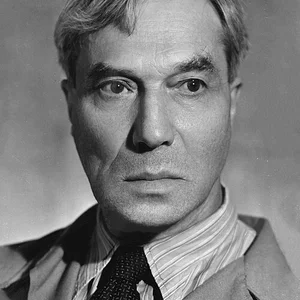

A Soviet Russian writer and poet, Boris Pasternak is the author of the novel *Doctor Zhivago*, a sweeping portrait of Russia swept up in the 1917 revolution and the civil war. Awarded the Nobel Prize in Literature in 1958, he was forced by the Soviet authorities to decline it.
Boris Pasternak(1890 — 1960)
Boris Pasternak
Union soviétique, Empire russe
6 min read
Frequently asked questions
Key Facts
- Born in 1890 in Moscow into a cultured family of Jewish artists (his father a painter, his mother a pianist)
- Published the poetry collection *My Sister, Life* in 1922, which revealed him as a major poet
- *Doctor Zhivago*, rejected in the USSR, was published in Italy in 1957 thanks to the publisher Feltrinelli
- Received the Nobel Prize in Literature in 1958 but was forced to decline it under pressure from the Soviet regime
- Died in 1960 in Peredelkino, near Moscow, marginalized by the authorities
Works & Achievements
Collection of poems written during the summer of 1917 that established Pasternak as a major voice in modern Russian poetry.
Autobiographical prose narrative in which he recalls his formative years, music, Marburg, and the poet Mayakovsky.
Poetry collection marking a turn toward a clearer, more accessible language.
To survive at a time when his own works were frowned upon, Pasternak produced translations that became classics in Russia, notably Hamlet and Faust.
Sweeping novel about a physician-poet swept up by the revolution and the civil war; a masterpiece banned in the USSR and published in Italy.
A brief account of his life and his art, written toward the end of his life and for a long time published only abroad.
Anecdotes
In 1912, the young Pasternak went to study philosophy in Marburg, Germany, under the famous professor Hermann Cohen. But after a marriage proposal was rejected, he abruptly abandoned philosophy to devote himself to poetry: he would later say that he had “dismissed” philosophy the way one leaves a house behind.
The son of a painter and a concert pianist, Pasternak was first destined for a career in music. Fascinated by the composer Scriabin, a friend of the family, he composed music himself for years before giving it up, believing he lacked the perfect pitch he considered indispensable.
In 1934, Pasternak received a phone call from Stalin himself, who wanted to know his opinion of the poet Osip Mandelstam, who had just been arrested. Caught off guard, Pasternak gave an evasive answer and long regretted his failure to defend his fellow poet more forcefully; Mandelstam ultimately died in deportation.
In 1958, he was awarded the Nobel Prize in Literature. He first telegraphed his joy to Stockholm, but then, under pressure from the Soviet authorities who threatened to exile him, he had to send a telegram of refusal four days later. A violent press campaign branded him a “pig,” and he was expelled from the Union of Writers.
When he died in 1960 at his dacha in Peredelkino, no official newspaper announced the date of the funeral. Yet, alerted by word of mouth, a crowd of thousands of admirers came to accompany him, and young people recited his banned poems over his grave.
Primary Sources
Immensely grateful, touched, proud, astonished, overwhelmed.
Considering the meaning this distinction has taken on in the society to which I belong, I must renounce this undeserved prize that has been awarded to me. Please do not take my voluntary refusal amiss.
Leaving my homeland would be the equivalent of death for me. I am bound to Russia by my birth, by my life, and by my work.
The murmur has died down. I have come on stage. […] To live a life is not as simple as to cross a field.
Key Places
Pasternak's birthplace, where he grew up among artists and spent most of his life.
University town where the young Pasternak studied philosophy in 1912 before turning definitively to poetry.
Village of writers' dachas near Moscow where Pasternak wrote *Doctor Zhivago*, lived out his final years, and was buried.
Town in the Kazan region where Pasternak was evacuated during the Second World War and where he worked on his translations of Shakespeare.
Liens externes & ressources
Références
Œuvres
Ma sœur la vie
1922
Sauf-conduit
1931
Seconde naissance
1932
Traductions de Shakespeare et du Faust de Goethe
années 1940-1950
Le Docteur Jivago
1957
Essai d'autobiographie
1957