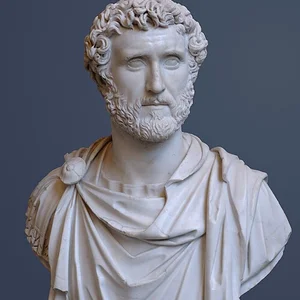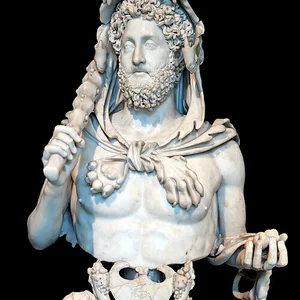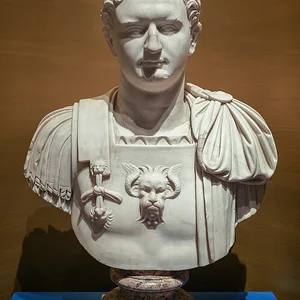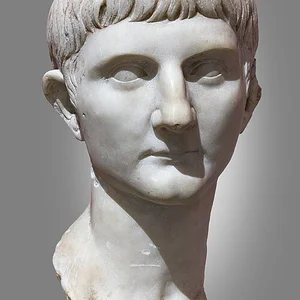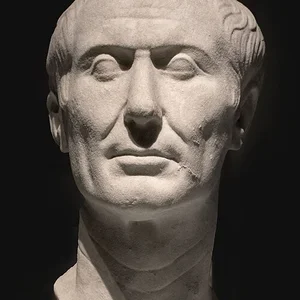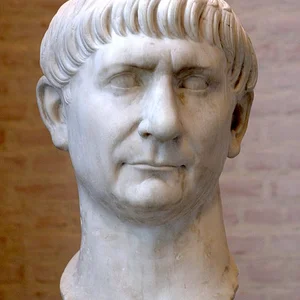

Trajan (53–117) was the first Roman emperor born outside Italy, from the province of Hispania. His reign is considered the height of the Roman Empire, marked by major conquests and a generous social policy.
Trajan(53 — 117)
Trajan
Rome antique
9 min read
Frequently asked questions
Famous Quotes
« May my reign be such that you can say you were happy under my rule.»
Key Facts
- 98: became emperor after adoption by Nerva; first provincial emperor (born in Hispania)
- 101–106: Dacian Wars — conquest of Dacia (present-day Romania) and its vast gold reserves
- 113–117: conquest of Mesopotamia and Armenia, marking the greatest territorial extent of the Roman Empire
- 106: foundation of the province of Arabia Petraea
- 113: erection of Trajan's Column in Rome, a masterpiece of imperial propaganda
Works & Achievements
A monumental complex in Rome comprising a basilica, two libraries, a covered market, and Trajan's Column. Funded by the spoils of the Dacian Wars, it is the largest imperial forum and a pinnacle of ancient urban planning.
A 38-meter column carved with a helical frieze depicting the Dacian Wars through 2,500 figures. A major iconographic source on the Roman army, it stands in Rome and is listed as a UNESCO World Heritage Site.
A bridge stretching over one kilometer, designed by Apollodorus of Damascus to cross the Danube during the Dacian Wars. One of the greatest feats of engineering in the ancient world, it was later demolished by Hadrian for fear of barbarian invasions.
A system of loans to Italian landowners whose interest payments funded food and education for poor children. The first large-scale social welfare policy in the Roman Empire, it was continued by Trajan's successors.
Two military campaigns that annexed the territory of modern-day Romania, rich in gold and silver mines. The conquest brought Rome an enormous amount of plunder and thousands of slaves, which funded major public works.
Trajan's final major campaign, which pushed Roman borders to the Persian Gulf and created the provinces of Armenia, Assyria, and Mesopotamia. It represents the greatest territorial extent of the Roman Empire in history.
A multi-story commercial complex built against the Quirinal Hill, considered an ancestor of the modern shopping center with around a hundred shops. Remarkably well preserved, it now houses a museum of the imperial fora.
Anecdotes
Trajan was the first Roman emperor born outside of Italy, in Italica in Hispania (present-day Spain). His provincial origins did not prevent him from being adopted by Emperor Nerva and becoming one of Rome's most admired rulers — proof that the Empire was beginning to look beyond its Italian borders.
During his campaigns in Dacia, Trajan had a monumental bridge built across the Danube, stretching approximately 1,135 meters, designed by the architect Apollodorus of Damascus. It was one of the most ambitious engineering feats of the ancient world, built to allow Roman legions to cross into this challenging territory.
The Roman Senate awarded him the title of Optimus Princeps, meaning 'the best of princes.' This exceptional honor illustrates just how highly his reign was regarded as a model of good governance: he consulted the Senate, respected the elite, and avoided the arbitrary executions that had characterized the reigns of some of his predecessors.
Trajan established the alimenta, an unprecedented social welfare program: the state lent money to landowners in Italy, and the interest from these loans was used to feed and educate poor children in towns across the country. This initiative reflects a remarkable concern for social welfare for its time.
Pliny the Younger, governor of Bithynia, maintained a famous correspondence with Trajan on the subject of Christians. Trajan replied that they should not be actively sought out, but punished if they publicly refused to sacrifice to the Roman gods. This letter is one of the very few official Roman documents to mention Christians.
Primary Sources
"You have followed the right rule, my dear Pliny, in examining the cases of those who have been denounced to you as Christians. For it is not possible to lay down any general rule. They are not to be sought out."
"You claimed for yourself nothing but what was of use to the State; you took from command only what was needed to defend, not to oppress."
"Trajan was strong in body, vigorous in mind, youthful in spirit despite his advanced age; he had neither arrogance nor weakness."
"The Senate and the Roman people [dedicate this column] to the emperor Caesar, son of the divine Nerva, Nerva Trajan Augustus Germanicus Dacicus..."
Key Places
Trajan's birthplace in Hispania Baetica, one of the oldest Roman colonies in Iberia. Trajan grew up there before joining the army, and the city prospered greatly thanks to its imperial connection.
The largest and last of Rome's imperial forums, inaugurated in 112 AD, featuring the famous Trajan's Column and Trajan's Markets. It represents the pinnacle of Roman civic architecture, funded by the spoils of the Dacian wars.
The religious and political capital of Dacia, besieged and destroyed by Trajan during the Dacian Wars of 101–106 AD. Its conquest marked the definitive annexation of Dacia as a Roman province.
The site where Apollodorus of Damascus built Trajan's famous bridge over the Danube, stretching over a kilometer in length. This engineering masterpiece enabled the supply of Roman legions during the Second Dacian War.
Capital of the Parthian Empire, captured by Trajan in 116 AD during his major eastern campaign. This victory brought the Roman Empire to its greatest territorial extent, reaching as far as the Persian Gulf.
The coastal city where Trajan died in August 117 AD while returning from the Parthian campaign, struck down by a stroke. His ashes were brought back to Rome and interred at the base of Trajan's Column.
Typical Objects

Articulated armor made of iron strips worn by Roman legionaries under Trajan, depicted on Trajan's Column. It symbolizes the military power that made the Dacian conquests possible.

A 38-meter commemorative monument erected in Rome in 113 AD, decorated with a 200-meter helical frieze depicting the Dacian Wars. It remains a unique visual source on the Roman army.

Weapons, shields, and standards captured from the Dacians and displayed during Trajan's triumph in Rome. They bear witness to the wealth and military sophistication of Rome's adversaries.

A gold coin struck with the emperor's portrait and inscriptions commemorating his victories. These coins circulated throughout the Empire, spreading the ruler's image all the way to its frontiers.

Everyday writing materials used for military orders, administrative correspondence, and letters such as those exchanged with Pliny the Younger. Several Dacian wax tablets have been recovered by archaeologists.

A purple military cloak fastened at the shoulder, the insignia of supreme command worn by the imperator. Trajan wore it during his campaigns, visually marking his status as commander-in-chief.

The sacred golden standard of each legion, carried by the aquilifer and never to be abandoned on pain of dishonor. It embodied the cohesion and honor of the units that enabled Trajan to conquer Dacia.
School Curriculum
Vocabulary & Tags
Key Vocabulary
Daily Life
Morning
Trajan rose early, in keeping with the military tradition that defined him. From dawn, he received his advisors, generals, and ambassadors in the audience hall of the imperial palace on the Palatine Hill. The salutatio — the morning greeting ceremony in which senators and dignitaries came to pay their respects — set the rhythm for the start of his day.
Afternoon
Afternoons were devoted to military and administrative affairs: reading reports from his provincial governors, dictating rescripts (imperial responses to legal petitions), and strategically planning military campaigns. Trajan also oversaw the major construction projects he commissioned in Rome alongside his architect Apollodorus of Damascus.
Evening
In the evenings, Trajan attended banquets (convivia) known for their relative restraint compared to the excesses of some emperors. He enjoyed hunting, thermal baths (particularly the baths he had built on the Esquiline Hill), and the company of those close to him. His wife Plotina and his sister Marciana played important roles in court life.
Food
Trajan's diet followed the habits of Roman high society: white wheat bread, olive oil, vegetables, cheeses, fish, and roasted meats. He was known to drink wine in moderation, in contrast to the image of debauchery associated with certain emperors. Important meals consisted of several courses (gustatio, prima mensa, secunda mensa) featuring refined dishes sourced from across the Empire.
Clothing
During peacetime in Rome, Trajan wore the toga praetexta — a white toga edged with purple — as a symbol of his consular and imperial authority. On campaign, he wore the paludamentum (the purple military cloak), an ornate cuirass (lorica musculata), and caligae, the hobnailed military sandals. A laurel wreath crowned his head during triumphal processions.
Housing
Trajan resided primarily in the imperial palace on the Palatine Hill in Rome, a complex spanning several hectares that included audience halls, gardens, libraries, and private apartments. On campaign, he stayed in the praetorium — the command tent at the center of the legionary camp (castra) — surrounded by his officers and Praetorian Guard.
Historical Timeline
Period Vocabulary
Visual Style
Le style visuel de l'époque de Trajan allie la grandeur monumentale de l'architecture impériale romaine — marbre blanc, dorures et pourpre — aux paysages contrastés des campagnes daciques et parthiques, tels que les représentent les reliefs de la Colonne Trajane.
Sound Ambience
L'univers sonore de Trajan mêle le fracas militaire des légions en campagne — armures, trompettes, ordres criés en latin — à l'effervescence d'une Rome impériale en pleine construction, avec ses foules, ses fontaines et ses chantiers monumentaux.
Liens externes & ressources
Références
Œuvres
Forum de Trajan
112 ap. J.-C.
Colonne Trajane
113 ap. J.-C.
Pont sur le Danube (Drobeta)
105 ap. J.-C.
Programme des Alimenta
vers 98-100 ap. J.-C.
Conquête de la Dacie
101-106 ap. J.-C.
Campagne parthique et conquête de la Mésopotamie
113-117 ap. J.-C.
Marchés de Trajan
110-112 ap. J.-C.