 flip
flipKrishara — Rice and Mung Beans with Ghee and Cumin
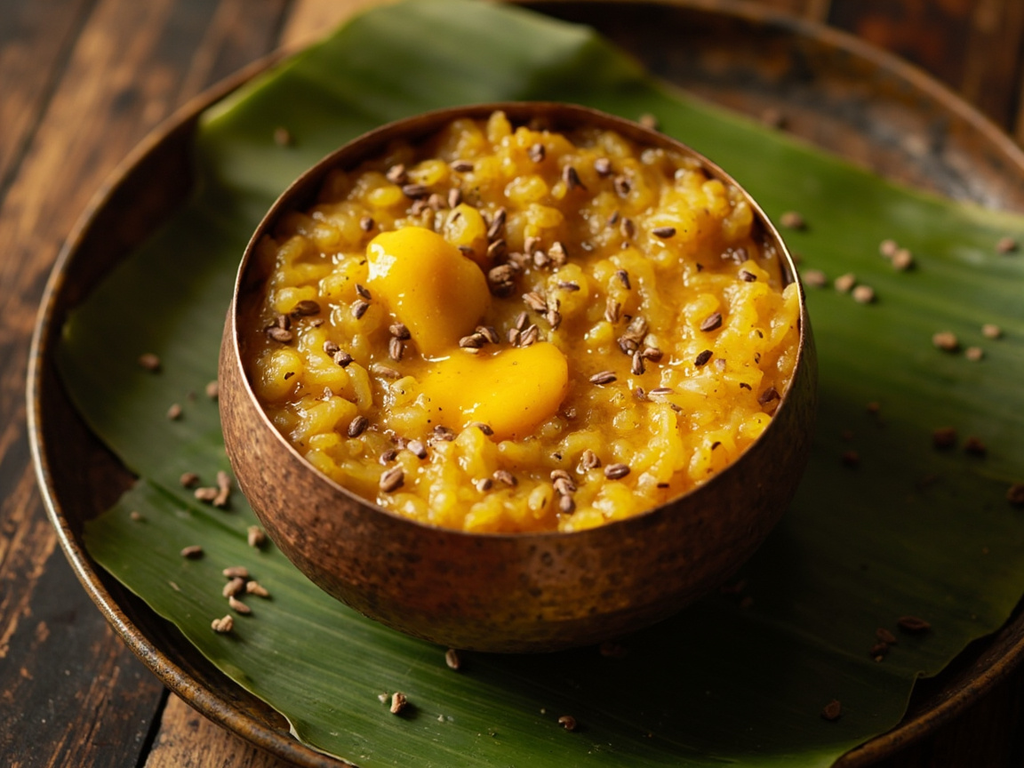
Krishara — Rice and Mung Beans with Ghee and Cumin
Why this dish? This is the everyday dish of a Brahmin from Ujjain: rice and lentils cooked together, simple, pure, filling. Brahmagupta took it after sunrise before climbing to the observatory to calculate the planets' positions; krishara (ancestor of khichari) is mentioned in ancient texts as food of the sober man.
Rice and hulled mung beans simmered together until melting, perfumed with ghee, cumin, turmeric, and a pinch of asafoetida. A one-pot meal: two ingredients, perfect balance, recommended by physicians to studious minds.
Approach, and listen to him who counts the stars. Before I trace my circles in the dust of Ujjain, I break the night's fast with this humble dish my mother already made: rice and mungo cook together in a single pot, just as unity and zero together hold all calculation. Pour hot ghrita, throw a pinch of hing so the belly stays light, and never forget cumin — it awakens the inner fire. Eat in silence: a mind that would read the sky must not burden the body.
- •White rice — one measure (cereal base)
- •Hulled mung beans (mudga) — half a measure (legume)
- •Ghee (ghrita) — as needed (sacred fat)
- •Cumin (jiraka) — a pinch (warming spice)
- •Turmeric (haridra) — a pinch (color and healing)
- •Asafoetida (hingu) — a grain (digestive)
- •Rock salt (saindhava) — to taste (seasoning)
- •Dried ginger (shunthi) — a little (medicinal heat)
Krishara — Rice and Mung Beans with Ghee and Cumin
Rice and hulled mung beans simmered together until melting, perfumed with ghee, cumin, turmeric, and a pinch of asafoetida. A one-pot meal: two ingredients, perfect balance, recommended by physicians to studious minds.
Why this dish? This is the everyday dish of a Brahmin from Ujjain: rice and lentils cooked together, simple, pure, filling. Brahmagupta took it after sunrise before climbing to the observatory to calculate the planets' positions; krishara (ancestor of khichari) is mentioned in ancient texts as food of the sober man.
Approach, and listen to him who counts the stars. Before I trace my circles in the dust of Ujjain, I break the night's fast with this humble dish my mother already made: rice and mungo cook together in a single pot, just as unity and zero together hold all calculation. Pour hot ghrita, throw a pinch of hing so the belly stays light, and never forget cumin — it awakens the inner fire. Eat in silence: a mind that would read the sky must not burden the body.
Ingredients (period version)
- White rice — one measure (cereal base)
- Hulled mung beans (mudga) — half a measure (legume)
- Ghee (ghrita) — as needed (sacred fat)
- Cumin (jiraka) — a pinch (warming spice)
- Turmeric (haridra) — a pinch (color and healing)
- Asafoetida (hingu) — a grain (digestive)
- Rock salt (saindhava) — to taste (seasoning)
- Dried ginger (shunthi) — a little (medicinal heat)
Ingredients
- Basmati rice — 150 g (cereal base)
- Yellow split moong dal — 100 g (legume)
- Ghee — 2 tbsp (fat)
- Cumin seeds — 1 tsp (spice)
- Turmeric powder — 1/2 tsp (color)
- Asafoetida (hing) — 1 pinch (digestive)
- Fresh grated ginger — 1 tsp (heat)
- Salt — 1 tsp (seasoning)
- Water — 750 ml (cooking)
Method
- Rinse rice and moong dal together until water runs clear.
- Heat ghee in a pot, crackle cumin seeds for a few seconds, then add hing and ginger.
- Add rice, dal, and turmeric, stir to coat with fragrant ghee.
- Add water and salt, bring to a boil then lower heat.
- Cover and simmer 20-25 min until soft and porridge-like; add water if needed.
- Serve hot with a final drizzle of ghee on top.
How it was made : It was cooked in a clay pot over a fire of dried cow dung or wood, without tomato or chili (absent from India before the 16th century). Heat came from ginger and peppers; rice and mungo, easy to digest, were prescribed to the sick and ascetics alike.
The contemporary twist : Serve in a hammered copper bowl with a spoonful of melted ghee on top and a pinch of freshly cracked black pepper — a fourteen-century-old comfort food.
Sources : K.T. Achaya, Indian Food: A Historical Companion, Oxford University Press, 1994
Brahmagupta · Charactorium