 flip
flipGruel Porridge with Simples
Gruel Porridge with Simples
Why this dish? Presented as a peasant-healer of legendary Brittany, Agatha begins her days with the poor man's cereal porridge, enlivened by the herbs she gathers at dawn on the forest path. It is the foundation of her diet: nourishing, free, healing.
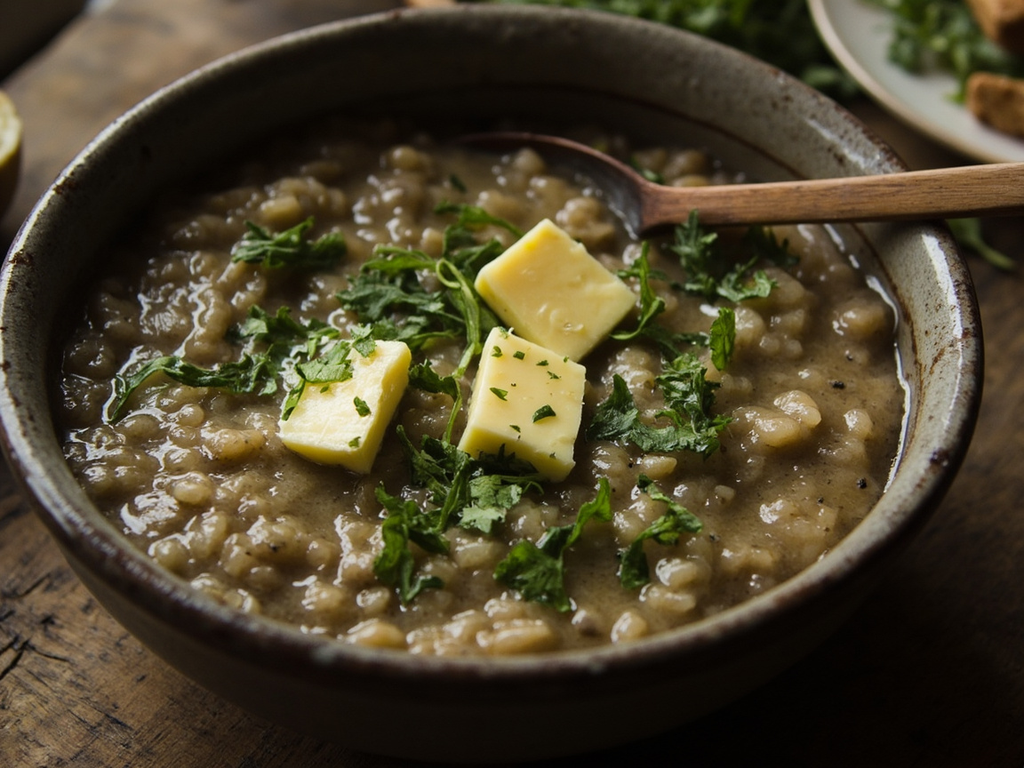
A thick porridge of oats and rye, slowly cooked in water, enriched with chopped nettles and a little salted butter. The humblest and most everyday dish: one that sticks to the bones before a day of foraging.
Come closer, little one, and fear not my cauldron. Before the cock crows, I toss my gruel into the spring water and stir it, stir it, until it thickens like mud after a storm. Into it, a handful of nettles I cut with my left hand before the dew falls—they no longer sting once boiled, the fire takes away their anger. A knob of butter, some grey salt, and you'll be as strong as a woodcutter until none. Eat it hot, for cold it turns to stone.
- •Oat groats and rye flour — two handfuls (base cereal)
- •Fresh nettles (young shoots) — a good handful (simple / greens)
- •Spring water — as needed (cooking liquid)
- •Salted butter — a walnut-sized piece (fat binder)
- •Grey salt — a pinch (seasoning)
Gruel Porridge with Simples
A thick porridge of oats and rye, slowly cooked in water, enriched with chopped nettles and a little salted butter. The humblest and most everyday dish: one that sticks to the bones before a day of foraging.
Why this dish? Presented as a peasant-healer of legendary Brittany, Agatha begins her days with the poor man's cereal porridge, enlivened by the herbs she gathers at dawn on the forest path. It is the foundation of her diet: nourishing, free, healing.
Come closer, little one, and fear not my cauldron. Before the cock crows, I toss my gruel into the spring water and stir it, stir it, until it thickens like mud after a storm. Into it, a handful of nettles I cut with my left hand before the dew falls—they no longer sting once boiled, the fire takes away their anger. A knob of butter, some grey salt, and you'll be as strong as a woodcutter until none. Eat it hot, for cold it turns to stone.
Ingredients (period version)
- Oat groats and rye flour — two handfuls (base cereal)
- Fresh nettles (young shoots) — a good handful (simple / greens)
- Spring water — as needed (cooking liquid)
- Salted butter — a walnut-sized piece (fat binder)
- Grey salt — a pinch (seasoning)
Ingredients
- Rolled oats — 120 g (base cereal)
- Rye flour — 2 tbsp (rustic binder)
- Nettles (or spinach/young greens as substitute) — 100 g (simple / greens)
- Water — 700 ml (cooking liquid)
- Semi-salted butter — 20 g (fat binder)
- Salt — 1 pinch (seasoning)
Method
- Wearing gloves, rinse the nettles and plunge them into boiling water for 1 minute to remove the sting, then chop finely.
- Bring the 700 ml of salted water to a simmer, sprinkle in the oats and rye flour.
- Stir constantly over low heat for 15 to 20 minutes until a thick porridge forms.
- Stir in the chopped nettles and butter, mix for another 2 minutes.
- Serve piping hot in an earthenware bowl.
How it was made : Cereal porridge (oats, rye, barley) was the staple dish of European peasants, eaten morning and evening, long before bread became daily fare. Nettles, free and abundant at the forest edge, served as a vegetable-remedy: rich in iron, they were said to "strengthen the blood."
The contemporary twist : A drizzle of hazelnut oil and a few nettles fried into crispy chips on top: the poor man's porridge takes on the airs of a gastropub porridge.
Sources : Massimo Montanari, La faim et l'abondance. Histoire de l'alimentation en Europe · Bruno Laurioux, Manger au Moyen Âge
Agatha Southeil · Charactorium