 flip
flipArán coirce — oatcakes with churned butter
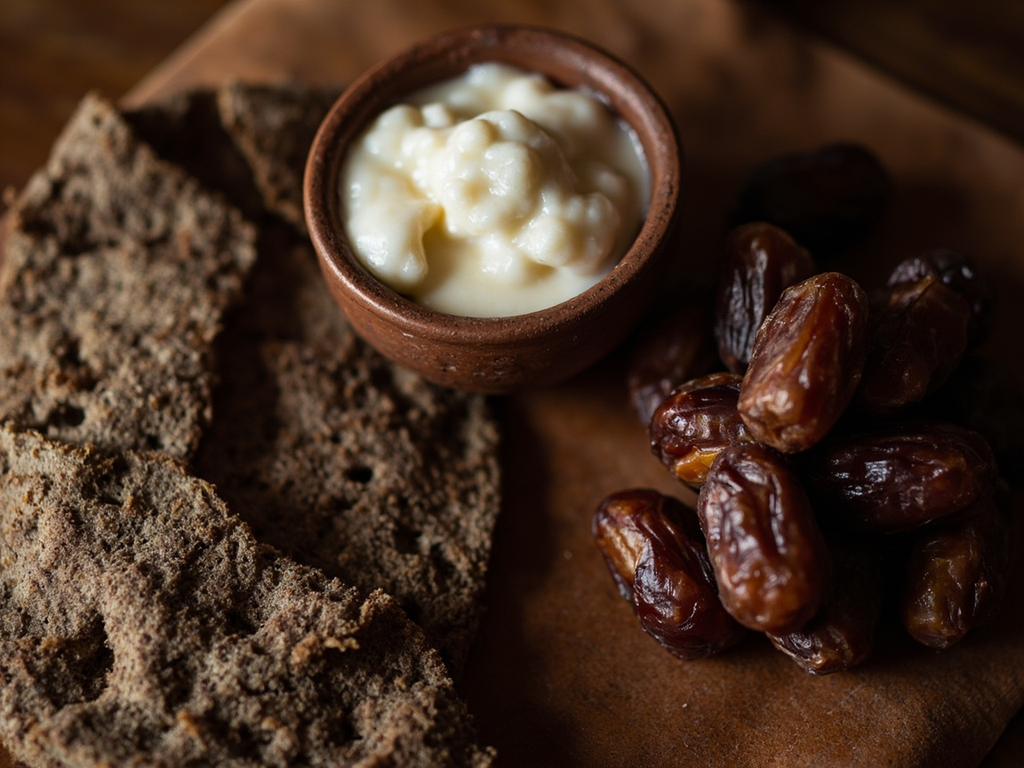
Arán coirce — oatcakes with churned butter
Why this dish? Oats and milk are the staple of Kildare monastery. Every morning, before the offices, the sisters cook these flat cakes on the hot stone and spread them with the community's butter — the simplest and most constant food of Brigid's life.
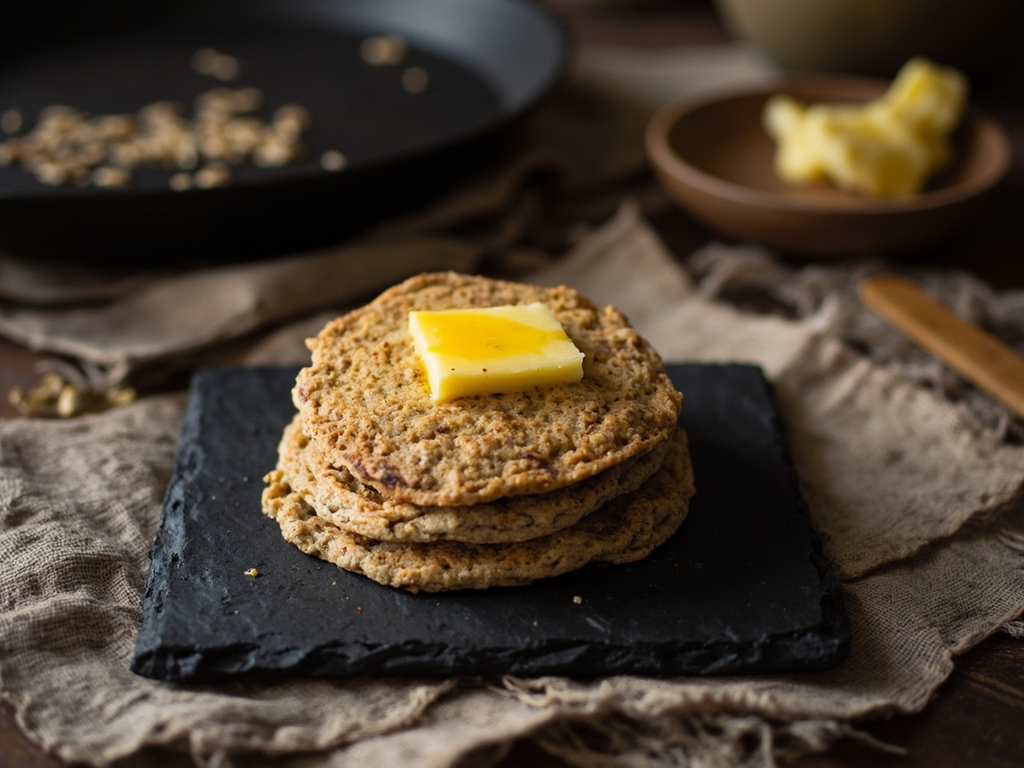
A rustic oatcake of coarsely ground oats, dry-baked on a stone or hot griddle, then generously buttered. Crispy at the edge, tender at the heart: the bread of the humble and the monks.
Come close, my child, and do not be ashamed of simplicity. See: I take the oat flour that the Curragh has given us, mix it with a little water and salt, and spread it thin on the stone that the fire has reddened. We turn it when the edge lifts. On the hot cake I lay the butter from our churn — the very butter that God, in His goodness, has never let our door lack. Eat, and keep a portion for the one who will be hungry after you.
- •Coarse oat flour — two handfuls per person (base)
- •Spring water — enough to bind (binder)
- •Salt — a pinch (seasoning)
- •Churned butter — as much as you like (topping, signature)
Arán coirce — oatcakes with churned butter
A rustic oatcake of coarsely ground oats, dry-baked on a stone or hot griddle, then generously buttered. Crispy at the edge, tender at the heart: the bread of the humble and the monks.
Why this dish? Oats and milk are the staple of Kildare monastery. Every morning, before the offices, the sisters cook these flat cakes on the hot stone and spread them with the community's butter — the simplest and most constant food of Brigid's life.
Come close, my child, and do not be ashamed of simplicity. See: I take the oat flour that the Curragh has given us, mix it with a little water and salt, and spread it thin on the stone that the fire has reddened. We turn it when the edge lifts. On the hot cake I lay the butter from our churn — the very butter that God, in His goodness, has never let our door lack. Eat, and keep a portion for the one who will be hungry after you.
Ingredients (period version)
- Coarse oat flour — two handfuls per person (base)
- Spring water — enough to bind (binder)
- Salt — a pinch (seasoning)
- Churned butter — as much as you like (topping, signature)
Ingredients
- Blended oat flakes (or oat flour) — 200 g (base)
- Hot water — 100 to 130 ml (binder)
- Salt — 1/2 tsp (seasoning)
- Good quality salted butter — 60 g (topping, signature)
Method
- Mix the oat flour and salt, then add the hot water gradually until you get a soft, non-sticky dough.
- Let rest for 5 minutes to allow the oats to absorb the water.
- Form balls and flatten them very thinly between two sheets of paper into discs about 12 cm.
- Heat a dry pan or cast-iron griddle without fat.
- Cook each cake for 3–4 minutes per side, until golden and the edges lift.
- Serve immediately, spread with a thick layer of butter.
How it was made : Oats were the queen of cereals in medieval Ireland, better suited to the damp climate than wheat. These cakes were baked on a flat stone (leac) placed on the embers, or on an iron griddle, without an oven. Butter was not a luxury but an everyday fat, preserved salted in wooden containers.
The contemporary twist : Stack them unevenly on a slate, topped with a curl of cold farmhouse butter that melts slowly, and a sprinkle of sea salt flakes.
Sources : Fergus Kelly, Early Irish Farming, Dublin Institute for Advanced Studies, 1997 · A. T. Lucas, "Irish Food before the Potato", Gwerin, 1960 · Regina Sexton, A Little History of Irish Food, 1998
Brigid of Kildare · Charactorium