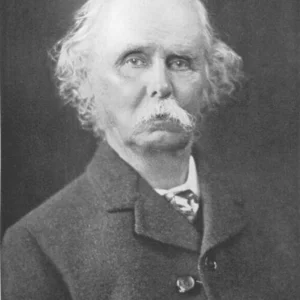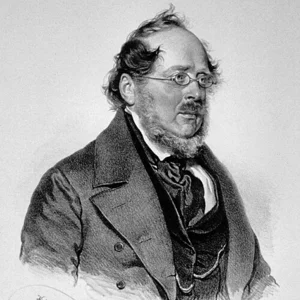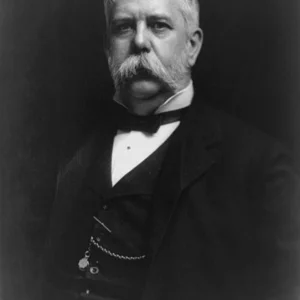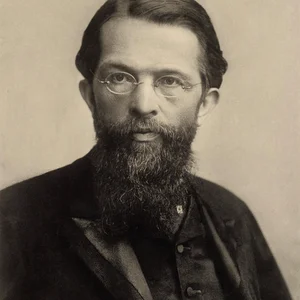

Carl Menger (1840-1921) was an Austrian economist and the founder of the Austrian School of economics. With his theory of marginal utility, he took part in the “marginalist revolution” that transformed economic thought in the 19th century.
Carl Menger(1840 — 1921)
Carl Menger
Autriche, Autriche-Hongrie, empire d'Autriche
7 min read
Frequently asked questions
Key Facts
- Born in 1840 in Nowy Sącz, in Galicia (Austrian Empire)
- Publishes his “Principles of Economics” (Grundsätze der Volkswirtschaftslehre) in 1871, the founding text of the Austrian School
- Develops the theory of marginal utility, contributing to the marginalist revolution alongside Jevons and Walras
- Becomes professor of political economy at the University of Vienna in 1873
- Opposes the German Historical School during the “Methodenstreit” (the dispute over methods) in the 1880s
- Dies in 1921 in Vienna
Works & Achievements
The founding work of the Austrian School. It establishes the subjective theory of value and marginal utility, the basis of all his work.
In it Menger defends a deductive method and the search for general economic laws, triggering the *Methodenstreit* against the German historical school.
A polemical pamphlet in which Menger responds to the criticisms of Gustav Schmoller and defends his conception of economic science.
An essay in which Menger sets out his theory of the spontaneous origin of money, born from exchange rather than from a decision of the State.
Through his teaching in Vienna, Menger trained Böhm-Bawerk and Wieser, launching an economic current still influential today.
Menger taught economics to the son of Emperor Franz Joseph and accompanied him on a great educational journey across Europe.
Anecdotes
In 1871, Carl Menger published his "Principles of Economics" when he was only 31 years old. Without knowing it, he was one of three economists — along with the Englishman Jevons and the Frenchman Walras — who discovered almost simultaneously, and each on their own, the same great idea: the value of a good depends on the usefulness of its last available unit. This is called the "marginalist revolution".
Before becoming a professor, Menger worked as an economic journalist for the Viennese press and analyzed markets. It was by observing that real prices did not match the theories of his time that he had the intuition for his own theory of value.
In 1876, Menger was entrusted with a prestigious mission: teaching economics to the young crown prince Rudolf of Habsburg, son of Emperor Franz Joseph. For two years, he accompanied the prince across Europe to introduce him to the various countries and their economies.
Menger embarked on a long and famous intellectual dispute with the German economist Gustav Schmoller, which has gone down in history under the name "Methodenstreit
(the battle of methods). They disagreed on one question: should economics seek general and universal laws
or should it study the history of each country case by case?
To explain how money comes into being, Menger imagined that no king or government invented it by decree. According to him, money would have been born on its own, little by little, because merchants spontaneously chose to trade the goods that were easiest to resell, such as gold.
Primary Sources
Value is therefore nothing inherent in goods, no property of them, nor is it an independent thing existing in its own right. It is a judgment that economizing people make about the importance of the goods at their disposal for the maintenance of their lives and well-being.
All useful goods whose available quantity is less than the need for them are economic goods; those whose available quantity exceeds the need are non-economic goods.
How can it be that institutions which serve the common good and are essential to its development could have arisen without a common will directed toward their establishment?
Money is not an invention of the State, nor the product of a legislative act. It arose spontaneously out of the exchange relations between people.
Key Places
A town in Galicia, then a province of the Austrian Empire and today located in Poland, where Carl Menger was born in 1840.
Menger obtained his chair in political economy here in 1873 and trained the first generation of the Austrian School, including Böhm-Bawerk and Wieser.
Capital of the Austro-Hungarian Empire where Menger spent most of his career and died in 1921. The birthplace of the Austrian School of economics.
One of the universities where Menger studied law before turning to political economy.
Menger continued his law studies here in the 1860s, before defending his doctorate in Kraków.
Typical Objects

The instruments with which Menger wrote his books and notes. In the 19th century, all intellectual work was done by hand, with a quill dipped in ink.

Menger devoted part of his research to explaining the spontaneous origin of money. The gold coin illustrates the good that merchants most readily accept in trade.

Menger assembled an immense collection of more than 20,000 books and pamphlets on economics, one of the richest in Europe. After his death it was bought by the University of Tokyo, which still holds it today.

The original text of the *Principles of Economics* of 1871, the founding work of the Austrian School. It sets out the subjective theory of value based on marginal utility.

The dais and desk from which Menger taught economics at the University of Vienna. His lectures shaped the first generation of the Austrian School.

The daily paper where Menger began his career as a journalist tasked with analyzing the markets. It was by observing real prices that he forged his intuition of subjective value.
School Curriculum
Vocabulary & Tags
Key Vocabulary
Daily Life
Morning
A renowned professor, Menger devoted his mornings to preparing and delivering his lectures at the University of Vienna. There he discussed his theories before students who came from all across the Austro-Hungarian Empire.
Afternoon
The afternoon was dedicated to research and reading in his vast personal library. There he annotated books and pamphlets, building up the documentation that fed his works.
Evening
In the evening, Menger frequented the cafés of Vienna, high places of the intellectual life of the era, where scholars and writers debated. There he carried on discussions about economics and scientific method.
Food
Nineteenth-century middle-class Viennese cuisine combined soups, meats in sauce, schnitzel and pastries such as the Sachertorte. Coffee, served in the city's famous cafés, accompanied daily life.
Clothing
Like any academic of high Austro-Hungarian society, Menger wore a dark suit, waistcoat, stiff-collared shirt and tie, often complemented by a frock coat and a hat when going out.
Housing
Menger lived in a middle-class apartment in Vienna, an imperial capital with broad avenues like the Ring. His home held an exceptional library of more than 20,000 volumes.
Historical Timeline
Period Vocabulary
Liens externes & ressources
Références
Œuvres
Grundsätze der Volkswirthschaftslehre (Principes d'économie politique)
1871
Untersuchungen über die Methode der Socialwissenschaften (Recherches sur la méthode des sciences sociales)
1883
Die Irrthümer des Historismus (Les Erreurs de l'historicisme)
1884
Article « Geld » (Monnaie)
1892
Fondation de l'école autrichienne d'économie
années 1880-1890
Préceptorat du prince héritier Rodolphe
1876-1878