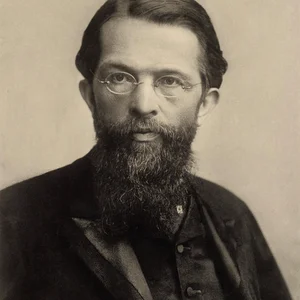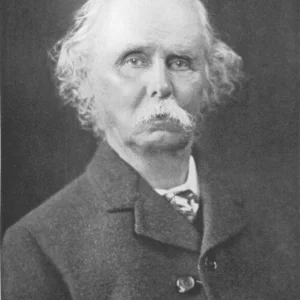

Alfred Marshall (1842-1924) was a British economist and a leading figure of the neoclassical school. His textbook *Principles of Economics* (1890) profoundly shaped the teaching of economic science for several decades.
Alfred Marshall(1842 — 1924)
Alfred Marshall
Royaume-Uni de Grande-Bretagne et d'Irlande
7 min read
Frequently asked questions
Key Facts
- Born in 1842 in London and died in 1924 in Cambridge
- Professor of political economy at the University of Cambridge from 1885
- Published *Principles of Economics* in 1890, a reference work for decades
- Developed the concepts of partial equilibrium, elasticity of demand and consumer surplus
- Trained a generation of economists, including John Maynard Keynes, founding the Cambridge school
Works & Achievements
First textbook, co-written with his wife and designed for teaching. It already lays the foundations of his approach to economics education.
Theoretical essays circulated privately, in which Marshall develops his graphical tools for analysing trade and value.
His major work, which synthesises marginalist analysis and classical economics. It defined the teaching of economics for half a century.
Marshall secures a standalone university degree in economics, separate from moral sciences and history. A key step in the institutionalisation of the discipline.
An in-depth study of industrial organisation and the real-world conditions of business, the fruit of decades of observation.
Marshall's last major work, devoted to money and international trade, published a year before his death.
Marshall coins and popularises these tools, still taught today in every economics course. They measure the sensitivity of prices and the gain to buyers.
Anecdotes
Before becoming an economist, Alfred Marshall dreamed of being a clergyman or a mathematician. His father, a very authoritarian cashier at the Bank of England, wanted to send him to Oxford to study ancient Greek and theology. Young Alfred refused and went to Cambridge to study mathematics, where he finished among the top students in his class.
Marshall had a habit of writing his boldest ideas in footnotes and appendices, keeping the main text very simple. He said that economics should be written so that even a busy businessman could understand it, and that complicated mathematics should be relegated to an appendix so as not to frighten the reader.
We owe to him the famous image of the “scissors”: Marshall explained that asking whether it is supply or demand that sets the price is like asking which blade of a pair of scissors actually cuts the paper. The answer is: both together, one cannot work without the other.
Marshall and his wife Mary Paley made up a scholarly couple that was rare for the time: Mary was one of the first women to study economics at Cambridge and wrote a book with him. Yet later on, Alfred opposed granting real university degrees to women, which created lasting tensions.
Often ill and of fragile health, Marshall took more than twenty years to write his *Principles of Economics*. He revised the book relentlessly, publishing eight editions in his lifetime, always dissatisfied and seeking the most precise formulation.
Primary Sources
Economic conditions are constantly changing, and each generation looks at its own problems in its own way. Economic force does not operate in a vacuum.
We might as reasonably dispute whether it is the upper or the under blade of a pair of scissors that cuts a piece of paper, as whether value is governed by utility or cost of production.
Political economy or economic science is a study of men's actions in the ordinary business of life; it examines how a man gets his income and how he uses it.
Use mathematics as a shorthand language, rather than as an engine of inquiry. Keep to them till you have done. Translate into English. Then illustrate by examples that are important in real life. Burn the mathematics.
Key Places
District in south London where Alfred Marshall was born in 1842, into a modest family of bank clerks.
College where Marshall studied mathematics and then became a fellow. It was there that he shifted from the sciences to political economy.
Marshall was professor of political economy here from 1885 to 1908 and founded an independent economics programme. He trained a whole generation of economists.
Marshall served here as the first principal and professor of political economy from 1877 to 1881, after his marriage.
Marshall briefly taught economics here to candidates for the Indian Civil Service in the early 1880s.
The house Marshall had built in Cambridge, where he wrote most of his work. He died there in 1924.
Typical Objects

Marshall's great textbook, endlessly reissued and revised. It served as the reference book for generations of economics students.

The famous cross-shaped graph popularized by Marshall, where two curves intersect to determine the equilibrium price. It is the most iconic image of modern economics.

Marshall tirelessly wrote and revised his texts by hand, reworking each edition. The pen was the everyday tool of the Victorian scholar.

In the lecture halls of Cambridge, Marshall drew his curves in chalk to explain the equilibrium of markets. The central teaching tool of the emerging field of university economics.

An object associated with Marshall's father, a cashier at the Bank of England. It symbolizes the world of Victorian finance in which the future economist grew up.

The academic robe worn by Cambridge professors and students during ceremonies. It marked membership in the scholarly elite of Victorian England.
School Curriculum
Vocabulary & Tags
Key Vocabulary
Tags
Daily Life
Morning
Marshall, who was in fragile health, organized his day around long stretches of intellectual work. In the morning, in his study at Balliol Croft, he read, reflected and wrote, often standing at a lectern to spare his back and his heart.
Afternoon
The afternoon was devoted to teaching at Cambridge or to the meticulous revision of his manuscripts. He also received his students, whom he urged to think for themselves rather than memorize ready-made formulas.
Evening
In the evening, Marshall continued his reading and talked with his wife Mary, herself an economist. The couple led a sober, studious life, focused on scholarly work rather than on social life.
Food
The diet of a well-off Victorian academic relied on simple English cooking: roast meats, potatoes, boiled vegetables, puddings, bread and tea. Marshall, mindful of his fragile health, kept to a measured and regular way of life.
Clothing
Marshall wore the dark attire of the Victorian academic: frock coat or jacket, stiff collar, tie and waistcoat. To teach and at ceremonies, he donned the Cambridge academic gown.
Housing
He lived at Balliol Croft, a comfortable house he had built in Cambridge, surrounded by a garden. The home was designed for work: a large study lined with books formed the heart of the dwelling.
Historical Timeline
Period Vocabulary
Liens externes & ressources
Références
Œuvres
The Economics of Industry (avec Mary Paley Marshall)
1879
The Pure Theory of Foreign Trade / Domestic Values
1879
Principles of Economics
1890
Création de l'Economics Tripos à Cambridge
1903
Industry and Trade
1919
Money, Credit and Commerce
1923
Concepts d'élasticité de la demande et de surplus du consommateur
1890