 flip
flipWiener Schnitzel (breaded veal cutlet)
Wiener Schnitzel (breaded veal cutlet)
Why this dish? The Viennese cutlet is THE emblematic dish of the Viennese bourgeoisie in Menger's time, served on reception days and Sundays. For a respected professor at the University of Vienna, it was the dish of hospitality par excellence.
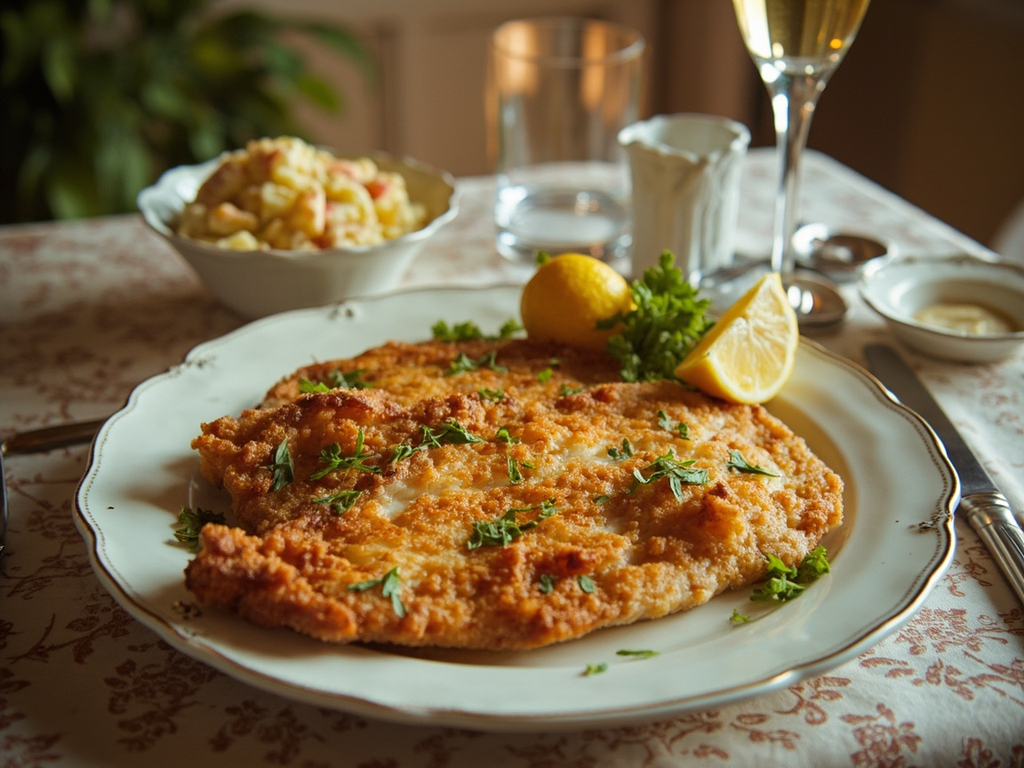
A thin veal cutlet coated in a golden, puffed breading, fried in lard until it swells and crisps, finished with a simple squeeze of lemon. The pinnacle of Viennese domestic art.
Allow me to explain, for mistakes are often made. The true Viennese cutlet must be beaten until thin as a leaf, then passed through flour, egg, and breadcrumbs — never pressed, or the crust sticks to the flesh instead of puffing. Fry it in very hot lard, moving the pan with a supple motion, and the crust lifts like a sail. A quarter of lemon, and nothing else: perfection, you see, is always in moderation.
- •Veal top round — thin cutlets (meat)
- •Wheat flour — as needed (first coating)
- •Beaten eggs — 2-3 (binder)
- •White bread breadcrumbs — generous (breading)
- •Lard — abundant (frying)
- •Lemon — 1 (finishing)
Wiener Schnitzel (breaded veal cutlet)
A thin veal cutlet coated in a golden, puffed breading, fried in lard until it swells and crisps, finished with a simple squeeze of lemon. The pinnacle of Viennese domestic art.
Why this dish? The Viennese cutlet is THE emblematic dish of the Viennese bourgeoisie in Menger's time, served on reception days and Sundays. For a respected professor at the University of Vienna, it was the dish of hospitality par excellence.
Allow me to explain, for mistakes are often made. The true Viennese cutlet must be beaten until thin as a leaf, then passed through flour, egg, and breadcrumbs — never pressed, or the crust sticks to the flesh instead of puffing. Fry it in very hot lard, moving the pan with a supple motion, and the crust lifts like a sail. A quarter of lemon, and nothing else: perfection, you see, is always in moderation.
Ingredients (period version)
- Veal top round — thin cutlets (meat)
- Wheat flour — as needed (first coating)
- Beaten eggs — 2-3 (binder)
- White bread breadcrumbs — generous (breading)
- Lard — abundant (frying)
- Lemon — 1 (finishing)
Ingredients
- Veal cutlets — 4 (about 150 g each) (meat)
- Flour — 100 g (coating)
- Eggs — 3 (binder)
- Fine breadcrumbs — 200 g (breading)
- Lard (or clarified butter) — 300 g (frying)
- Salt — to taste (seasoning)
- Lemon — 1 (serving)
Method
- Place cutlets between two sheets and pound with a mallet to 4-5 mm thickness. Salt.
- Prepare three plates: flour, beaten eggs, breadcrumbs.
- Dredge each cutlet in flour, then egg, then breadcrumbs without pressing.
- Heat lard to 170°C in a large pan (the fat should cover the cutlet).
- Fry 1-2 minutes per side, gently shaking the pan so the breading puffs and turns golden.
- Drain on paper, serve immediately with a lemon wedge.
How it was made : In the 19th century, frying was always done in lard, with enough fat so the cutlet swam: this bath makes the breading puff. It was accompanied by parsley potatoes or a warm potato salad (the potato, from the New World, had become completely common in Central Europe since the 18th century).
The contemporary twist : Slide a leaf of wild garlic into the breading in spring, for a green perfume that surprises under the golden crust.
Carl Menger · Charactorium