 flip
flipBigos — Hunter's Sauerkraut Stew
Bigos — Hunter's Sauerkraut Stew
Why this dish? Mickiewicz immortalized bigos in Pan Tadeusz (Book IV): after the hunt, the poet describes the cauldron of cabbage and game simmering in the forest. This dish is not a supposition for him — it is a page written by his own hand, the taste of the nobility of Lithuania (Litwa) that he mourned from exile.
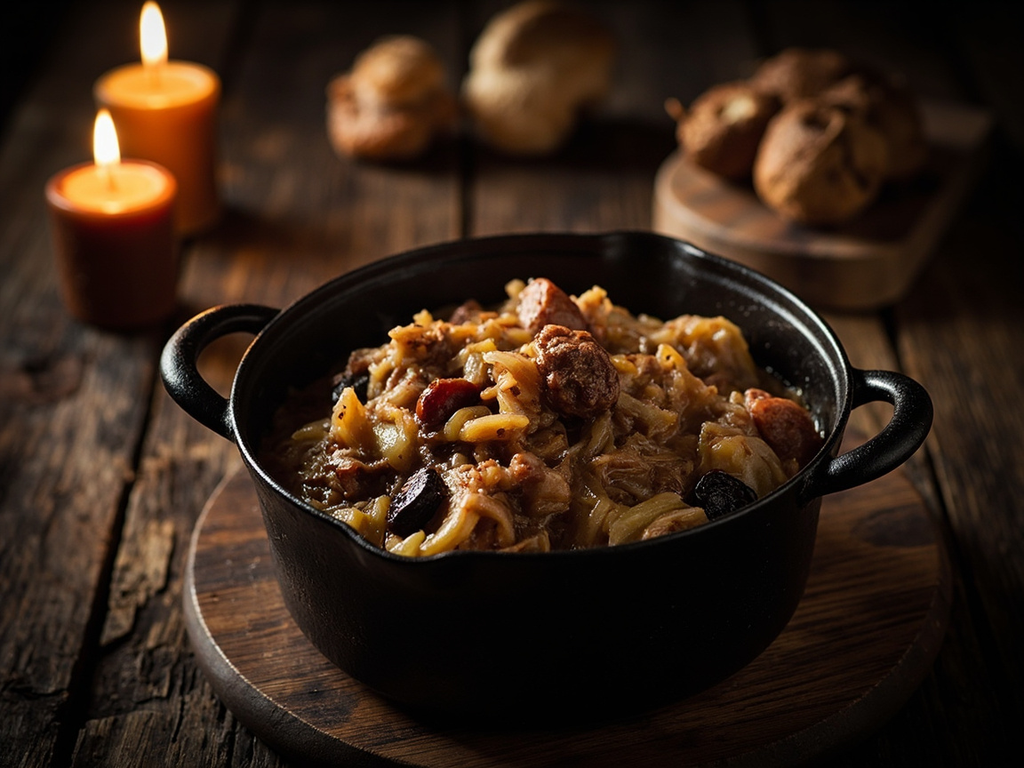
The king of long tables: fresh cabbage and sauerkraut simmered for hours with several meats, dried mushrooms and prunes. It improves when reheated day after day, its flavor deepening each time.
Ah, bigos! I sang its virtues in my poem, and I do not retract a word. Know that a good bigos is not hurried: you fill the cauldron with fresh cabbage and sour cabbage, throw in the meats of the hunt, and the gentle fire does the rest while the hunters chat. Reheat it the next day, and the day after that — it is only then, I swear, that it attains its full nobility. No dish of France, in all my exile, has been able to give me that scent again.
- •Sauerkraut (kapusta kiszona) — a lot (acidity and preservation)
- •Fresh cabbage — as much (sweetness, balance)
- •Mixed meats (game, pork, beef, smoked sausage) — leftovers from the hunt (umami, body)
- •Dried forest mushrooms — a handful (forest umami)
- •Dried prunes — a few (smoky sweetness)
- •Juniper berries, bay leaf — to taste (hunt aromatics)
Bigos — Hunter's Sauerkraut Stew
The king of long tables: fresh cabbage and sauerkraut simmered for hours with several meats, dried mushrooms and prunes. It improves when reheated day after day, its flavor deepening each time.
Why this dish? Mickiewicz immortalized bigos in Pan Tadeusz (Book IV): after the hunt, the poet describes the cauldron of cabbage and game simmering in the forest. This dish is not a supposition for him — it is a page written by his own hand, the taste of the nobility of Lithuania (Litwa) that he mourned from exile.
Ah, bigos! I sang its virtues in my poem, and I do not retract a word. Know that a good bigos is not hurried: you fill the cauldron with fresh cabbage and sour cabbage, throw in the meats of the hunt, and the gentle fire does the rest while the hunters chat. Reheat it the next day, and the day after that — it is only then, I swear, that it attains its full nobility. No dish of France, in all my exile, has been able to give me that scent again.
Ingredients (period version)
- Sauerkraut (kapusta kiszona) — a lot (acidity and preservation)
- Fresh cabbage — as much (sweetness, balance)
- Mixed meats (game, pork, beef, smoked sausage) — leftovers from the hunt (umami, body)
- Dried forest mushrooms — a handful (forest umami)
- Dried prunes — a few (smoky sweetness)
- Juniper berries, bay leaf — to taste (hunt aromatics)
Ingredients
- Sauerkraut — 500 g, rinsed and squeezed (acidity)
- Fresh white cabbage — 400 g, shredded (sweetness)
- Pork shoulder — 400 g, cubed (melting meat)
- Polish smoked sausage (kiełbasa) — 250 g, sliced (smoky umami)
- Smoked bacon — 150 g (base fat)
- Dried mushrooms (porcini) — 30 g, rehydrated (umami)
- Pitted prunes — 8 (sweetness)
- Juniper berries — 6 (aromatic)
- Bay leaves — 2 (aromatic)
- Salt, pepper — to taste (seasoning)
Method
- Soak the dried mushrooms in hot water for 30 minutes, reserve the soaking water.
- In a large pot, render the bacon, then brown the pork and sausage.
- Add both cabbages, the chopped mushrooms with their filtered soaking water, prunes, juniper and bay leaf.
- Cover and simmer on very low heat for at least 2 hours, stirring occasionally, adding a little water if needed.
- Ideally, cool and reheat the next day (and the day after): that is what makes real bigos.
- Adjust seasoning and serve piping hot with black bread.
How it was made : In the 18th-19th centuries, bigos was the dish of the szlachta (minor nobility) hunts: it was transported in cauldrons, reheated over campfires, and each reheating improved it. Lacto-fermented sauerkraut allowed it to keep all winter without refrigeration. No tomato or potato in classic bigos: it is a dish of cabbage, meat and forest.
The contemporary twist : Present it in a cast-iron pot at the center of the table, 'hunter's cauldron' style, with a small glass of ice-cold vodka alongside to respect the tradition of Polish feasts.
Sources : Adam Mickiewicz, Pan Tadeusz (1834), Book IV — description of bigos · Maria Dembińska, Food and Drink in Medieval Poland (1999)
Adam Mickiewicz · Charactorium