 flip
flipSopa azteca (sopa de tortilla)
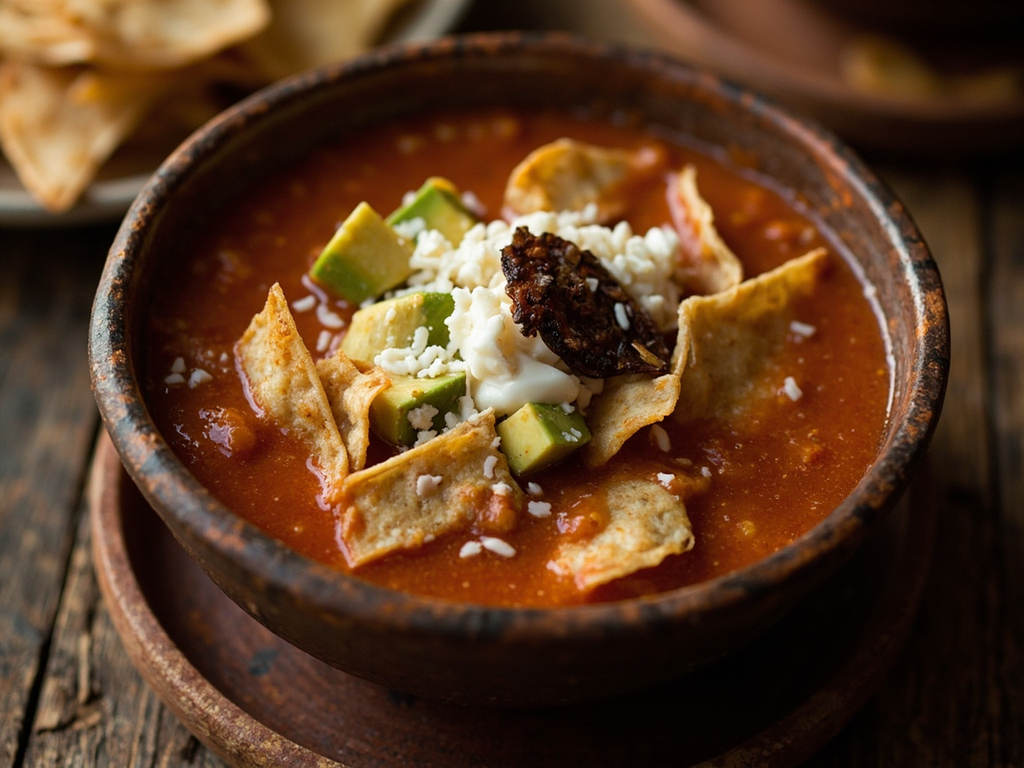
Sopa azteca (sopa de tortilla)
Why this dish? A pillar of the everyday Mexican table, sopa de tortilla recycled yesterday's tortillas into a comforting broth. For Fuentes, whose work dialogues between the Aztec world and modern Mexico—think of *La región más transparente*, his great novel of Mexico City—this soup, bearing the very name "Aztec," encapsulates the persistence of ancient corn at the heart of the contemporary metropolis.
A tomato broth flavored with pasilla chile and epazote, into which fried tortilla strips are plunged, garnished with avocado, fresh cheese, and cream.
See what we can make from a leftover: yesterday's tortilla, hardened, becomes a feast in broth. At home in Mexico City, it was the soup for rainy evenings, when the most transparent city disappeared under clouds. We rubbed the pasilla chile on the comal until it released its scent of burnt earth, tossed in a sprig of epazote, and placed avocado and cream at the bottom of the bowl. Eat it scalding hot: it is eternal Mexico reinventing itself with next to nothing.
- •Day-old corn tortillas — a few, cut into strips (body of the soup, fried)
- •Ripe tomatoes — several, roasted on the comal (broth base)
- •Dried pasilla chile — 1 or 2, toasted (spice and smokiness)
- •Onion and garlic — to taste (aromatics)
- •Epazote — one sprig (fragrant herb)
- •Chicken broth — enough to cover (liquid)
- •Avocado, fresh cheese, cream — for garnish (freshness and creaminess)
Sopa azteca (sopa de tortilla)
A tomato broth flavored with pasilla chile and epazote, into which fried tortilla strips are plunged, garnished with avocado, fresh cheese, and cream.
Why this dish? A pillar of the everyday Mexican table, sopa de tortilla recycled yesterday's tortillas into a comforting broth. For Fuentes, whose work dialogues between the Aztec world and modern Mexico—think of *La región más transparente*, his great novel of Mexico City—this soup, bearing the very name "Aztec," encapsulates the persistence of ancient corn at the heart of the contemporary metropolis.
See what we can make from a leftover: yesterday's tortilla, hardened, becomes a feast in broth. At home in Mexico City, it was the soup for rainy evenings, when the most transparent city disappeared under clouds. We rubbed the pasilla chile on the comal until it released its scent of burnt earth, tossed in a sprig of epazote, and placed avocado and cream at the bottom of the bowl. Eat it scalding hot: it is eternal Mexico reinventing itself with next to nothing.
Ingredients (period version)
- Day-old corn tortillas — a few, cut into strips (body of the soup, fried)
- Ripe tomatoes — several, roasted on the comal (broth base)
- Dried pasilla chile — 1 or 2, toasted (spice and smokiness)
- Onion and garlic — to taste (aromatics)
- Epazote — one sprig (fragrant herb)
- Chicken broth — enough to cover (liquid)
- Avocado, fresh cheese, cream — for garnish (freshness and creaminess)
Ingredients
- Corn tortillas — 6, cut into thin strips (to fry for garnish)
- Tomatoes — 4 ripe (broth)
- Dried pasilla chile — 2 (smoky spice + fried garnish)
- Onion — 1 (base)
- Garlic — 2 cloves (base)
- Epazote (or cilantro if unavailable) — 1 sprig (herb)
- Chicken broth — 1.2 L (liquid)
- Avocado — 1 (garnish)
- Queso fresco or mild feta — 80 g (garnish)
- Crème fraîche or sour cream — 4 tbsp (garnish)
- Neutral oil — for frying (cooking tortillas)
Method
- Fry the tortilla strips in hot oil until golden and crispy; drain. Briefly fry one seeded pasilla chile, then reserve crumbled for garnish.
- Dry-roast tomatoes, onion, and garlic in a pan, then blend with a rehydrated pasilla chile until smooth.
- Pour this purée into a hot pot, let it "sear" for a few minutes, then add the broth. Add epazote and simmer for 15 minutes; season with salt.
- Place tortilla strips in the bottom of bowls and pour the boiling broth over them.
- Garnish with diced avocado, crumbled cheese, a drizzle of cream, and fried pasilla chile. Serve immediately to keep the crunch.
How it was made : A soup of popular origin born from domestic economy—reusing dried tortillas—it is prepared throughout central Mexico. The pasilla chile and epazote, a pre-Hispanic herb with a distinctive taste, give it its identity; they were once toasted on a clay comal and the tomato base ground in a molcajete.
The contemporary twist : An express version serves the garnish as a "composed bowl" on the side, each person assembling their soup at the table—perfect for a chatty family lunch.
Sources : Diana Kennedy, The Cuisines of Mexico · Ricardo Muñoz Zurita, Diccionario enciclopédico de la gastronomía mexicana
Carlos Fuentes · Charactorium