 flip
flipMacher Jhol — river fish curry
Macher Jhol — river fish curry
Why this dish? River fish was the absolute center of the Bengali table, and Asima's was no exception: in Calcutta, crossed by the Hooghly, macher jhol was the everyday dish. A Bengali is defined by his rice and his fish.
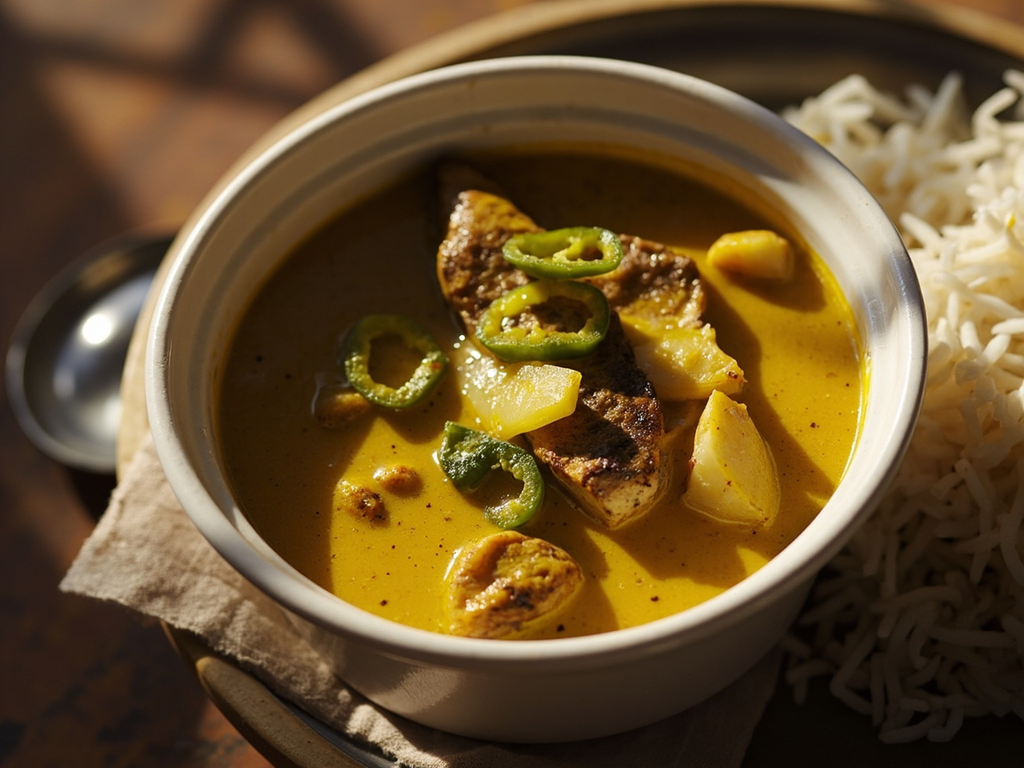
A light and fragrant fish curry: steaks (rohu or carp) first seared, then simmered in a sauce of turmeric, ginger, and cumin, spiked with a little chili. Clear and comforting, it is eaten drowned in rice.
They say a Bengali without his fish is like a river without water — and it is true, I have never known a proper lunch without a steak in my plate. Rub your fish with salt and turmeric before searing, that is the secret for it to hold in the sauce. The jhol must remain clear, light, almost a perfumed water — no cream or heaviness; this is not a feast, it is our daily bread. With a little warm rice, that is enough to nourish a scholar as much as a child.
- •River fish (rohu or carp) — a few steaks (central ingredient)
- •Turmeric — a pinch (color and antiseptic)
- •Ginger — a piece (aromatic base)
- •Ground cumin — a little (background spice)
- •Green chili — one or two (heat)
- •Mustard oil — as needed (frying and perfume)
- •Potato — one, quartered (garnish)
Macher Jhol — river fish curry
A light and fragrant fish curry: steaks (rohu or carp) first seared, then simmered in a sauce of turmeric, ginger, and cumin, spiked with a little chili. Clear and comforting, it is eaten drowned in rice.
Why this dish? River fish was the absolute center of the Bengali table, and Asima's was no exception: in Calcutta, crossed by the Hooghly, macher jhol was the everyday dish. A Bengali is defined by his rice and his fish.
They say a Bengali without his fish is like a river without water — and it is true, I have never known a proper lunch without a steak in my plate. Rub your fish with salt and turmeric before searing, that is the secret for it to hold in the sauce. The jhol must remain clear, light, almost a perfumed water — no cream or heaviness; this is not a feast, it is our daily bread. With a little warm rice, that is enough to nourish a scholar as much as a child.
Ingredients (period version)
- River fish (rohu or carp) — a few steaks (central ingredient)
- Turmeric — a pinch (color and antiseptic)
- Ginger — a piece (aromatic base)
- Ground cumin — a little (background spice)
- Green chili — one or two (heat)
- Mustard oil — as needed (frying and perfume)
- Potato — one, quartered (garnish)
Ingredients
- Carp or tilapia steaks — 4 pieces (central ingredient)
- Turmeric powder — 1 tsp (color)
- Fresh ginger — 1 tbsp paste (aromatic base)
- Ground cumin — 1 tsp (background spice)
- Green chili — 1 to 2, slit (heat)
- Potato — 1, quartered (garnish)
- Mustard oil — 3 tbsp (frying and perfume)
- Salt — to taste (seasoning)
Method
- Rub the fish steaks with salt and half the turmeric, let rest for 10 minutes.
- Heat mustard oil until it lightly smokes, then sear the fish for 1 minute per side and set aside.
- In the same oil, brown the potato quarters.
- Add the ginger paste, cumin, and remaining turmeric, sauté for one minute.
- Pour in two glasses of hot water, salt, add the slit chilies, and simmer until the potatoes are tender.
- Return the fish to the sauce, cook for 5 more minutes. Serve hot over white rice.
How it was made : Macher jhol is the quintessential domestic dish of Bengal. The day's catch from the Hooghly and ponds was used; pungent mustard oil and turmeric served both to flavor and to preserve. The potato, arrived from America via trading posts, was integrated by the 19th century.
The contemporary twist : Plate the whole steak on a mirror of filtered, translucent jhol, sprinkled with coriander, to reveal the 'consommé' finesse of this curry that is always thought to be thick.
Sources : Chitrita Banerji, *Bengali Cooking: Seasons and Festivals* · K.T. Achaya, *Indian Food: A Historical Companion*
Asima Chatterjee · Charactorium