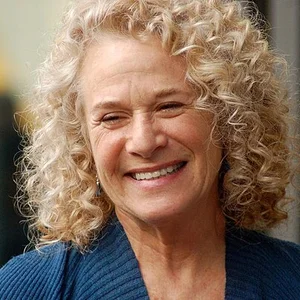

American singer-songwriter born in 1942, Carole King is one of the defining figures of rock and pop from the 1960s–1970s. Her album *Tapestry* (1971) remains one of the best-selling records in history.
Carole King(1942 — ?)
Carole King
États-Unis
9 min read
Frequently asked questions
Famous Quotes
« I feel the earth move under my feet.»
« Music is my religion.»
Key Facts
- 1942: born in Brooklyn, New York
- 1960s: co-wrote dozens of hits with Gerry Goffin for other artists (The Shirelles, Aretha Franklin)
- 1971: release of *Tapestry*, 25 million copies sold, 4 Grammy Awards
- 2013: Presidential Medal of Freedom awarded by Barack Obama
- 2014: the musical *Beautiful* tells her life story on Broadway
Works & Achievements
The first number-one hit on the American pop charts for a Black female group, this romantic ballad co-written with Gerry Goffin revealed Carole King's talent at age 18 and launched the golden era of the Brill Building.
Co-written with Gerry Goffin and producer Jerry Wexler, this song became one of Aretha Franklin's greatest recordings and an anthem of feminine dignity; Carole King herself would later record it on Tapestry with comparable intensity.
A masterpiece of the singer-songwriter genre, this album with its intimate lyrics and stripped-down acoustic arrangements has sold more than 25 million copies worldwide and remains one of the most-listened-to records of the 20th century, ushering in a new era of sincerity in pop.
Written for Tapestry, this song was also recorded by her friend James Taylor, whose version reached number one and earned Carole King the Grammy for Song of the Year in 1972 — a rare honor awarded to the songwriter rather than the performer.
This double A-side single from Tapestry reached number one in the United States for five consecutive weeks; 'It's Too Late,' a song about the end of a romantic relationship, won the Grammy for Record of the Year and showcases King's artistic maturity.
The third album following her landmark debut trilogy, it confirms Carole King's musical evolution toward a more rhythmic and sun-drenched sound, incorporating jazz and funk influences, and reached number one in the United States.
Anecdotes
At just 17 years old, Carole King co-wrote 'Will You Love Me Tomorrow' with her boyfriend Gerry Goffin. Recorded by the Shirelles in 1960, it became the first number-one hit on the American pop charts performed by a Black girl group. This meteoric success launched the career of a Brooklyn teenager who composed at the piano in her bedroom.
In the 1960s, Carole King worked in the offices of the Brill Building, a Midtown Manhattan skyscraper packed with songwriters and music publishers. She wrote songs 'assembly-line style' for other artists, sometimes churning out several hits per week. It was a true hit factory: her melodies graced the voices of stars like Aretha Franklin, The Drifters, and Dusty Springfield.
In 1962, Carole King and Gerry Goffin were looking for a song for their babysitter, a young woman named Eva Boyd. They wrote 'The Loco-Motion' for her — a catchy, irresistible track they recorded with her under the stage name Little Eva. The record shot straight to the top of the charts — and their babysitter became a star overnight.
Her album Tapestry, released in February 1971, remains one of the most extraordinary commercial phenomena in music history. It held the number-one spot on the American charts for 15 consecutive weeks and sold over 25 million copies worldwide. At the 1972 Grammy Awards ceremony, Carole King walked away with four trophies in a single evening: Album of the Year, Song of the Year, Record of the Year, and Best Female Vocal Performance.
In the late 1960s, Carole King left New York and settled in the bohemian enclave of Laurel Canyon, in the hills of Los Angeles. She lived among a community of musicians who constantly influenced one another — Joni Mitchell, James Taylor, Crosby, Stills & Nash — playing acoustic guitar and composing in a laid-back atmosphere, far from the commercial machinery of New York's Brill Building. This radical break from her past as a behind-the-scenes songwriter would allow her to fully step into her own as a performer.
Primary Sources
I had no idea that what I was doing was unusual. Writing songs was just something I did, like breathing. It never occurred to me that I would one day perform them myself.
All the songs on this album were written at a time when I was feeling very much in touch with myself. I hope they bring you some of the same feeling.
I never thought of myself as a performer. I was a songwriter. Getting up on stage and singing my own songs felt terrifying at first, but Tapestry changed everything — it forced me to stop hiding behind other people's voices.
I am completely overwhelmed. I want to thank James Taylor, who sang 'You've Got a Friend' better than I ever could, and Lou Adler, who believed in this album when no one else did.
Key Places
Carole King was born on February 9, 1942, in the Manhattan Beach neighborhood of Brooklyn. It was in this urban, musical postwar environment that she discovered the piano and began composing as a teenager.
In this office building that became the cathedral of American pop songwriting, Carole King spent years writing hits for other artists. It was here that the King-Goffin duo produced dozens of chart-toppers between 1960 and 1966.
This wooded, bohemian neighborhood in the Hollywood Hills is where Carole King reinvented herself in the late 1960s. She rubbed shoulders with Joni Mitchell, James Taylor, and the future Eagles, composing much of the *Tapestry* repertoire there in a free and creative atmosphere.
It was in these studios — formerly the Charlie Chaplin Studios — that *Tapestry* was recorded in 1970–1971 under the artistic direction of Lou Adler, in a relaxed, almost domestic atmosphere, with acoustic guitars and piano front and center.
On February 27, 1971, Carole King gave one of her first major public concerts at Carnegie Hall, performing the songs from *Tapestry*. This legendary concert marked her definitive emergence as a performing artist.
From the late 1980s onward, Carole King settled in the mountains of Idaho, where she led a quiet life and became deeply involved in environmental activism. This voluntary retreat stands in sharp contrast to the decades she spent in the spotlight.
Typical Objects

Carole King has composed almost exclusively at the piano since childhood. It is at her keyboard that she sets Gerry Goffin's lyrics to music and, later, writes her own words for Tapestry.

Like all Brill Building songwriters, King filled notebooks with melody and lyric drafts. These notebooks represent the heart of her creative process, often begun on the subway or late at night.

After moving to Laurel Canyon, Carole King adopted the acoustic guitar to accompany her folk-rock compositions — a more portable instrument than the piano and emblematic of the California music scene of the 1970s.

In the 1950s–1970s, the LP and the 45 were the sole formats for recorded music. King listened to her contemporaries' records to analyze arrangements and refine her own style.

Recording studios of the era used magnetic tape machines for multitrack sessions. Carole King recorded Tapestry at A&M Studios in Los Angeles on this type of equipment.

The defining object of Carole King's career: with its cover photo of the artist in jeans and barefoot, this record marks a clear break with the glamour of 1960s pop stars and establishes an image of sincerity and authenticity.
School Curriculum
Vocabulary & Tags
Key Vocabulary
Tags
Daily Life
Morning
In her Laurel Canyon home in the early 1970s, Carole King rose early and settled straight at the piano or guitar, making the most of the morning quiet to let melodies come to her. She made her own coffee in her rustic kitchen, cats weaving around the stools, and began sketching out chords before breakfast.
Afternoon
Afternoons were devoted to studio recording or collaborative work sessions with musician friends — James Taylor, Danny Kortchmar, or Russ Kunkel. Sessions at A&M Studios were famously relaxed, with artists wandering around barefoot and bringing their own food, far from the clock-watching rigidity of the New York Brill Building studios.
Evening
Evenings in Laurel Canyon were often spent at fellow musicians' homes, playing music informally around a campfire or listening to records. The neighborhood's artistic community had a habit of sharing new compositions before recording them, in an atmosphere of warm mutual inspiration worlds away from commercial competition.
Food
Carole King embraced the California lifestyle of the 1970s, gravitating toward natural, minimally processed food — fresh fruit, whole grains, garden vegetables. Like many artists of her generation influenced by the hippie movement, she favored locally sourced produce and often cooked for her friends herself.
Clothing
On the iconic cover of *Tapestry*, Carole King appears in faded jeans, a wool sweater, and bare feet — a deliberately anti-glamour image that sums up her 1970s wardrobe: relaxed, authentic, unadorned. She was fond of long printed cotton dresses, typical of the hippie-folk aesthetic of Laurel Canyon.
Housing
Her Laurel Canyon home was a typical wooden house in the Hollywood Hills, surrounded by dense vegetation, with a deck overlooking the canyon. The interior — warm and slightly cluttered — blended musical instruments, books, and Berber rugs into a creative home open to friends and passing musicians, a world away from the New York apartments of her childhood.