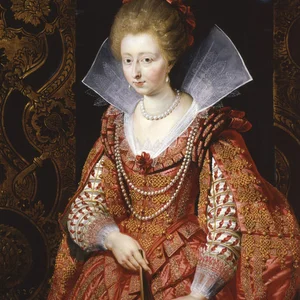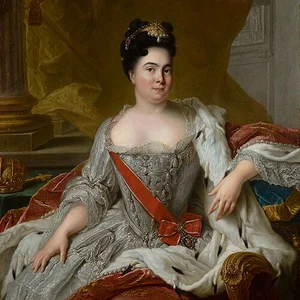

Empress of Russia from 1725 to 1727, second wife of Peter the Great. Born to a humble Baltic peasant family, she was the first woman to rule the Russian Empire, ushering in the century of the empresses.
Catherine I
Catherine I of Russia (Marta Helena Skowrońska)
7 min read
Frequently asked questions
Key Facts
- Born in 1684 into a peasant family in the Baltic region, of very humble standing
- Secretly married Peter the Great in 1707, then officially in 1712
- Crowned empress consort in 1724 by Peter the Great
- Became reigning Empress of Russia upon the death of Peter the Great in 1725
- Created the Supreme Privy Council in 1726 and reigned until her death in 1727
Works & Achievements
The first woman to rule the Russian Empire, she ushered in the “century of empresses” that would shape eighteenth-century Russia.
She brought to fruition the project conceived by Peter the Great, giving Russia a scholarly institution of European standing.
A new governing body bringing together the great dignitaries; it steered most of the Empire's policy during her reign.
She had Peter's instructions carried out, launching the exploration of the Empire's eastern reaches and of the strait separating Asia from America.
She conferred for the first time this new decoration devised by Peter, intended to reward civil and military service.
A measure of social relief that eased the heavy fiscal burden weighing on the peasantry after Peter's wars.
Anecdotes
Born Marta Skowrońska into a modest Baltic family, she was captured at around eighteen years of age during the capture of the fortress of Marienburg by Russian troops in 1702, during the Great Northern War. A spoil of war, she passed from the household of Field Marshal Sheremetev to that of the favorite Menshikov, where Peter the Great noticed her. From prisoner of war, she would become empress: a rise unique in European history.
To marry the tsar, Marta had to convert to the Orthodox faith: she gave up her name and was rechristened Catherine (Yekaterina Alexeyevna). Her godfather at the baptism was Peter's own son, the tsarevich Alexei, which explains her patronymic “Alexeyevna.”
In 1711, during the disastrous Pruth campaign against the Ottomans, the Russian army found itself surrounded. Catherine, who was accompanying Peter, kept her composure in the face of danger. Tradition holds that she gathered her jewels to help win over the grand vizier and secure a peace. In memory of this courage, Peter created the Order of Saint Catherine in 1714, intended for women.
Catherine was one of the few people able to soothe Peter the Great's terrible rages and nervous fits. Foreign diplomats posted at the court noted that a single word from her was sometimes enough to calm the tsar trembling with fury.
At Peter's death in February 1725, the succession had not been settled. It was the support of the powerful favorite Menshikov, and above all of the Imperial Guard regiments gathered around the palace, that placed Catherine on the throne: for the first time, a woman — and a foreigner of peasant origin — reigned over the Russian Empire.
Primary Sources
On campaign, the tsar writes to his wife with familiar tenderness, calling her “Katerinushka, my friend” and urging her to join him — a rare testimony to a sovereign's conjugal affection for a woman of humble birth.
The Hanoverian resident in Russia describes Peter's court and Catherine's role, highlighting Europeans' astonishment at an empress sprung from such humble circumstances.
The Holstein minister, present in Saint Petersburg, recounts the final days of Peter the Great and the accession of Catherine, raised to the throne by the Guard and by Menshikov.
Peter the Great justifies his wife's coronation by the services she rendered to the State, notably during the military campaigns, and bestows upon her the imperial dignity.
The imperial decree institutes a council of high dignitaries charged with assisting the sovereign in affairs of State, marking a sharing of power at the summit of the Empire.
Key Places
Baltic fortress captured by the Russians in 1702; it was here that the young Marta was taken prisoner and swept into a Russian destiny.
Capital founded by Peter the Great; Catherine lived, reigned, and died here in 1727.
Site of Catherine's solemn coronation as empress in 1724.
Estate given by Peter to Catherine; the future palace there was later named Catherine Palace in her memory.
Industrial city in the Urals founded in 1723 and named in honor of Catherine (and of Saint Catherine).
Typical Objects

The first European-style imperial crown made for a Russian coronation, commissioned for Catherine's crowning as empress. It symbolizes Russia's transformation into an Empire.

The sash, star, and cross of the order created in her honor in 1714; it became the highest distinction for women in the Russian Empire.

The rich ceremonial mantle worn at the coronation of 1724, a visible mark of her imperial dignity—she who had been born a servant.

Objects of the Orthodox faith she adopted upon her conversion and her baptism under the name Catherine, a condition of her marriage to the tsar.

Regalia held during official ceremonies, attributes of the sovereign power she exercised from 1725 to 1727.

The affectionate letters exchanged with the tsar during his campaigns, rare intimate glimpses into the life of an imperial couple in the early 18th century.
School Curriculum
Vocabulary & Tags
Key Vocabulary
Tags
Daily Life
Morning
As empress, Catherine began her day according to the rituals of the court: an Orthodox prayer before the icons, then washing and dressing assisted by her ladies-in-waiting. Very soon, affairs of state awaited her, but she largely left these to her advisers, above all Prince Menshikov.
Afternoon
The afternoon was divided between audiences, the reception of foreign ambassadors, and the signing of ukases prepared by the Supreme Privy Council. Catherine, poorly educated and unable to write properly, listened to reports rather than drafting them.
Evening
Court evenings were known to be festive: banquets, music, dancing, and sometimes drinking bouts inherited from the time of Peter, whose taste for boisterous conviviality Catherine shared. She loved to entertain and to keep a warm atmosphere around her.
Food
The imperial table combined traditional Russian dishes (soups, fish, game, black bread) with more refined fare introduced from Western Europe. Wines, beer, and brandy flowed in abundance during court festivities.
Clothing
For ceremonies, Catherine wore sumptuous court gowns in the European style, embroidered with gold and adorned with jewels, along with the ermine mantle and the insignia of the Order of Saint Catherine. In daily life, her dress remained simpler than that of the nobles by birth.
Housing
She lived in the palaces of Saint Petersburg, the new capital built on the marshes of the Neva, and in country residences such as Tsarskoye Selo. These dwellings, designed in imitation of the palaces of Europe, displayed the modernity that Peter had sought.
Historical Timeline
Period Vocabulary
Liens externes & ressources
Références
Œuvres
Accession au trône impérial
1725
Ouverture de l'Académie des sciences de Saint-Pétersbourg
1725
Création du Conseil privé suprême
1726
Soutien à la première expédition du Kamtchatka (Vitus Béring)
1725
Institution de l'ordre de Saint-Alexandre Nevski
1725
Allègement de l'impôt de capitation
1727