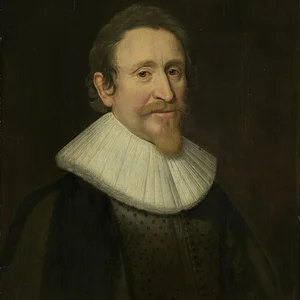

Hugo Grotius (Huig de Groot), a Dutch jurist, philosopher, and diplomat, is regarded as one of the founders of modern international law and natural law. His major work, “De jure belli ac pacis” (1625), lays the foundations of a body of law governing relations between nations.
Hugo Grotius(1583 — 1645)
Hugo Grotius
Provinces-Unies
6 min read
Frequently asked questions
Key Facts
- Born in 1583 in Delft in the United Provinces; a child prodigy, he entered the University of Leiden at the age of 11.
- Published “Mare Liberum” (The Freedom of the Seas) in 1609, defending the principle of free movement on the seas.
- Sentenced to life imprisonment in 1619 during the religious conflicts, he escaped in 1621 hidden inside a book chest.
- Published “De jure belli ac pacis” (On the Law of War and Peace) in 1625, the founding text of international law.
- Died in 1645 in Rostock, after serving as Sweden's ambassador to France.
Works & Achievements
Treatise defending the freedom of navigation and trade on the oceans, a founding text of the law of the sea.
Legal manuscript justifying the capture of ships; it contains the chapter that became "Mare liberum".
Major work founding modern international law and systematizing the doctrine of natural law.
Widely circulated apologetic work, translated into many languages, defending Christianity through reason.
History of the revolt of the Netherlands, inspired by Roman historians such as Tacitus.
Tragedy in Latin on the expulsion of Adam from paradise, revealing his early literary talent.
Anecdotes
At only eleven years old, Hugo Grotius entered the University of Leiden, where his professors already regarded him as a prodigy. At fifteen, he accompanied an embassy to France, and King Henry IV is said to have introduced him as “the miracle of Holland.”
In 1619, Grotius was sentenced to life imprisonment for political and religious reasons, and locked away in Loevestein Castle. His wife Maria van Reigersberch then organized a spectacular escape: in 1621, he slipped out hidden inside a large book chest that the guards believed was full of books.
After his escape, Grotius took refuge in France, where King Louis XIII granted him a pension. He would eventually serve Sweden as its ambassador in Paris, thus becoming the diplomat of a foreign country while he was an outlaw in his own.
It was in exile, in France, that Grotius wrote his masterpiece *De jure belli ac pacis* (On the Law of War and Peace), published in 1625. Shaken by the atrocities of the Thirty Years' War, he sought to prove that a body of law exists even between nations at war.
Grotius died in 1645 after a shipwreck on the German coast, at Rostock, worn out by cold and illness on his way back from a journey to Sweden. His last words are said, by tradition, to have been: “By undertaking much, I have accomplished nothing.”
Primary Sources
What we have just said would retain some validity, even if one were to grant — which cannot be done without the greatest crime — that there is no God, or that he takes no concern in human affairs.
The sea is common to all, because it is so vast that it suffices for all peoples for every use, whether drawing water, fishing, or navigating.
Natural law is a rule suggested to us by right reason, which makes known to us that an action, according to whether or not it conforms to rational nature, is tainted with moral turpitude or else morally necessary.
Reason itself teaches us that we must seek the truth concerning the divinity, and that nothing is more worthy of man than this search.
Key Places
Birthplace of Hugo Grotius, where he was born in 1583 into a family of cultured notables.
Prestigious university where Grotius enrolled at the age of eleven and trained in classical letters and law.
Fortress where Grotius was imprisoned starting in 1619. He escaped in 1621, hidden inside a book chest.
Place of his exile, where he wrote “De jure belli ac pacis” and later served as Sweden's ambassador.
Baltic port city where Grotius died in 1645, shortly after a shipwreck on his return from a journey to Sweden.
Church in Delft where Grotius is buried; a funerary monument there honors his memory.
Liens externes & ressources
Références
Œuvres
Mare liberum (La Mer libre)
1609
De jure praedae (Du droit de prise)
vers 1604-1606
De jure belli ac pacis (Du droit de la guerre et de la paix)
1625
De veritate religionis christianae (De la vérité de la religion chrétienne)
1627
Annales et Historiae de rebus Belgicis
publié en 1657 (posthume)
Adamus exul (Adam exilé)
1601