 flip
flipCourt Koulibiac of Fish
Court Koulibiac of Fish
Why this dish? In Saint Petersburg, the young capital open to the Baltic, noble fish (sturgeon, pike-perch) reigned at imperial banquets. The *koulibiac*, a grand Russian pie in pastry enhanced with European refinement, embodies this marriage between Russian foundation and Western sophistication dear to the reign of Peter and Catherine.
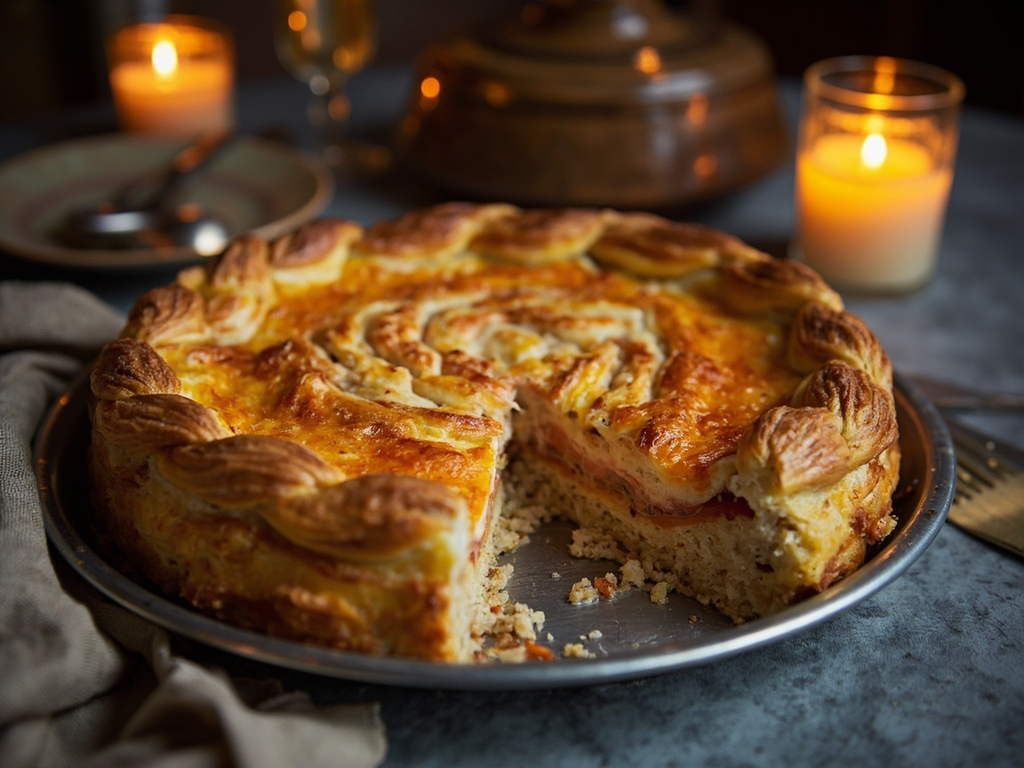
A majestic hot pie: a golden crust encloses layers of fish, buckwheat (or imported rice), and eggs, bound with butter and dill. Sliced into thick steaming wedges at the festive table.
For my feasts, I want the crust to be seen before the fish is smelled — let it gild like the domes at sunset! Slip between the layers of fish a good fat porridge and hard-boiled eggs, for a meager *koulibiac* is an insult to the guest. My husband the great Peter liked to pierce the crust with a chimney, to pour in melted butter perfumed with dill as it came from the oven — do likewise, and you will be blessed. That is how one feasts, neither as a miser nor a fool.
- •Sturgeon or pike-perch flesh — a large piece (noble filling)
- •Butter-enriched yeast dough — enough to wrap (crust)
- •Buckwheat groats (kasha) — one bowl cooked (binding layer)
- •Hard-boiled eggs — several (filling)
- •Butter — generously (richness)
- •Dill, onion — to taste (perfume)
Court Koulibiac of Fish
A majestic hot pie: a golden crust encloses layers of fish, buckwheat (or imported rice), and eggs, bound with butter and dill. Sliced into thick steaming wedges at the festive table.
Why this dish? In Saint Petersburg, the young capital open to the Baltic, noble fish (sturgeon, pike-perch) reigned at imperial banquets. The *koulibiac*, a grand Russian pie in pastry enhanced with European refinement, embodies this marriage between Russian foundation and Western sophistication dear to the reign of Peter and Catherine.
For my feasts, I want the crust to be seen before the fish is smelled — let it gild like the domes at sunset! Slip between the layers of fish a good fat porridge and hard-boiled eggs, for a meager *koulibiac* is an insult to the guest. My husband the great Peter liked to pierce the crust with a chimney, to pour in melted butter perfumed with dill as it came from the oven — do likewise, and you will be blessed. That is how one feasts, neither as a miser nor a fool.
Ingredients (period version)
- Sturgeon or pike-perch flesh — a large piece (noble filling)
- Butter-enriched yeast dough — enough to wrap (crust)
- Buckwheat groats (kasha) — one bowl cooked (binding layer)
- Hard-boiled eggs — several (filling)
- Butter — generously (richness)
- Dill, onion — to taste (perfume)
Ingredients
- Salmon or pike-perch fillet, skinless — 600 g (filling)
- Brioche or puff pastry — 2 sheets (approx. 500 g) (crust)
- Cooked buckwheat (or rice) — 200 g cooked (layer)
- Hard-boiled eggs — 3 (filling)
- Butter — 60 g (richness)
- Dill, finely chopped sautéed onion — 1 bunch, 1 onion (perfume)
- Egg yolk for glazing — 1 (finish)
Method
- Cook the buckwheat, mix with butter-sautéed onion and dill; let cool.
- Roll out one pastry sheet, spread a layer of buckwheat, then seasoned fish, then sliced hard-boiled eggs, then more buckwheat.
- Cover with the second pastry sheet, seal the edges, and cut a small chimney in the center.
- Glaze with egg yolk and bake at 190°C for 35–40 minutes until golden brown.
- Upon removal, pour a stream of melted butter through the chimney; let rest 10 minutes before slicing.
How it was made : Traditional *koulibiac* used *viziga* (dried sturgeon spinal cord) and several layers of fish; court versions could have five layers separated by thin pancakes (*blini*) to absorb juices. The Russian oven provided enveloping heat for the crust. The elongated shape was cut into generous slices.
The contemporary twist : Braided crust like a wheat sheaf, served with a separate dill beurre blanc for a Franco-Russian nod.
Sources : William Pokhlebkin, « La cuisine nationale de nos peuples » · Elena Molokhovets, « Un cadeau aux jeunes ménagères » (XIXe s., pour la tradition codifiée)
Catherine I · Charactorium