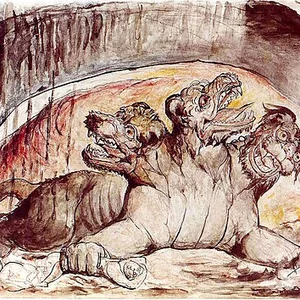

Cerberus is the monstrous three-headed dog who guards the entrance to the Underworld in Greek mythology. Son of Typhon and Echidna, he prevents the living from entering and the dead from leaving. Heracles captured him alive during his twelfth and final labor.
Cerberus
Cerberus
10 min read
Frequently asked questions
Key Facts
- Cerberus is the son of the monsters Typhon and Echidna
- He has three dog heads and a serpent for a tail
- He guards the entrance to the kingdom of Hades, in the Underworld
- Heracles captures him alive during his twelfth labor, on the orders of Eurystheus
- He is one of the most famous monsters in Greek mythology
Works & Achievements
The first Greek text to describe in detail the genealogy of Cerberus, son of Typhon and Echidna. Hesiod attributes fifty heads to him and establishes him as the quintessential hound of Hades, laying the foundational mythological framework.
Pindar is one of the first authors to fix the canonical number of three heads for Cerberus and to place him at the heart of the account of Heracles' twelfth labor, in an ode celebrating an athlete's victory.
Aeneas's descent into the Underworld is the most complete and influential description of infernal topography in Latin literature. The scene in which Cerberus is lulled to sleep by the Sibyl inspired generations of artists and writers through the Renaissance.
Ovid recounts the myth of Orpheus and Eurydice, describing Cerberus subdued by the music of the lyre — illustrating how artistic beauty can triumph even over the most formidable chthonic powers.
The most systematic mythological compendium of Antiquity, which devotes a detailed passage to Heracles' twelfth labor and the capture of Cerberus. This text remains an essential reference source for modern mythographers.
Dante places Cerberus in the third circle of Hell as guardian of the gluttons, and Virgil silences him by throwing handfuls of earth into his mouths. This work ensures the transmission of the ancient myth through the Middle Ages and into the European Renaissance.
A Greek tragedy in which Cerberus's return to the upper world serves as a dramatic turning point. Having completed his final labor, Heracles is struck mad by Hera — illustrating the danger of breaching the boundary between the realm of the dead and that of the living.
Anecdotes
Cerberus is described by Hesiod in the *Theogony* with fifty heads, not three as the most widespread tradition holds. It is only with Pindar and later authors that the number three becomes established, becoming the canonical representation we know today. This evolution illustrates how myths transform and solidify over the centuries.
The twelfth and final labor of **Heracles** was to capture Cerberus alive and bring him to the surface. **Hades** gave his consent on the condition that he use neither weapon nor force. Heracles subdued the monster with his bare hands, seized him by the neck, dragged him to **Mycenae** to present him to **King Eurystheus**, then returned him to the Underworld.
**Orpheus**, the legendary musician, managed to lull Cerberus to sleep by playing his lyre during his descent to the Underworld to find his wife **Eurydice**. The melody was so entrancing that even the **Erinyes**, the vengeful Furies, wept. This episode is one of the rare instances where Cerberus is appeased without a fight.
In the myth of **Psyche**, the young woman must cross the gates of the Underworld to bring back a vial of beauty to **Aphrodite**. A mysterious figure advises her to bring two honey-and-poppy cakes to put the formidable guardian to sleep. This detail has endured through the centuries: the Latin expression *panem et circenses* (bread and circuses) draws on a similar formula to describe the art of appeasing a threatening guardian.
**Aeneas**, the hero of **Virgil**'s *Aeneid*, must also pass before Cerberus during his descent to the Underworld. The **Cumaean Sibyl**, who guides him, throws the three-headed dog a cake soaked in honey and soporifics. The monster falls asleep at once, allowing the two travelers to pass without incident. **Virgil** takes up the motif of the drugged cake here, already present in the Greek tradition.
Primary Sources
She [Echidna] bore Cerberus, the raw-flesh-devouring hound of Hades, with his voice of bronze, shameless, with fifty heads, a terrible monster, full of fire and force.
Cerberus makes these realms resound with his triple-throated baying, a monstrous bulk crouching in a cave opposite. Then the Sibyl, seeing his necks bristling with serpents, threw him a morsel drowsy with honey and drugged grain. Cerberus, his three throats gaping with frenzied hunger, seized it, and relaxing his huge back, sank down and stretched his massive body across the entire floor of his den.
Heracles descended to Taenarum in Laconia to fetch Cerberus. Hades gave him leave to take the creature, on condition that he overpower it without using any weapons. Heracles seized Cerberus by the throat with his iron-clad hands until he had subdued him, then brought him back to Eurystheus.
Orpheus passed through the kingdoms of the shades and stood before Persephone and the lord who rules over that gloomy realm. Then, matching his lyre to his words, he sang: […] Even Cerberus himself was seized with wonder and stood motionless.
He [Heracles] tamed Cerberus, the son of Echidna, that three-headed hound, and brought him up to the light from the dwelling-places where the sun never enters.
Key Places
A promontory of the Peloponnese regarded in antiquity as one of the entrances to the Underworld. It was from here that Heracles was said to have descended to capture Cerberus, and the site was marked by a temple and a cave reputed to be bottomless.
A volcanic lake near Pozzuoli, whose sulfurous vapors killed birds flying over its waters. The Romans placed an entrance to the Underworld here, made famous by Virgil in the *Aeneid* as the site of Aeneas's descent past Cerberus.
A river in Epirus identified with one of the infernal rivers. The ancient Greeks believed the waters of the Acheron led to the Underworld, the realm Heracles crossed to face Cerberus during his twelfth labor.
The city where the Eleusinian Mysteries were celebrated — secret initiatory rites dedicated to Demeter and Persephone. These initiations prepared worshippers to pass through the Underworld without fearing Cerberus, by teaching them the proper words and offerings.
The symbolic starting point of Heracles' journey for his twelfth labor. Though impossible to pinpoint precisely, this place marks the beginning of the heroic *katabasis* that leads to the gates guarded by Cerberus.
Typical Objects

A traditional offering used to lull Cerberus to sleep during descents into the Underworld. Psyche and the Cumaean Sibyl both resort to it in the most famous myths, making this cake a magical passport to pass through the gates of Hades.

The indestructible metal of the gods, the only material capable of binding creatures as powerful as Cerberus. Heracles uses such a chain to subdue him during his twelfth labor, without wounding or killing him.

A stringed instrument whose enchanting melody was powerful enough to lull Cerberus to sleep and suspend the torments of the damned. The lyre symbolizes the power of art over the most brutal forces, even those of death.

A coin placed in the mouth or on the eyes of the dead to pay the ferryman of the Underworld. Without this obol, the dead were left to wander the banks of the Styx, near the territory guarded by Cerberus.

According to many sources, Cerberus had not only three canine heads but also a mane or tail made of venomous serpents. These reptiles recall his chthonic origins and his kinship with other serpentine monsters such as Medusa.

The funerary tree par excellence in Greek and Roman antiquity, planted around tombs. The cypress marks the boundary between the world of the living and that of the dead — the very space Cerberus is charged with guarding.
School Curriculum
Vocabulary & Tags
Key Vocabulary
Daily Life
Morning
At the first hours of the eternal cycle of the Underworld — for sunlight never penetrates it — Cerberus resumes his watch at the entrance to Hades' kingdom. His three heads simultaneously monitor the different approaches to the infernal domain, each turned in a different direction. The monster makes a circuit around the bronze gates, sniffing the air to detect any living presence that might dare draw near.
Afternoon
Continuing his eternal vigil, Cerberus greets the newly dead who arrive after crossing the Styx with Charon. He welcomes them warmly, wagging his tail and licking their hands — for his role is to prevent the dead from leaving, not to turn them away on arrival. The souls he admits then appear before the tribunal of Minos, Aeacus, and Rhadamanthus to be judged.
Evening
When the flow of the dead ebbs, Cerberus half-dozes, his three heads nodding off in turn so that one always remains awake. The snakes that form his mane and tail coil around him like a venomous blanket. The monster is never truly off guard: the slightest attempt by a living being to cross the gates, or by a dead soul to escape, sends him leaping forward with all claws bared.
Food
Cerberus is described as a dog "who devours raw flesh" (Hesiod). He is said to feed on the bodies of the dead and the reckless souls who try to flee. The honey-and-poppy cakes offered by heroes are an exceptional treat, capable of temporarily suspending his vigilance thanks to their soporific properties.
Clothing
As a divine, non-human creature, Cerberus wears no clothing. His massive body is that of a colossal dog with dark or mottled fur, depending on the source. His three necks bear a mane of living snakes; his tail, equally serpentine, rears up as an additional weapon. Steel claws and fangs capable of crushing adamant complete his natural "armor."
Housing
Cerberus dwells in a vast cavern at the entrance to Hades, just beyond the bronze gates that separate the world of the living from the world of the dead. His lair is carved from black volcanic rock and bathed in a dim, perpetual glow. The surrounding landscape is marked by the rivers of the Underworld — Styx, Acheron, Phlegethon, and Lethe — whose soporific vapors form his natural environment.
Historical Timeline
Period Vocabulary
Visual Style
Esthétique grecque antique sombre et chthonienne, mêlant céramique à figures noires, relief hellénistique et palette de noirs profonds, rouges sang et ors anciens, pour évoquer les portes immuables du royaume des morts.
Sound Ambience
Sons des profondeurs infernales : grognements triples et caverneux de Cerbère, eaux noires du Styx, gémissements lointains des âmes et sifflements de serpents dans l'obscurité éternelle.
Liens externes & ressources
Références
Œuvres
Théogonie — Hésiode
vers 700 av. J.-C.
Odes isthmiques — Pindare
vers 478 av. J.-C.
Énéide, Livre VI — Virgile
29-19 av. J.-C.
Métamorphoses, Livre X — Ovide
vers 8 apr. J.-C.
Bibliothèque — Pseudo-Apollodore
Ier-IIe siècle apr. J.-C.
La Divine Comédie, Enfer — Dante Alighieri
1314
Héraclès furieux — Euripide
vers 416 av. J.-C.