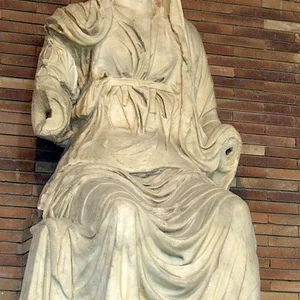

Roman goddess of agriculture, harvests, and fertility, equivalent to the Greek Demeter. She is the origin of the word “cereals” and held a central place in Roman religion and daily life.
Ceres
Ceres
8 min read
Frequently asked questions
Key Facts
- Her cult was introduced to Rome in 493 BCE during a famine, on the orders of the Sibylline Books
- Equivalent of the Greek goddess Demeter in the Roman pantheon
- The word “cereals” comes directly from her name
- Her daughter Proserpina (Persephone) was abducted by Pluto, mythologically explaining the alternation of the seasons
- The Cerealia, festivals held in her honor, were celebrated in April in Rome
Works & Achievements
Ceres taught humans to plow the earth, sow wheat, and harvest crops, drawing them out of an existence of foraging and acorn-gathering. This invention of agriculture is her most celebrated civilizing act.
These secret initiation rites, among the most important of Antiquity, promised initiates a better life after death. They draw directly from the myth of Ceres's quest to find Proserpina.
This monument was the first great center of plebeian worship in Rome, a symbol of the plebeians' struggle for their rights and a place where their laws were kept.
Annual April games combining chariot races, theatrical performances, and agricultural rites, one of the great popular festivals of the Roman calendar celebrated until the end of the Empire.
The canonical version of the Ceres myth in Latin literature, recounting the abduction of Proserpina, her mother's desperate search, and the birth of the seasons.
Virgil invokes Ceres as guide and protector of peasants in this founding poem on Roman agriculture, casting her as the civilizing figure par excellence.
Anecdotes
The very name of Ceres has traveled through the centuries all the way to our breakfast tables: the Romans called the grains they offered her “cereals” — wheat, barley, and spelt — since these formed the backbone of their diet. To this day, the word “cereal” pays her silent tribute every morning at breakfast, though most people have no idea.
According to myth, Pluto, god of the Underworld, abducted Ceres’ daughter Proserpina while she was picking flowers in Sicily. Devastated, Ceres abandoned her divine duties: crops failed and famine threatened the world. Jupiter had to negotiate a compromise — Proserpina would spend part of the year in the Underworld, thus explaining the changing of the seasons.
The Temple of Ceres on the Aventine Hill, dedicated in 493 BC, was a deeply plebeian institution. It served not only as a place of worship but also as an archive for plebeian laws and as a grain market — one of the few Roman institutions where women played an active role.
Every April, Rome celebrated the Ludi Ceriales from April 12 to 19. One of the most striking traditions involved tying lit torches to the tails of foxes — perhaps a vestige of ancient agrarian magic meant to protect the harvest from fire and evil spirits.
When a magistrate violated the rights of a plebeian, he could be declared sacer — literally consecrated to Ceres, outlawed, and condemned to death. This concept of sacratio reveals just how deeply the goddess embodied social justice as much as agricultural fertility in the Roman consciousness.
Primary Sources
Proserpina, in the depths of dark Tartarus, was gathering flowers in the meadow when Pluto saw her, loved her, and carried her off… Ceres searched for her daughter over every land and every sea, bearing two torches lit from the fires of Etna.
She searched for her swift-footed daughter across the lands and the fertile sea, holding blazing torches in both hands… Never did ambrosia or sweet nectar pass her lips, never did she bathe her body, so long as her grief endured.
*Ceres* from *gerere* — that is, from bearing the fruits — received this name, the first letter having been altered through usage: for it is she who bears and provides sustenance to humankind.
*Prima Ceres ferro mortalis uertere terram instituit* — Ceres was the first to teach mortals to turn the earth with iron, when the sacred acorns and the berries of the arbutus had failed in the hallowed groves.
In your honor, Ceres, a crowd clothed in white walked the streets… The matrons brought you as offerings the first fruits of their fields, fresh-cut ears of grain and honey cakes.
Key Places
Founded in 493 BC, this temple was the heart of the plebeian cult of Ceres in Rome, also serving as an archive for plebeian laws and a grain market.
A city considered by the Romans to be the mythical site of Proserpina's abduction by Pluto. Its sanctuary of Ceres, perched in the highlands of the island, was one of the most venerated in Antiquity.
Site of the famous Eleusinian Mysteries dedicated to Demeter and Persephone, the Greek counterparts of Ceres and Proserpina. These secret initiation rites drew pilgrims from across the Mediterranean world.
Pluto's subterranean kingdom to which Proserpina was taken by force. According to some versions, Ceres descended there to negotiate with Jupiter for her daughter's partial return to the world above.
Home of the Olympian gods, where Ceres holds her place among the great deities. It is here that Jupiter arbitrates the conflict between her and Pluto and decides the fate of Proserpina.
Typical Objects

Ceres's most iconic attribute, wheat ears symbolize the fertility of the earth and the nourishment of humankind. She is depicted holding them in her hand or crowned with a golden sheaf.

Ceres wandered the world holding two torches lit from the fires of Mount Etna as she searched for her daughter Proserpina. This object symbolizes both her maternal quest and her power over the cycles of life.

An instrument of the harvest, the sickle is associated with Ceres as a tool of the agricultural gift she brings to mortals. It alludes to the invention of farming attributed to the goddess.

A sacred chest containing secret ritual objects reserved for initiates. It evokes the Eleusinian Mysteries connected to Demeter/Ceres and the initiatory dimension of her cult.

A shallow cup used to pour wine, milk, or honey as an offering during ceremonial rites. It appears frequently in sculptural depictions of Ceres performing her priestly duties.

A mixture of roasted spelt flour and salt sprinkled over offerings to consecrate them to the deity. Specifically linked to Ceres, this sacred culinary rite reflects her dominion over grains.
School Curriculum
Vocabulary & Tags
Key Vocabulary
Daily Life
Morning
At sunrise, the priestesses of Ceres would light the sacred fires in her temple on the Aventine and arrange the ritual offerings: spelt loaves, honey cakes, and freshly cut sheaves of wheat. Hymns were recited to ask for her blessing on the sowing or the harvest, depending on the season.
Afternoon
In mythological representations, Ceres roamed her domains to watch over the growth of the crops, guiding farmers and inspecting the golden fields. During the Ludi Ceriales, processions of women dressed in white wound through the streets of Rome in her honor, carrying baskets of first fruits.
Evening
At night, Ceres brandished her blazing torches — a reminder of her desperate search for Proserpina across the world. In the evenings, farmers would offer her libations of wine and milk before supper, thanking her for the day's work. During the Mysteries, initiates kept an all-night vigil reciting secret formulas.
Food
As goddess of the harvest, Ceres presided over the meals of ordinary Romans: wheat bread, spelt porridge (puls), garden vegetables, and orchard fruits. The offerings dedicated to her — roasted grain ears, mola salsa cakes — reflected the simple food of the plebeians rather than aristocratic banquets.
Clothing
Ancient representations show Ceres clad in a long stola of golden yellow, evoking ripe wheat beneath the sun. Her head is crowned with ears of wheat and wildflowers; her priestesses wore white robes symbolizing ritual purity during ceremonies.
Housing
Ceres resides on Olympus among the gods, but her preferred realm is the mortal earth: vast cultivated plains, fields of swaying grain, and well-stocked granaries. The Aventine temple was her earthly home in Rome, the center of her cult and the repository of plebeian archives.
Historical Timeline
Period Vocabulary
Liens externes & ressources
Références
Œuvres
Don de l'agriculture aux mortels
Temps mythiques
Institution des Mystères éleusiniens
VIe siècle av. J.-C. (codification)
Temple de Cérès sur l'Aventin
493 av. J.-C.
Ludi Ceriales (Jeux Céréaliens)
212 av. J.-C. (institution officielle)
Ovide, Métamorphoses Livre V — récit du rapt de Proserpine
8 apr. J.-C.
Virgile, Géorgiques — Cérès protectrice des laboureurs
29 av. J.-C.