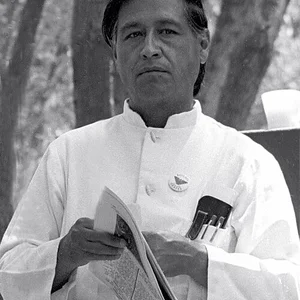

César Chávez (1927-1993) was an American labor leader and activist of Mexican descent. He co-founded the United Farm Workers union and defended the rights of farm workers in the United States through nonviolent means.
Cesar Chavez(1927 — 1993)
César Chávez
États-Unis
7 min read
Frequently asked questions
Famous Quotes
« ¡Sí, se puede!»
« Once social change begins, it cannot be reversed. You cannot uneducate the person who has learned to read. You cannot humiliate the person who feels pride. You cannot oppress the people who are not afraid anymore.»
Key Facts
- Born on March 31, 1927, in Yuma, Arizona, into a family of Mexican-American farm workers
- Co-founded the National Farm Workers Association in 1962, the future United Farm Workers (UFW)
- Led the Delano grape strike and boycott starting in 1965
- Led a 25-day fast in 1968 to reaffirm the movement's commitment to nonviolence
- Died on April 23, 1993; March 31 is celebrated as César Chávez Day in several states
Works & Achievements
The first lasting union for farm workers, created with Dolores Huerta. It would become the United Farm Workers, finally giving field workers a collective voice.
A five-year movement that rallied millions of consumers across the country. It led to the first union contracts signed by the major growers.
A pilgrimage of more than 300 miles to carry the workers' cause all the way to the California capital. It brought the movement to the attention of the national public.
A dramatic act affirming that the struggle had to remain peaceful despite provocations. It strengthened the moral and spiritual dimension of the movement.
A union formed from the merger of the NFWA and a Filipino American organization, affiliated with the AFL-CIO. It negotiated hundreds of contracts and brought lasting improvements to working conditions.
A law won through the pressure of the UFW, the first to guarantee farm workers the right to unionize and bargain collectively. A major social advance in the United States.
A 36-day hunger strike to denounce the chemicals poisoning workers and children. It drew attention to health and ecology in agriculture.
Anecdotes
In 1968, César Chávez began a 25-day hunger strike to remind his followers of the importance of nonviolence, as tensions were rising in the vineyards of California. He broke the fast by sharing bread with Senator Robert Kennedy, who had come to support him. Weakened, he had to be helped to his feet.
The slogan “¡Sí, se puede!” (“Yes, we can!”) was coined in 1972 by Dolores Huerta, the union's co-founder, during one of Chávez's hunger strikes in Arizona. This motto became a rallying cry for workers and far beyond, eventually inspiring the “Yes, we can” of American political campaigns.
Chávez launched a massive table-grape boycott in 1965: he asked Americans to stop buying them until farm workers were treated better. The movement was so widely followed that millions of people stopped consuming grapes, forcing growers to negotiate in 1970.
Born into a family of small Arizona landowners, Chávez watched his family lose its farm during the Great Depression. Having become a migrant farm worker, he is said to have attended more than thirty different schools during his childhood, following the harvests, and he left school after the eighth grade to work in the fields.
A great admirer of Gandhi and Martin Luther King, Chávez made fasting and peaceful marching his main weapons. In 1966, he led a march of more than 480 kilometers, from Delano to Sacramento, the capital of California, to draw attention to the plight of the grape pickers.
Primary Sources
“We are the sons of the Mexican Revolution, a revolution of the poor seeking bread and justice. […] We shall march until our cause is won.”
“We are men and women who have suffered and endured much, and not only in the fields, but also in the struggle to organize ourselves. We are prepared to lose our lives rather than give up our cause.”
“It is my deepest hope that all of us may find the courage to give everything for our cause. To be a man is to suffer for others. God help us to be men!”
“Farm workers are the nourishers of the nation, yet they are among the poorest and most exploited of all.”
Key Places
Region where César Chávez was born in 1927 and where his family ran a small farm before losing it during the Depression. He also died nearby in 1993, in San Luis.
Birthplace of the union: this is where Chávez founded the NFWA in 1962 and launched the grape strike in 1965. Starting point of the great march to Sacramento.
State capital and endpoint of the 1966 march, which aimed to alert the authorities to the plight of farm workers. A symbolic site of the movement's legislative victories.
Headquarters of the UFW from 1971 onward, nicknamed “Nuestra Señora Reina de la Paz” (La Paz). Chávez lived and worked there; the site is now home to a national memorial.
City where Chávez led a 24-day hunger strike in 1972, which gave rise to the slogan “¡Sí, se puede!”. A center of the struggles against Arizona's anti-union laws.
Typical Objects

Red banner emblazoned with a stylized black Aztec eagle, the emblem of the United Farm Workers union. It flew at every march and strike as a symbol of the workers' pride and unity.

A placard held up by activists outside supermarkets, urging consumers not to buy grapes. It turned the boycott into a peaceful weapon of unprecedented power.

A small curved knife used to cut bunches of grapes in the vineyards of California. An everyday tool of the workers Chávez wanted to protect and pay better.

A hoe with a very short handle that forced workers to labor bent over for hours, causing chronic back pain. Its ban in California in 1975 was a major union victory.

A banner of the Virgin of Guadalupe, patron saint of Mexico, carried at the head of the UFW marches. It united Catholic faith with social struggle for Mexican-American workers.

A card certifying a worker's membership in the United Farm Workers union. It granted access to collective protection, healthcare, and the right to negotiate wages.
School Curriculum
Vocabulary & Tags
Key Vocabulary
Tags
Daily Life
Morning
Very early, before dawn, César Chávez often rose to pray or meditate, faithful to his Catholic faith. During his years as an organizer, his mornings were devoted to meetings with the workers and to planning actions.
Afternoon
In the afternoon, he traveled across the countryside to meet workers in the camps and villages, listening to their grievances and persuading them to join the union. He also devoted time to difficult negotiations with the growers and their lawyers.
Evening
In the evening, Chávez held neighborhood gatherings or meetings by lamplight, tirelessly explaining the strategy of nonviolence. He read a great deal, especially Gandhi, Saint Francis, and writings on social justice.
Food
Coming from a poor family, he ate simply: tortillas, beans, rice, and vegetables. Once he became an activist, he undertook several long fasts, sometimes drinking only water for weeks, and later adopted a largely vegetarian diet.
Clothing
Chávez deliberately dressed like the workers he defended: a plaid shirt, plain trousers, and a worn jacket. This plainness displayed his solidarity and his rejection of luxury.
Housing
As a child, he lived in migrant shacks and makeshift housing that shifted with the harvests. As an adult, he chose to live modestly, on a very small union salary, in the La Paz community in Keene.
Historical Timeline
Period Vocabulary
Liens externes & ressources
Références
Œuvres
Fondation de la National Farm Workers Association (NFWA)
1962
Grève et boycott du raisin de Delano
1965-1970
Marche de Delano à Sacramento
1966
Jeûne de 25 jours pour la non-violence
1968
United Farm Workers (UFW)
1972
California Agricultural Labor Relations Act
1975
Jeûne contre les pesticides
1988