 flip
flipOfe Egusi — Egusi Soup with Green Vegetables, Served with Eba
Ofe Egusi — Egusi Soup with Green Vegetables, Served with Eba
Why this dish? Adichie has stated that egusi soup belongs to the heart of her native Igbo cuisine; it is the dish of family reunions in Enugu and Nsukka, the one prepared when the household gathers.
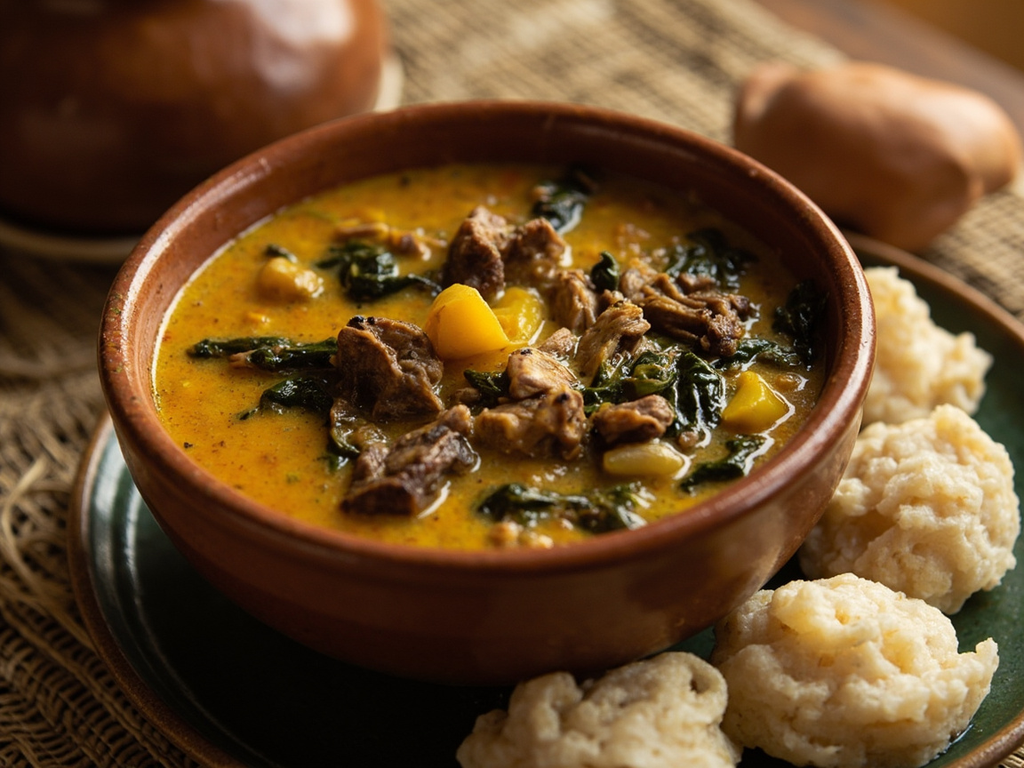
A thick, golden soup where ground egusi seeds, cooked in red palm oil, form small, soft nuggets among water spinach, smoked fish, and meat. It is eaten with eba, a warm cassava dough that you shape into balls with your fingertips.
You want to know what we ate at home in Nsukka? Egusi, always egusi. My mother would toast the seeds, grind them in the mill, and the whole house knew we were going to eat well. Don't let anyone tell you a single story about a hungry Africa — at my house, the table overflowed, and we dipped eba into the soup with our hands, laughing, fighting over the last piece of smoked fish. That's what it means to be Igbo: feed people until they can't protest.
- •Shelled egusi seeds — two bowls, ground (binding and umami)
- •Red palm oil — a generous ladle (base and color)
- •Smoked fish and stockfish — as much as you like (umami base)
- •Goat or beef — a few pieces (festive protein)
- •Ugu leaves (pumpkin leaves) or amaranth — one large bunch (greens)
- •Fresh chili and onion — to taste (heat and base)
- •Ground dried crayfish — a handful (umami)
Ofe Egusi — Egusi Soup with Green Vegetables, Served with Eba
A thick, golden soup where ground egusi seeds, cooked in red palm oil, form small, soft nuggets among water spinach, smoked fish, and meat. It is eaten with eba, a warm cassava dough that you shape into balls with your fingertips.
Why this dish? Adichie has stated that egusi soup belongs to the heart of her native Igbo cuisine; it is the dish of family reunions in Enugu and Nsukka, the one prepared when the household gathers.
You want to know what we ate at home in Nsukka? Egusi, always egusi. My mother would toast the seeds, grind them in the mill, and the whole house knew we were going to eat well. Don't let anyone tell you a single story about a hungry Africa — at my house, the table overflowed, and we dipped eba into the soup with our hands, laughing, fighting over the last piece of smoked fish. That's what it means to be Igbo: feed people until they can't protest.
Ingredients (period version)
- Shelled egusi seeds — two bowls, ground (binding and umami)
- Red palm oil — a generous ladle (base and color)
- Smoked fish and stockfish — as much as you like (umami base)
- Goat or beef — a few pieces (festive protein)
- Ugu leaves (pumpkin leaves) or amaranth — one large bunch (greens)
- Fresh chili and onion — to taste (heat and base)
- Ground dried crayfish — a handful (umami)
Ingredients
- Ground egusi seeds — 250 g (binding and umami)
- Red palm oil — 6 tbsp (base and color)
- Smoked fish (mackerel), flaked — 150 g (umami base)
- Stewing beef, cubed — 400 g (protein)
- Fresh spinach (or substitute ugu) — 300 g, roughly chopped (greens)
- Onion, scotch bonnet chili — 1 onion, 1/2 to 1 chili (base and heat)
- Ground dried crayfish + 1 bouillon cube — 2 tbsp + 1 cube (salty umami)
- Water or broth — 600 ml (cooking liquid)
Method
- Cook the beef with onion, salt, and a little chili until tender; reserve the broth.
- Mix ground egusi with a little water to form a thick paste.
- Heat palm oil in a pot, drop small spoonfuls of egusi paste without stirring too much, then let simmer for 10 minutes until they set.
- Add the broth, meat, smoked fish, ground crayfish, and bouillon cube; cover and simmer for 15 minutes.
- Stir in the spinach and chili, cook 5 more minutes, adjust salt.
- For eba: sprinkle garri (cassava flour) into boiling water while stirring until smooth; serve as balls alongside the soup.
How it was made : Traditionally, egusi seeds were toasted then ground on a stone, and the soup simmered over a wood fire in an earthenware pot. Each Igbo family has its method: egusi 'caking' or egusi 'lacing' — a source of endless domestic debate.
The contemporary twist : Serve the soup in a glazed calabash with eba molded into uniform half-spheres using a cookie cutter, in a contemporary Afro-bistronomy style — a nod to literary dinners in Lagos.
Sources : Tunde Wey, writings on Nigerian cuisine · Chimamanda Ngozi Adichie, interviews on her native Igbo cooking
Chimamanda Ngozi Adichie · Charactorium