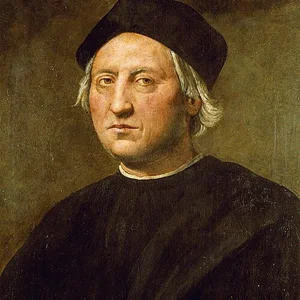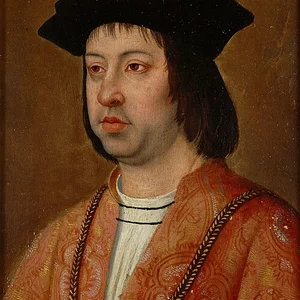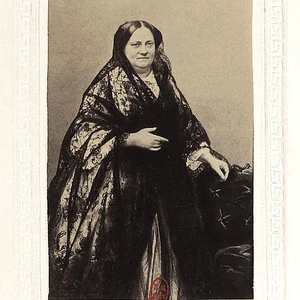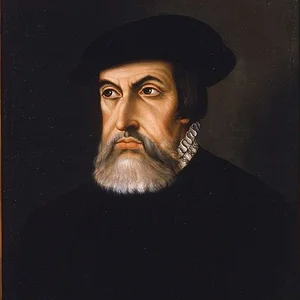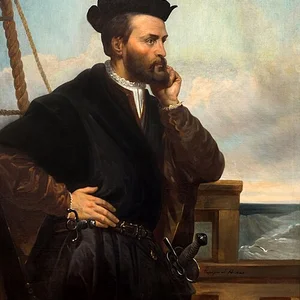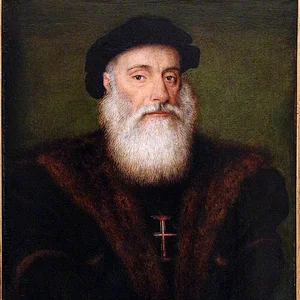

Portuguese navigator (1460–1525) who established the first European sea route to India by sailing around Africa. His voyage of 1497–1499 marked a major turning point in the Age of Discovery and opened the way for European commercial expansion into Asia.
Vasco de Gama(1460 — 1525)
Vasco de Gama
royaume de Portugal
8 min read
Frequently asked questions
Key Facts
- 1497–1499: First voyage to India by rounding the Cape of Good Hope
- 1498: Arrival at Calicut (India) and establishment of direct trade contacts
- Rounding the Cape of Good Hope (November 1497): a crucial passage opening a new sea route
- 1502–1503: Second voyage to India to strengthen Portuguese presence
- 1524: Appointed Viceroy of Portuguese India shortly before his death
Works & Achievements
The first successful European sea voyage to India, achieved by sailing around the Cape of Good Hope. This expedition established a direct maritime route between Europe and Asia, transforming global trade and marking the beginning of European expansion into the East.
Successful navigation around the southern tip of Africa, opening a sea route to the Indian Ocean. This achievement demonstrated the viability of a maritime alternative to the overland trade routes controlled by the Ottomans.
The first arrival of a European expedition at Calicut on the Kerala coast of India. This event marks the beginning of direct maritime trade between Europe and South Asia.
A follow-up expedition to consolidate Portuguese influence and establish trading posts in India. Vasco da Gama reinforced the Portuguese presence and asserted naval dominance in the Indian Ocean.
Creation of the first viable European maritime trade route to Asia, bypassing the African continent. This route revolutionized international commerce, significantly reducing both costs and travel time compared to overland routes.
Appointed as Portuguese Viceroy of India, he administered Portugal's possessions and consolidated European maritime control in Asia. His governorship strengthened the Portuguese colonial presence in the East.
Anecdotes
In 1497, before leaving Portugal, Vasco da Gama received a letter from King Manuel I designating him 'Admiral of the Sea of India', granting him absolute authority over the expedition. This appointment reveals the enormous importance Portugal placed on a mission that could transform European trade.
During his voyage, Vasco da Gama had to put down a mutiny among his own sailors in 1498: exhausted and suffering from scurvy, the crew members demanded to turn back. Through his authority and determination, he managed to hold the group together and continue the route to India, demonstrating remarkable leadership.
In May 1498, Vasco da Gama arrived at Calicut (Kozhikode) in India after 10 months at sea. Upon arrival, he declared to local authorities: 'We have come in search of Christians and spices', revealing the two main objectives of Portuguese expansion into Asia.
The return voyage proved catastrophic: of the 160 crew members, only 55 survived to reach Portugal in 1499. Vasco da Gama himself came close to death several times, contracting a serious tropical illness that left him weakened for months after his return.
Appointed Governor of India in 1524, shortly before his death, Vasco da Gama was not able to enjoy this supreme honor for long. He died in Cochin in 1525, far from the Portugal he had left 28 years earlier for an adventure that changed the course of world history.
Primary Sources
And so we arrived at Calicut, where we found spices, precious stones and other goods of great value, which confirmed that we had reached India by sea.
Vasco da Gama, our navigator, has completed his voyage to India and returned successfully, having found the long-sought sea route and established direct trade with the East.
And the Captain-Major Vasco da Gama ordered that a stone cross be planted on that coast as a sign of Portuguese possession and in recognition of Christ who guided us on this voyage.
After one hundred and forty-four days of sailing from South Africa, we finally sighted the shores of India, thus completing the voyage that many had believed impossible.
Key Places
A coastal Portuguese town where Vasco da Gama was born around 1460. It is the starting point of his life as a navigator and explorer.
Portugal's main port from which Vasco da Gama set sail on July 8, 1497, for his expedition to India. The Portuguese capital was the center of royal power and the Age of Discovery.
A crucial geographic landmark rounded by Vasco da Gama in November 1497, marking the passage into the Indian Ocean and opening the sea route to Asia.
A major Indian port where Vasco da Gama arrived on May 20, 1498, establishing the first direct maritime connection between Europe and India. It is the high point of his first voyage.
An East African coastal region passed through by Vasco da Gama on his voyage to India in 1497–1498, where he gathered valuable information about maritime routes.
An Indian port where Vasco da Gama established a trading post in 1503 during his second voyage, consolidating Portuguese presence in Asia.
Typical Objects

The type of ship used by Vasco da Gama on his voyage to India (1497–1499). Light and highly maneuverable, this sailing vessel was perfectly suited for the long ocean crossings of the Age of Discovery.
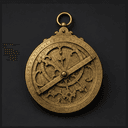
A navigation instrument used to determine latitude by measuring the position of celestial bodies. Essential for Renaissance explorers like Vasco da Gama to find their bearings on the open sea.

An indispensable navigation tool of the 15th century, used to determine direction. It revolutionized long-distance travel by giving sailors a constant sense of orientation.

Detailed sea maps showing coastlines and known trade routes. The cartographers of Vasco da Gama's era relied on these documents to plan voyages toward new territories.

A weapon of both prestige and combat carried by Portuguese explorer-navigators. A symbol of Vasco da Gama's noble status and of European military power during his encounters with India.

A timekeeping device used during sea crossings. Crucial for calculating the distance traveled and the ship's position on long ocean voyages.

The flag bearing the Portuguese coat of arms, flown on Vasco da Gama's ships to assert royal authority and territorial claims upon the discovery of new lands.

A personal record kept daily, documenting observations, weather conditions, and the voyage's route. Vasco da Gama's log stands as a firsthand account of his expedition to India and the discoveries made along the way.
School Curriculum
Vocabulary & Tags
Key Vocabulary
Tags
Époque
Daily Life
Morning
Vasco da Gama begins his day at dawn, often alongside his officers to review charts, navigation instruments, and the ship's provisions. He regularly attends morning Mass — an important practice for a Portuguese nobleman of his era — then inspects the crew and the condition of the sails.
Afternoon
The afternoon is devoted to navigation decisions, consulting astrolabes and compasses, and administrative correspondence with the Portuguese Crown. He oversees sailor training, ship repairs, and confers with other captains to discuss trade routes and discoveries.
Evening
In the evening, Vasco da Gama dines in his private cabin, often in the company of senior officers. He dedicates time to writing reports and logbooks detailing astronomical observations, encounters with local populations, and weather conditions.
Food
His diet, considerably better than that of the crew, includes hardtack, salted or dried fish, rice, dried legumes, and cheese imported from Portugal. He also has access to wine and preserved fruits — markers of status and essential for health during long voyages.
Clothing
Vasco da Gama wears noble attire typical of the Portuguese Renaissance: wool tunics, ornate doublets, fitted hose, and fine-quality capes. At sea, he dons more practical garments that nonetheless reflect his rank, including leather boots and a commander's hat.
Housing
In Lisbon, he resides in a spacious Portuguese nobleman's household with multiple rooms and servants. During his sea voyages, he occupies the flagship's finest cabin, equipped with functional furniture, navigation instruments, and charts — clearly separated from the quarters of his subordinate officers.
Historical Timeline
Period Vocabulary
Visual Style
Un style d'illustration inspiré de la cartographie portugaise et de la peinture flamande du XVIe siècle, capturant l'aventure maritime avec un éclairage doré dramatique, des caravelles majestueuses et une palette riche de couleurs océanes et terrestres évoquant les vieux parchemins d'époque.
Sound Ambience
Une ambiance sonore de port maritime portugais de la Renaissance, immergée dans les bruits de préparation des navires de Vasco de Gama : grincements de bois, claquements de voiles, cris des marins et vagues lointaines, évoquant l'épopée des Grandes Découvertes.
Liens externes & ressources
Références
Œuvres
Voyage vers l'Inde (1497-1499)
1497-1499
Contournement du cap de Bonne-Espérance
1497-1498
Arrivée à Calicut (Kozhikode), Inde
1498
Deuxième voyage en Inde
1502-1503
Etablissement de la route commerciale maritime Europe-Asie
1499
Gouvernement de Cochin et du littoral indien
1524-1525