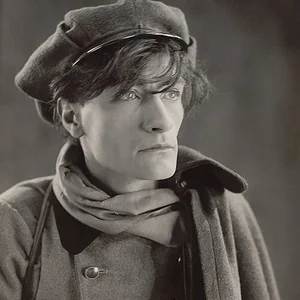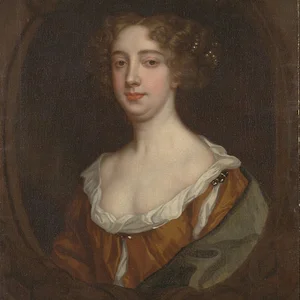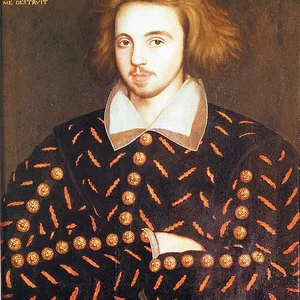

English playwright, poet, and translator of the Elizabethan Renaissance. A contemporary and rival of Shakespeare, he revolutionized English theatre with his blank-verse tragedies before dying violently at the age of 29.
Christopher Marlowe(1564 — 1593)
Christopher Marlowe
royaume d'Angleterre
7 min read
Frequently asked questions
Famous Quotes
« Was this the face that launch'd a thousand ships?»
« Come live with me and be my love»
Key Facts
- Born in 1564 in Canterbury, the same year as William Shakespeare
- Studies at the University of Cambridge, where he earns his degrees (1584, 1587)
- Writes Tamburlaine the Great (around 1587), which popularized blank verse on the stage
- Composes The Tragical History of Doctor Faustus, a retelling of the myth of the man who sells his soul to the devil
- Dies stabbed at Deptford on 30 May 1593, under murky circumstances
Works & Achievements
A tragedy about the meteoric conquests of a shepherd who becomes emperor of Asia; it revolutionized English theatre by establishing blank verse.
A play about a scholar who sells his soul to the devil in exchange for knowledge and power; a masterpiece meditating on ambition and damnation.
A dark, provocative tragedy centered on the merchant Barabas, which influenced Shakespeare's Shylock.
A historical drama about the downfall of an English king, regarded as a model for Shakespeare's history plays.
A play inspired by the St. Bartholomew's Day massacre of 1572, reflecting the French Wars of Religion.
A tragedy of classical inspiration drawn from Virgil's *Aeneid*, most likely his first play.
A long, unfinished mythological poem about two lovers separated by the sea, completed after his death by George Chapman.
A famous pastoral poem inviting one to rustic love, which became one of the best known in the English language.
Anecdotes
On 30 May 1593, Christopher Marlowe spent the day in a house in Deptford, near London, in the company of three men connected to the world of espionage. A quarrel broke out when it came time to settle the bill (“the reckoning”), and Ingram Frizer drove a dagger above the playwright's eye, killing him instantly at only 29. Frizer pleaded self-defence and was pardoned less than a month later, which for four centuries has fuelled suspicions of murder.
In 1587, the University of Cambridge nearly refused to grant Marlowe his master's degree, because rumour had it he had left to join a Catholic seminary at Reims, in France. The Queen's Privy Council intervened in person by letter to declare that he had, on the contrary, “done Her Majesty good service”: a troubling hint that he may have been working as a spy for the Crown.
A few days before his death, an informer named Richard Baines handed the authorities a note accusing Marlowe of atheism and blasphemy, claiming for example that he asserted “religion was invented only to keep men in awe.” In the Elizabethan era, such words could lead to the stake.
With his play *Tamburlaine the Great* around 1587, Marlowe established blank verse on the English stage — a ten-syllable line without rhyme and with a powerful ring. The poet Ben Jonson later dubbed this style “Marlowe's mighty line,” acknowledging that he had paved the way for Shakespeare himself.
In 1589, Marlowe was imprisoned at Newgate after a sword fight in a London street: his friend the poet Thomas Watson had killed a man before his eyes. Marlowe was eventually freed, the case having been judged self-defence, but the episode shows just how violent the lives of London's playwrights could be.
Primary Sources
Ingram Frizer then dealt him a fatal wound above the right eye, two inches deep and one inch wide, of which the said Christopher Marlowe died instantly.
In all his actions he had conducted himself with order and discretion, whereby he had done Her Majesty good service; it was not Her Majesty's pleasure that anyone employed as he had been in matters touching the good of his country should be defamed.
That the beginning of religion was only established to keep men in awe; that all those who do not love tobacco and young boys are fools.
And tell how far thou didst our Lyly outshine, or sporting Kyd, or Marlowe's mighty line.
Key Places
A town in Kent and a major religious centre of England, where Marlowe was born in 1564 into a shoemaker's family and studied at the King's School.
A college of the University of Cambridge where Marlowe earned his degrees thanks to a scholarship reserved for future clergymen. It was here that rumours about his secret activities first arose.
A theatre built by Philip Henslowe on the south bank of the Thames, where several of Marlowe's plays were performed before crowds of spectators.
A famous prison in the city where Marlowe was held in 1589 after a sword fight that left one man dead.
A port town southeast of London where Marlowe met his death in a house rented by Eleanor Bull, during a quarrel that has remained a mystery.
A French city home to an English Catholic seminary; the rumour of a stay by Marlowe in this place fuelled the theory that he undertook spying missions.
Typical Objects

Cut from a large goose feather and dipped in ink, the quill was the playwright's everyday tool for writing his plays on expensive sheets of paper. It was with this that Marlowe composed his tragedies in blank verse.

A small bladed weapon worn at the belt, common among men of the period. It was a dagger “of the value of twelve pence,” according to the coroner's report, that caused Marlowe's death at Deptford.

A small theatrical booklet printed in quarto format, sold cheaply in the shops near St Paul's Cathedral. Marlowe's plays circulated in this form after their success on stage.

Theatre troupes invested considerable sums in sumptuous costumes — velvet, brocade, fake armour — to embody kings and conquerors. The role of the tyrant Tamburlaine called for spectacular outfits to dazzle the audience.

A black garment worn by the university's students and graduates, a symbol of learning. Marlowe donned it to earn his bachelor's and then his master's degree at Corpus Christi College.

Ten-syllable lines in iambic pentameter, without rhyme, which Marlowe established as the great form of English drama. More than an object, it is his literary tool, hailed as “Marlowe's mighty line.”
School Curriculum
Vocabulary & Tags
Key Vocabulary
Tags
Daily Life
Morning
A scholarship student at Cambridge, the young Marlowe rose early to attend prayers and then classes in Latin, rhetoric, and theology. Once he had become a writer in London, his mornings were devoted to writing, quill in hand, on precious sheets of paper.
Afternoon
In the afternoon, playwrights frequented theatres such as the Rose, where plays began in broad daylight around two o'clock to make the most of the light. There Marlowe could follow rehearsals, talk with the actors, and adapt his texts for the stage.
Evening
In the evening, London came alive in the taverns where poets, actors, and shady characters all rubbed shoulders. There Marlowe would meet up with other writers, the “University Wits,” to drink, debate, and sometimes quarrel; it was during one such gathering in Deptford that he met his death.
Food
People ate mainly bread, cheese, beef or mutton, and fish on meatless days. Light beer was drunk at every meal, since water was considered dangerous, and people were beginning to sample novelties brought back from the New World.
Clothing
Marlowe wore close-fitting garments in the Elizabethan fashion: a doublet, puffed breeches, a ruffled collar, and a cloak, with a dagger at his belt. Sumptuary laws even regulated which fabrics could be worn according to one's rank, but he is said to have liked to dress above his station.
Housing
As a student, he lodged in a shared room at his Cambridge college. In London, like many writers of modest means, he probably rented a room in timber-framed houses along narrow, unsanitary alleys that were breeding grounds for outbreaks of the plague.
Historical Timeline
Period Vocabulary
Liens externes & ressources
Références
Œuvres
Tamerlan le Grand (Tamburlaine the Great), 1re et 2e parties
vers 1587-1588
La Tragique Histoire du docteur Faust (Doctor Faustus)
vers 1588-1592
Le Juif de Malte (The Jew of Malta)
vers 1589-1590
Édouard II (Edward II)
vers 1592
Le Massacre de Paris (The Massacre at Paris)
vers 1593
Didon, reine de Carthage (Dido, Queen of Carthage)
vers 1585-1587
Héro et Léandre (Hero and Leander)
publié en 1598