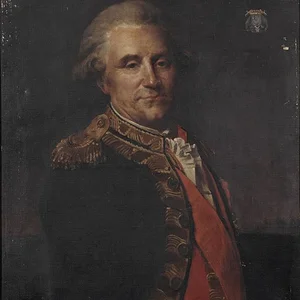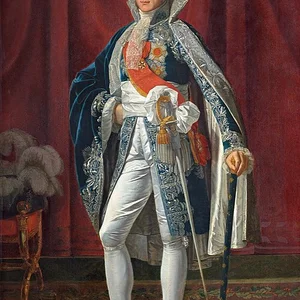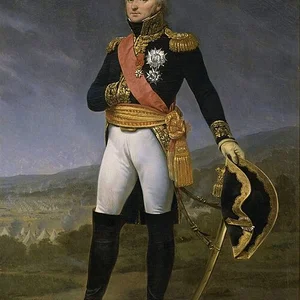

A French divisional general of the First Empire, Claude-Juste-Alexandre Legrand distinguished himself during the Napoleonic Wars, most notably at Austerlitz. He commanded several army corps under Napoleon Bonaparte.
Claude-Juste-Alexandre Legrand(1762 — 1815)
Claude-Juste-Alexandre Legrand
France
7 min read
Frequently asked questions
Key Facts
- Appointed divisional general under the First Empire
- Took part in the Battle of Austerlitz (1805), one of Napoleon's greatest victories
- Served in several Napoleonic military campaigns across Europe
- Commanded an infantry division within the Grande Armée
Works & Achievements
Legrand's division, vastly outnumbered, held the sectors of Telnitz and Sokolnitz against repeated Allied assaults, allowing Napoleon to execute his decisive central maneuver on the Pratzen Heights. It remains the most celebrated feat of arms in his career.
Legrand took part in the operations that led to the crushing of Prussia at Jena and to French dominance over Central Europe, culminating in the Treaty of Tilsit, which marked the zenith of the Empire.
Engaged in the Danube operations that ended in the victory of Wagram and the Treaty of Schönbrunn, Legrand led his troops through fierce fighting against an Austria determined to avenge Austerlitz.
In the aftermath of the Russian disaster, Legrand commanded units at the Battle of the Nations at Leipzig and in the defensive engagements covering the French retreat to the Rhine, in a war where the Grande Armée struggled to resist a coalition of all Europe.
Anecdotes
At the Battle of Austerlitz, on December 2, 1805, Legrand's division was given the perilous mission of holding alone the southern flank of the French line against repeated assaults by superior Russo-Austrian forces. His resistance at Telnitz and Sokolnitz allowed Napoleon to concentrate his best troops at the center to break through the Pratzen Heights. Without this heroic stand, the Napoleonic maneuver could never have succeeded.
Legrand had begun his military career as a common soldier under the Ancien Régime, long before the Revolution opened the doors to rapid advancement. The meritocracy of the Revolutionary and then Imperial era allowed him to climb every rung of the ladder, from private to divisional general in roughly twenty years — a perfect embodiment of the Napoleonic saying that every soldier carries a marshal's baton in his knapsack.
During the German campaigns, Legrand was known among his men for his presence on the front line during the most critical moments, sharing the same dangers as his soldiers. This closeness to the troops earned him remarkable loyalty from his regiments — a quality Napoleon particularly valued in his divisional generals.
Legrand's death on January 8, 1815, at Bitche, came just weeks after Napoleon's abdication, as the Empire was crumbling. His fate mirrors that of an entire generation of generals forged by twenty years of Revolutionary and Imperial warfare, whose careers and fortunes were inseparable from the regime that had raised them.
Primary Sources
General Legrand sustained with the greatest steadfastness the enemy's attacks on our left flank, covering the army's general movement with an energy worthy of the highest praise.
General Legrand's division, posted at Telnitz and Sokolnitz, repulsed vastly superior forces and held its position until the decisive hour, thereby contributing to the success of the day.
The resistance of the left-wing divisions, and in particular that led by Legrand, was one of the unsung keys to Austerlitz; without it, the bold central maneuver could never have been executed.
Entered service in 1782; appointed brigadier general in Year VII; divisional general in Year XI. Participated in the campaigns of Year II, Italy, Germany, Prussia, Austria, and Saxony.
Key Places
Legrand's birthplace, where he was born in 1762 in this Loire city already steeped in military history. Many young men left from here to join the Revolutionary and later Imperial armies.
Site of the battle of 2 December 1805, often described as Napoleon's tactical masterpiece. Legrand's division held the French left flank against Allied assaults, enabling the decisive central maneuver on the Pratzen Heights.
Heart of the Napoleonic Empire, where Legrand received his promotions and moved in military circles. The Ministry of War coordinated campaigns and assignments for divisional generals from here.
This Lorraine fortress town is where Legrand died on 8 January 1815, a few months after Napoleon's abdication. As a garrison town, it stands as a symbol of the end of a generation of soldiers whose fate was bound to that of the Empire.
Typical Objects

A two-cornered hat made of black felt, adorned with a tricolor cockade and a feather, distinctive of Napoleonic general officers. Worn facing forward or sideways depending on the circumstances, it allowed immediate identification of a general on the battlefield.

A bladed weapon with a long blade and gilded guard, worn at the belt by Napoleonic generals. Beyond its use in combat, it symbolized military authority and rank within the imperial hierarchy.

An indispensable optical instrument for the Napoleonic general officer, used to observe enemy movements from an elevated position. Legrand, like all his peers, never ventured into the field without this essential tool for directing operations.

A detailed topographic map, essential to planning Napoleonic military operations. Generals used it to study the terrain, choose positions, and coordinate the movements of several army corps.

A decoration created by Napoleon in 1802 to reward civil and military merit regardless of birth. Legrand, like most generals of the Grande Armée, was among the first great recipients of this republican and imperial distinction.

A navy blue coat with red lapels and gold embroidery, two-star epaulettes, and cuffed boots. The Napoleonic uniform was both functional on campaign and magnificent on parade, a reflection of the Empire's glory and hierarchy.
School Curriculum
Vocabulary & Tags
Key Vocabulary
Daily Life
Morning
Legrand rose at dawn, as Napoleonic military life demanded. He would begin by receiving reports from his staff officers on the condition of the troops, supplies, and ammunition. A quick inspection on horseback of the positions or billets allowed him to assess the situation firsthand.
Afternoon
Afternoons were devoted to conducting operations or, during rest periods, to the training and drilling of regiments. Legrand regularly gathered his colonels to coordinate movements and pass on orders from the imperial general staff, often delivered by courier from Napoleon himself.
Evening
The evening was the time for written reports sent up to corps headquarters and for reading incoming dispatches. Legrand dined simply with his aides-de-camp and close officers, discussing the next day's plans by candlelight, maps spread across a makeshift table.
Food
In the field, food remained frugal even for generals: army bread, boiled or roasted meat when the camp followers were well supplied, red wine, and sometimes brandy to ward off the cold on bivouac nights. Away from the front, general officers made use of locally requisitioned provisions.
Clothing
On campaign, Legrand wore the uniform of a division general: navy blue coat with gold embroidery, two-starred epaulettes, white breeches, and topped boots. In bad weather, the grey greatcoat or heavy cloak replaced the dress uniform, with practicality taking precedence over prestige.
Housing
On campaign, Legrand most often lodged in a requisitioned house in one of the villages the army passed through, or under a command tent during extended bivouacs. A table, a few maps, a camp bed, and a stove made up the essentials of a divisional headquarters in the field.
Historical Timeline
Period Vocabulary
Liens externes & ressources
Références
Œuvres
Défense du flanc sud à la bataille d'Austerlitz
2 décembre 1805
Commandement lors de la campagne d'Allemagne
1813