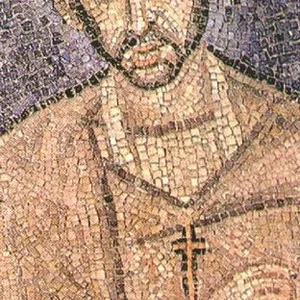

Bishop of Milan from 374 to 397, Ambrose is one of the four Fathers of the Latin Church. A spiritual and political figure of Late Antiquity, he imposed public penance on Emperor Theodosius I and baptized Augustine of Hippo in 387.
Saint Ambrose of Milan(339 — 397)
Ambrose of Milan
Rome antique
9 min read
Frequently asked questions
Famous Quotes
« Ubi Petrus, ibi Ecclesia. (Where Peter is, there is the Church.)»
« Non in dialectica complacuit Deo salvum facere populum suum. (It was not through dialectic that it pleased God to save His people.)»
Key Facts
- Born around 340 in Trier, into a family of the high Roman aristocracy
- Elected Bishop of Milan in 374 by popular acclamation, even though he had not yet been baptized
- Baptized Augustine of Hippo on April 24, 387, decisively influencing his conversion
- Imposed public penance on Emperor Theodosius I following the Massacre of Thessalonica (390), asserting the moral authority of the Church over political power
- Proclaimed a Doctor of the Church; feast day on December 7, the date of his episcopal consecration
Works & Achievements
Ambrose is considered the inventor of rhythmic Latin hymnody. He composed hymns sung in alternation by two choirs (antiphony) to sustain the morale of his congregation during the siege of the basilicas by Justina; some are still sung in the Catholic liturgy today.
A treatise in five books addressed to Emperor Theodosius to guide him toward Nicene orthodoxy against Arianism. A major doctrinal work that helped persuade the emperor to issue the Edict of Thessalonica in 380.
A treatise on Christian ethics directly inspired by Cicero's *De Officiis*, adapted to the duties of the clergy. The first major work of systematic Christian ethics in Latin, it shaped medieval moral thought for centuries.
A theological treatise affirming the divinity of the Holy Spirit, completing his defense of Trinitarian doctrine against Arianism. Written shortly after the Council of Constantinople (381), which had officially defined the doctrine.
A mystagogical catechesis addressed to the newly baptized, explaining the symbolic meaning of the sacraments of baptism, confirmation, and the Eucharist. A valuable document for understanding fourth-century Christian liturgy.
A corpus of ninety-eight letters addressed to emperors, bishops, the faithful, and his sister Marcellina, covering theology, politics, and pastoral care. An irreplaceable historical source on the political and religious life of the late fourth century.
Anecdotes
In 374, Ambrose was still only the governor of the province of Liguria-Emilia, and unbaptized, when he went to the basilica in Milan to calm the crowd gathered to elect a bishop. The crowd suddenly cried out: “Ambrose, bishop!” Astonished, he attempted to flee the city several times, but was brought back each time. Forced to accept, he received baptism and then all the ordinations within eight days, going from a simple layman to bishop.
In 390, Emperor Theodosius I ordered the massacre of several thousand inhabitants of Thessalonica in retaliation for a riot. Ambrose wrote him a firm letter: a Christian guilty of massacres could not receive communion. He refused entry to the basilica to the emperor himself. Theodosius, the most powerful man in the world, submitted and performed a public penance lasting several months — an unprecedented act in the history of the Church in the face of imperial power.
In the spring of 387, in the baptistery of Milan's cathedral, Ambrose baptized a rhetoric teacher from North Africa named Augustine. That moment would change the course of history: Augustine of Hippo would go on to become one of the greatest Christian theologians, and he devoted several pages of his Confessions to describing the impression Ambrose made on him — reading in silence, a remarkably rare habit at the time, without allowing himself to be disturbed by anyone.
Around 385–386, Empress Justina, regent of the Western Empire and a supporter of Arianism, demanded several of Milan's basilicas for the Arians. Ambrose flatly refused and barricaded himself with his congregation inside the basilica, which was besieged by imperial soldiers. For days and nights on end, he composed hymns that the crowd sang together in chorus to keep their spirits up. The empress eventually relented: Ambrose's peaceful resistance — through song and prayer — had stood firm against the army.
Hagiographic tradition holds that, as an infant lying in his cradle in the family garden in Trier, a swarm of bees landed on his lips without stinging him, then flew up toward the sky. His terrified father is said to have exclaimed: 'If this child lives, he will accomplish something great.' Bees and the beehive have since been the iconographic attributes of Ambrose, symbols of his golden eloquence and his ability to gather the faithful as a queen gathers her swarm.
Primary Sources
"I write to you what I must write to an emperor… A man who has killed so many innocents must do penance. Do not receive the sacrifice at your hands; do not approach the altar until you have laid aside your purple."
"What is honorable is useful, and what is useful is honorable; for God did not wish these two things to be separated in the servants of the Church."
"Eternal Creator of all things, who governs night and day, who assigns the seasons by varied rules to relieve our weariness…"
"When he lay in his cradle, a swarm of bees flew over his face and mouth. This was said to presage the divine eloquence that would flow from his lips."
"When he read, his eyes ran over the pages and his heart searched out the sense, but his voice and tongue were at rest. Often, when we were present, we saw him reading thus in silence, for he never read aloud."
Key Places
Ambrose's birthplace, around 339, then a frequent residence of the Western Roman emperors and seat of the Praetorian Prefecture of the Gauls, which was headed by his father.
The city where Ambrose served as governor and then as bishop from 374 to 397. The de facto imperial capital of the Western Empire, it was the stage for his confrontations with Justina and Theodosius, and the place where he baptized Augustine.
A basilica built by Ambrose himself from 379 onward, originally known as the *Basilica Martyrum*. He had the relics of the martyrs Gervase and Protase placed there and was buried within its walls in 397; it remains a place of pilgrimage to this day.
The city where Ambrose received his rhetorical and legal education after his father's death, following the great tradition of the Roman aristocracy, before entering the imperial administration.
Although Ambrose never traveled there, the massacre ordered by Theodosius in this city in 390 triggered the most celebrated confrontation of his career — one that fundamentally redefined the relationship between imperial power and ecclesiastical authority.
Typical Objects

Curved staff symbolizing the shepherd guiding his flock, insignia of the episcopal rank that Ambrose received at his ordination in 374. He wielded it as much as a symbol of spiritual authority as a political instrument in his dealings with emperors.

Ambrose's quintessential iconographic attribute, rooted in the legend of the cradle in Trier. The hive symbolizes his eloquence and his ability to produce the "sweetness" of the divine word, and appears alongside him throughout medieval Christian iconography.

In later hagiographic iconography, Ambrose is sometimes depicted holding a whip, an allusion to the penance he imposed on Theodosius I. It symbolizes the Church's power to "correct" the mighty, even emperors.

Ambrose was a tireless reader and commentator of Scripture. The sheer volume of his sermons on the Psalms and his biblical commentaries speaks to a man who always had a codex in hand, even during audiences.

Writing instruments of the 4th century, used for political and theological correspondence. Ambrose wrote dozens of letters to emperors, bishops, and the faithful that constitute a major historical source.

A band of white cloth worn over the shoulders, insignia of Ambrose's metropolitan dignity as bishop of Milan, then the imperial capital of the West. He also wore the dark, simple liturgical vestments of the early Christian tradition.
School Curriculum
Vocabulary & Tags
Key Vocabulary
Daily Life
Morning
Ambrose rose before dawn for the Matins prayer, in keeping with the rule he imposed on his clergy. He then celebrated the daily Eucharist in his cathedral at Milan — a practice still uncommon at the time — surrounded by his presbyterium. The morning was also devoted to silent reading of the Scriptures, a striking habit that his disciple Augustine noted with astonishment.
Afternoon
Afternoons were taken up by public audiences: he received without discrimination the poor, civil servants, clerics, and imperial ambassadors. He would then dictate his political and theological correspondence to his secretaries, sometimes several letters at once. He also conducted catechesis for the catechumens and prepared his Sunday sermons, renowned for their length and depth.
Evening
Evenings were devoted to theological writing and scriptural study. He wrote himself by candlelight, reviewed and corrected by his clerics. He also held regular meetings with the bishops of neighboring provinces under his metropolitan authority, for Milan was at that time the imperial capital and ecclesiastical center of the West.
Food
Ambrose observed frequent fasts, particularly on Wednesdays and Fridays, following the ancient Christian penitential discipline. His ordinary diet was simple: bread, vegetables, a few fruits and water, sometimes wine mixed with water during fraternal meals with the clergy. He refused the lavish banquets that tradition reserved for senior officials of his rank.
Clothing
As bishop, Ambrose wore during liturgical services the white alb, the chasuble, and the white pallium draped over his shoulders — the insignia of his metropolitan dignity. Outside of ceremonies, he wore the dark tunic and cloak of the clerics, renouncing the insignia of Roman aristocracy (toga, golden ornaments) that his social rank would have entitled him to wear.
Housing
He resided in the episcopal palace of Milan, adjacent to the double cathedral (baptistery and basilica), a monumental complex that he himself had helped to expand. His apartments, though situated in a prestigious building befitting his rank as metropolitan of the western capital, were renowned for their austerity: sparse furniture, many books and scrolls, a private chapel.
Historical Timeline
Period Vocabulary
Liens externes & ressources
Références
Œuvres
Hymnes liturgiques (Hymni Ambrosiani)
v. 385-397
De Fide (De la Foi)
379-380
De Officiis Ministrorum (Des devoirs des ministres de l'Église)
v. 386-390
De Spiritu Sancto (Du Saint-Esprit)
381
De Mysteriis (Des Mystères)
v. 390
Epistulae (Lettres)
374-397