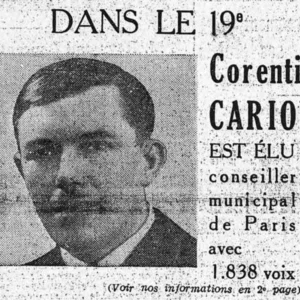

A Communist municipal councillor of the 19th arrondissement of Paris, Corentin Cariou was arrested by the Germans and shot in 1942 as a hostage in reprisal. His name was given to a station on the Paris Métro (line 7).
Corentin Cariou(1898 — 1942)
Corentin Cariou
France
8 min read
Frequently asked questions
Key Facts
- Communist municipal councillor of the 19th arrondissement of Paris before the war
- Arrested by the German occupation authorities
- Shot as a hostage in 1942 in reprisals against the Resistance
- His name is commemorated by the Corentin Cariou metro station on line 7 in Paris
Works & Achievements
Elected on a Communist ticket, Cariou championed the interests of workers and the working classes of his arrondissement on the Municipal Council, speaking out on social issues, housing, and working conditions.
Following the invasion of the USSR and the French Communist Party's entry into armed resistance (FTP), Cariou continued his militant activities underground, at great personal risk, until his arrest and subsequent execution by the Germans in April 1942.
Before and during his term on the municipal council, Cariou was deeply involved in local union and political life, helping to organise the labour movement in a neighbourhood with a high concentration of industry around La Villette.
Anecdotes
Born in 1898 in Plouha, Brittany, Corentin Cariou was the son of a working-class family that migrated to Paris in the early twentieth century, like thousands of Bretons drawn to the capital by industrial jobs. He settled in the 19th arrondissement, a working-class neighborhood built around the former La Villette slaughterhouses, and became a factory worker before entering politics.
A militant of the French Communist Party, Corentin Cariou was elected municipal councillor of the 19th arrondissement of Paris in the 1930s. He represented the workers and working-class communities of his neighborhood, campaigning notably for improved living and working conditions in this industrial district of Paris.
After Nazi Germany invaded the USSR in June 1941, the PCF openly joined the armed Resistance. The occupation authorities responded by arresting known and registered Communist militants. Cariou, given his profile as an elected official, was arrested and imprisoned by the Germans.
On April 17, 1942, Corentin Cariou was shot at the Fort of Mont-Valérien in Suresnes, as a hostage — a form of collective terror designed to discourage the Resistance. He was among a group of Communist militants and resistance fighters executed that day without trial or due process.
In 1946, the Line 7 metro station serving the northern part of the 19th arrondissement was named 'Corentin Cariou' in tribute to the executed municipal councillor. This decision reflects the working-class and resistance memory that still shapes the place names of Paris today.
Primary Sources
The police archives of the Paris Prefecture hold the arrest and surveillance records of PCF militants compiled under the Occupation, often in collaboration with German SD and Gestapo authorities.
Mont-Valérien was the main execution site for hostages and resistance members in the Paris region during the Occupation. German records and French archives preserve the names and dates of executions, among which appears Corentin Cariou, shot on April 17, 1942.
The PCF's newspaper, published illegally under the Occupation, paid tribute to executed militants and denounced the shooting of hostages carried out by the Germans in reprisal for acts of resistance.
The Paris City Archives hold the Municipal Council debates in which the contributions of Communist elected officials appear, including those of Corentin Cariou, representing the 19th arrondissement, on social issues and workers' conditions.
Key Places
A working-class district where Cariou served as municipal councillor. An industrial area surrounding the former La Villette slaughterhouses, with a strong trade union and communist tradition, and one of the areas most heavily targeted by German repression.
The main execution site for hostages and resistance members in the Paris region during the Occupation: more than 1,000 people were shot here. Corentin Cariou was executed on 17 April 1942; the site is today a national memorial.
Renamed in 1946 in honour of the executed municipal councillor. Located in the heart of the 19th arrondissement he represented, it serves as a daily place of remembrance for local residents.
Seat of the Paris Municipal Council, where Cariou sat as elected representative of the 19th arrondissement before the Communist Party was banned in 1939 and the council was dissolved by the Vichy regime.
Corentin Cariou's birthplace, where he was born in 1898. Like thousands of Bretons of his generation, he left his home region to find work in the factories and industries of Paris.
Typical Objects

An annual membership document for the PCF. Carrying this card during the Occupation was a particularly dangerous act, as the party had been banned and its members were actively hunted by the police and the Gestapo.

An illegally printed sheet passed from hand to hand to inform and mobilize the population against the occupier. Communist activists like Cariou produced and distributed them at the risk of their lives from 1940 onward.

A badge worn during official sessions of the Municipal Council, symbolizing the democratic legitimacy that Cariou defended on behalf of residents of the 19th arrondissement before the PCF was banned in 1939.

A mandatory document issued by the occupying authority to move around, work, or travel within Paris. For clandestine activists, lacking one — or carrying a forged one — meant a permanent risk of arrest.

An illegal edition of the communist newspaper, run off on mimeograph machines in secret printing houses. The PCF's main tool for information and mobilization under the Occupation, its mere possession could lead to arrest and deportation.

An official document entitling its holder to a weekly ration of bread, meat, sugar, and fats. Food shortages hit working-class neighborhoods like the 19th arrondissement particularly hard, where queues outside shops were a daily reality.
School Curriculum
Vocabulary & Tags
Key Vocabulary
Daily Life
Morning
Under the Occupation, a working-class militant like Cariou started his day early, shaped by the constraints of rationing. Obtaining bread or food meant queuing at dawn outside neighborhood shops, ration book in hand, before heading to work or to carry out militant activities.
Afternoon
Afternoons were divided between factory work and clandestine activities — discreetly distributing leaflets, holding secret meetings with fellow militants, and gathering information to pass on to resistance networks. Every outing required caution and wariness of strangers, as informers and police were ever-present in occupied Paris.
Evening
In the evenings, after curfew (set at 9 p.m., then at 11 p.m. depending on the period), life retreated indoors. Political discussions were held in hushed voices; radio sets were hidden away to pick up the BBC or Radio Moscow, despite the occupier's strict ban.
Food
The diet of Parisian workers under the Occupation was impoverished by rationing: poor-quality bread, seasonal vegetables, and very little meat or fat. The black market, expensive as it was, allowed families to supplement the official rations that were never enough for working-class households.
Clothing
Clothing reflected the working-class condition: work overalls, a sturdy cloth jacket, a flat cap. Textile shortages meant mending and repurposing old garments; shoe soles were replaced with wood or cardboard for want of leather available in shops.
Housing
In the 19th arrondissement, workers lived in modest dwellings — two or three rooms in old apartment buildings with dark inner courtyards. Coal heating was rationed, and the winters of 1941 and 1942 were particularly severe, with families often lacking enough fuel to heat their homes.
Historical Timeline
Period Vocabulary
Liens externes & ressources
Références
Œuvres
Mandat de conseiller municipal du 19e arrondissement de Paris
années 1930
Engagement dans la résistance communiste clandestine
1941-1942
Militantisme syndical et politique ouvrier dans le 19e arrondissement
années 1920-1930