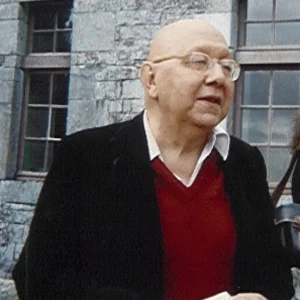

French philosopher, economist, and psychoanalyst of Greek origin, co-founder of the group and journal Socialisme ou Barbarie. A thinker of autonomy and the social imaginary, he developed a radical critique of Marxism and bureaucracies.
Cornelius Castoriadis(1922 — 1997)
Cornelius Castoriadis
Grèce, France
6 min read
Frequently asked questions
Famous Quotes
« An autonomous society is a society that explicitly institutes itself.»
Key Facts
- Born in 1922 in Constantinople, died in 1997 in Paris
- Emigrated to France in 1945 after studying in Athens
- Co-founded in 1948 the group and journal Socialisme ou Barbarie (active until 1967)
- Published in 1975 his major work, The Imaginary Institution of Society
- Became director of studies at the EHESS in 1980, where he taught until his death
Works & Achievements
Co-founding, with Claude Lefort, of a group and a journal that developed an original critique of the USSR and of bureaucracies, opposed to both capitalism and Stalinism.
His major work, which introduces the concepts of the social imaginary and autonomy. A foundational book for rethinking how societies create themselves.
A vast series of essay collections (published in several volumes, some posthumous) covering philosophy, politics, science and psychoanalysis.
A collection of his political writings from Socialisme ou Barbarie, analysing bureaucratic domination in both the East and the West.
An essay on Soviet military power and strategy, marking his engagement in the debates of the Cold War.
A late collection in which he denounces conformism, the retreat into private life and the weakening of political life in modern democracies.
His training and work as a psychoanalyst, integrated into his reflection on the imaginary and the creation of meaning in human beings.
Anecdotes
For nearly twenty years, Castoriadis wrote under pseudonyms such as Pierre Chaulieu and Paul Cardan. The reason was very concrete: as a Greek immigrant with an uncertain residency status, he risked being expelled from France because of his revolutionary political activities. He was not granted French citizenship until 1970.
He led an astonishing double life: by day, he was a respected economist working at the OECD, the international organization that advises governments; by night, he secretly led a revolutionary group that criticized that very same capitalism and state bureaucracies.
In December 1945, the young Castoriadis left a Greece torn apart by civil war and arrived in France aboard the ship Mataroa, along with a whole group of young Greek intellectuals on scholarships. Many of them would go on to become important figures in French thought.
The journal he co-founded, *Socialisme ou Barbarie* (1949-1967), was printed in only a few hundred copies, yet its influence was immense: its ideas about autonomy and its critique of bureaucracy fed the minds of the students of May 1968.
In the later part of his life, this philosopher and economist also trained in psychoanalysis and saw patients. For him, understanding how the human mind creates meaning was inseparable from reflecting on the freedom of societies.
Primary Sources
Society is creation, and creation of itself: self-creation. It institutes itself by instituting a world of social imaginary significations.
The alternative facing modern humanity is clear: either socialism, that is to say management by the producers themselves, or the barbarism of exploitation and bureaucracy.
An autonomous society is a society that knows that its laws are its own creation, and which can therefore explicitly call them into question.
We are living in an era of generalized conformism and of the rising tide of insignificance, where genuinely political questions are gradually being erased.
Key Places
City where Castoriadis was born in 1922, before his family moved to Greece.
City where he grew up, was educated, and became involved in political activism at a very young age before leaving Greece.
City where he settled from 1945 onward, led most of his intellectual and political life, and where he died in 1997.
The place where he worked as an economist by day, set apart from his nighttime revolutionary activities.
Institution where he became director of studies in 1979 and continued his philosophical teaching.
Typical Objects

The journal he co-founded in 1949, the vehicle for his political analyses. Though printed in small numbers, it had a lasting influence on critical thought.

An everyday tool of the 20th-century thinker, on which he wrote articles and manuscripts, often under a pseudonym.

His major book of 1975, in which he develops the notions of the social imaginary and of autonomy. A dense work that became a landmark of political philosophy.

In the last part of his life, Castoriadis practiced psychoanalysis and saw patients. The couch symbolizes this clinical side of his work.

The kind of document he produced in his official job as an economist, alongside his secret life as an activist.

A printed sheet handed out to spread the group's revolutionary ideas. Writing and distributing it were at the heart of clandestine political action.
School Curriculum
Vocabulary & Tags
Key Vocabulary
Daily Life
Morning
Castoriadis's mornings looked like those of an ordinary office worker: he would head to his economist's desk at the OECD, where he analyzed data and drafted reports. Nothing hinted at his double life as an activist.
Afternoon
His afternoons were split between his official job and the preparation of his own writings. Later in his life, he devoted his afternoons to teaching at the EHESS and to reading, devouring philosophy, science, and literature in several languages.
Evening
Evening was the time for his other life: meetings of the Socialisme ou Barbarie group, passionate debates, and the writing of articles under a pseudonym. He would talk for hours with his comrades about revolution and workers' autonomy.
Food
Castoriadis lived in the French manner, happily sharing long meals where the food served mainly as a pretext for conversation and the debate of ideas. A lover of discussion, he often stretched dinners late into the night.
Clothing
For his job at the OECD, he wore the plain suit of the mid-twentieth-century office employee. This respectable attire contrasted with the explosive content of his political ideas.
Housing
He lived in Paris, in the lodgings of an intellectual surrounded by books and papers. His home often served as a meeting place and a site of collective work for his activist comrades.
Historical Timeline
Period Vocabulary
Liens externes & ressources
Références
Œuvres
Fondation de Socialisme ou Barbarie
1949
L'Institution imaginaire de la société
1975
Les Carrefours du labyrinthe
1978-1999
La Société bureaucratique
1973
Devant la guerre
1981
La Montée de l'insignifiance
1996
Pratique de la psychanalyse
à partir des années 1970