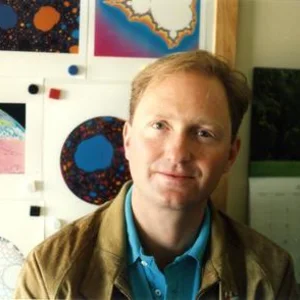

Curtis McMullen is an American mathematician born in 1958, a professor at Harvard University. A specialist in dynamical systems, hyperbolic geometry, and complex analysis, he was awarded the Fields Medal in 1998.
Curtis McMullen(1958 — ?)
Curtis T. McMullen
États-Unis
5 min read
Frequently asked questions
Key Facts
- Born on May 21, 1958, in Berkeley, California
- Awarded the Fields Medal in 1998 for his work in holomorphic dynamics and geometry
- Professor of mathematics at Harvard University since 1998
- Major work on dynamical systems, Riemann surfaces, and three-dimensional hyperbolic geometry
Works & Achievements
Foundational work carried out under the supervision of Dennis Sullivan, laying the groundwork for his research in holomorphic dynamics and hyperbolic geometry.
A major work connecting the renormalization of quadratic maps, the geometry of the Mandelbrot set, and 3-dimensional hyperbolic manifolds.
A book developing a deep parallel between the renormalization of dynamical systems and the geometry of hyperbolic manifolds that fiber over the circle.
An honor recognizing his contributions to the theory of dynamical systems, hyperbolic geometry, and complex analysis.
A series of investigations connecting the dynamics of polygonal billiards to geometry and number theory, opening up new fields of study.
Anecdotes
In 1998, Curtis McMullen received the Fields Medal at the International Congress of Mathematicians in Berlin. This honor, awarded every four years to researchers under the age of 40, is often nicknamed the “Nobel Prize of mathematics,” even though no actual Nobel Prize exists for this discipline.
McMullen long used computers to explore the fractal figures known as Julia sets. By tracing these images of infinite complexity, he connected the visual art of fractals to rigorous mathematical proofs about the chaotic behavior of functions.
Before teaching at Harvard, McMullen was a professor at the University of California, Berkeley, and studied at Williams College and then at Harvard. His thesis advisor was Dennis Sullivan, himself a renowned mathematician in the field of dynamical systems.
Part of his work focuses on “Kleinian groups” and hyperbolic geometry, objects that describe curved spaces impossible to draw on a flat sheet of paper. McMullen helped prove conjectures that had remained open for decades, such as those related to the density of these groups.
McMullen is also interested in mathematical billiards: imagining a perfect ball bouncing endlessly around a polygonal table. The study of these trajectories reveals surprising links between geometry, dynamics, and number theory.
Primary Sources
McMullen has made important contributions to various branches of the theory of dynamical systems, such as the algorithmic study of polynomial equations, the study of the distribution of the points of a lattice, hyperbolic geometry and holomorphic dynamics.
This book gives a self-contained account of the renormalization theory of quadratic-like maps and its connections with the geometry of the Mandelbrot set and with hyperbolic three-manifolds.
We develop a parallel between the renormalization of dynamical systems and the geometry of hyperbolic 3-manifolds that fiber over the circle.
Key Places
University where McMullen earned his PhD and then became a professor of mathematics from 1998 onward. It is where he carries out most of his research and supervises doctoral theses.
Institution where McMullen completed his undergraduate studies and earned his B.A. in 1980. It was the starting point of his mathematical training.
University where McMullen was a professor in the 1990s, before joining Harvard. A major center of American mathematical research.
Institution where McMullen also taught in the early 1990s, alongside the Institute for Advanced Study, a hub of research in pure mathematics.
Place where, in 1998, McMullen received the Fields Medal before the worldwide mathematical community, which gathers every four years.
Typical Objects

Machine used to compute and visualize fractal sets of infinite complexity such as the Julia and Mandelbrot sets. The generated image guides the mathematician's intuition before the rigorous proof.

A central tool for teaching and research in mathematics, on which equations and geometric diagrams are written. It remains irreplaceable for laying out a line of reasoning step by step in front of students.

A gold award given every four years to young mathematicians for exceptional discoveries. It bears the effigy of Archimedes and is often regarded as the highest honor in mathematics.

A peer-reviewed scientific publication in which the researcher lays out their proofs, as in the Annals of Mathematics. It is the main way a mathematical result is shared and validated.

A surface on which the mathematician jots down ideas, equations, and geometric sketches as their thinking unfolds. Many discoveries are born from these accumulated rough drafts.
School Curriculum
Vocabulary & Tags
Key Vocabulary
Tags
Daily Life
Morning
A mathematics professor's morning often begins with reading recent papers and preparing lectures. McMullen devotes part of his time to thinking alone in front of a chalkboard, sometimes for hours, about an open problem.
Afternoon
The afternoon is paced by classes, research seminars and meetings with his doctoral students. It is also the time to use the computer to generate and explore fractal images that feed his intuition.
Evening
The evening may stretch on with the writing of papers or correspondence with colleagues around the world. Mathematical ideas often keep ripening long after the office closes.
Food
Like many contemporary American academics, his diet is that of modern everyday life: meals eaten on campus, coffee ever-present in mathematics departments. Nothing extraordinary sets his diet apart from that of his contemporaries.
Clothing
Casual academic attire typical of researchers: a shirt, a simple jacket, practical clothes. His appearance stays understated, the focus being on intellectual work.
Housing
He lives in the Cambridge area, near Harvard, in the comfort of a large university city on the east coast of the United States. His main working environment is his office in the mathematics department.
Historical Timeline
Period Vocabulary
Liens externes & ressources
Références
Œuvres
Thèse de doctorat sur les familles de groupes kleiniens et la dynamique
1985
Complex Dynamics and Renormalization
1994
Renormalization and 3-Manifolds which Fiber over the Circle
1996
Médaille Fields
1998
Travaux sur les billards et surfaces de translation
années 2000-2010