Rani Lakshmibai(1828 — 1858)
Lakshmî Bâî
Empire marathe
8 min read
Queen of Jhansi (central India), she became one of the most iconic figures of the Indian Rebellion of 1857–1858 against British rule. Refusing the annexation of her kingdom by the East India Company, she personally led the fighting and died on the battlefield at age 29.
Frequently asked questions
Key Facts
- 1828: born in Varanasi (Benares) under the name Manikarnika Tambe
- 1842: married Raja Gangadhar Rao Newalkar, ruler of Jhansi — she took the name Lakshmî Bâî
- 1853: death of the Raja without a direct heir; the East India Company annexed Jhansi by applying the Doctrine of Lapse
- 1857–1858: during the Indian Rebellion, she led the defense of Jhansi against British forces
- June 17, 1858: died in combat during the Battle of Gwalior, becoming a martyr and symbol of Indian resistance
Works & Achievements
After her husband's death, the Rani personally took charge of governing Jhansi, managing finances, justice, and defense. Her administration was praised even by British contemporaries for its effectiveness.
Leading her troops personally from the ramparts, the Rani held Jhansi against a British army that outnumbered and outgunned her forces for several weeks, becoming a symbol of Indian resistance.
The Rani drafted several formal protests against the annexation of Jhansi, invoking Hindu law and the treaties signed with the Company. These texts stand as one of the earliest acts of legal resistance to British colonial policy in India.
This Hindi poem, now one of the most memorized texts in Indian schools, immortalized the figure of Rani Lakshmibai and helped make her a national symbol of the independence movement. Its celebrated verse: 'Khoob ladi mardani woh to Jhansi wali Rani thi.'
Anecdotes
Manikarnika Tambe, the future Rani Lakshmibai, received an unusually broad education for a girl of her era: she learned horse riding, fencing, and archery alongside the boys of the Peshwa court in Bithur. This martial training, rare for a high-caste young woman in the 19th century, gave her the skills that would make her a formidable warrior.
In 1853, her husband Maharaja Gangadhar Rao died without a biological heir. Before his death, he legally adopted a nephew named Damodar Rao, in the presence of a British officer, to ensure the succession. The East India Company nonetheless refused to recognize this heir under the 'Doctrine of Lapse' and annexed the kingdom of Jhansi in 1854. The Rani is said to have declared: 'Meri Jhansi nahin doongi' — 'I will not give up my Jhansi.'
During the fall of Jhansi in April 1858, the Rani escaped the besieged fortress by leaping the ramparts on horseback, with her adopted son Damodar Rao tied to her back. She rode over a hundred kilometers to Kalpi to join the rebel forces. This episode, reported by witnesses on both sides, became the most iconic image of her legend.
Sir Hugh Rose, the British general who led the campaign against her, wrote in his official reports that the Rani was 'the best and bravest military leader of the rebels.' This tribute from the enemy himself helped forge her heroic reputation as early as the 19th century — even in Britain.
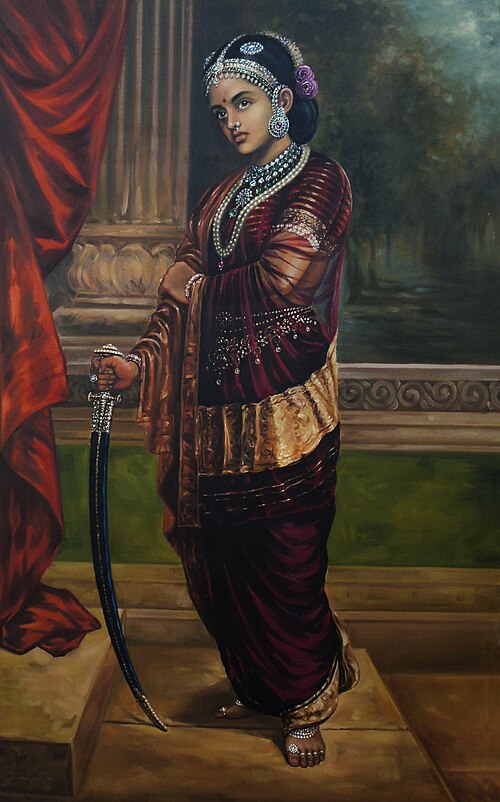
The Rani died in battle on June 17 or 18, 1858, near Gwalior, dressed as a warrior with sword in hand. She was not yet thirty years old. According to tradition, her followers burned her body before the British could seize it, refusing to let their queen be exposed to the enemy even in death.
Primary Sources
The Rani contests the application of the Doctrine of Lapse to Jhansi, noting that the adoption of Damodar Rao was carried out in accordance with Hindu law in the presence of a British representative, and that the refusal to recognize this heir constitutes a manifest injustice.
The Rani of Jhansi commanded her troops with great ability and personal bravery, and was the most dangerous of all the rebel leaders. She was remarkably brave and determined.
A first-hand account by a Brahmin from Nashik who was present in Jhansi and Gwalior during the revolt. Godse describes the Rani as a woman of natural authority, admired by her soldiers, who personally directed the defense of Jhansi's fortifications.
The Rani made a gallant defence of Jhansi, and when the town was carried by assault, she escaped with a body of cavalry and made her way to Kalpi, where she joined the rebel forces under the Nana Sahib.
Key Places
An impregnable 17th-century fortress that served as the seat of the Rani's kingdom. She organized the resistance there against General Rose's siege in March–April 1858 before making her escape.
A holy city on the banks of the Ganges where Manikarnika Tambe was born in 1828. She grew up at the court of the exiled Peshwa Baji Rao II, where she received her martial education.
A fortified town on the Yamuna River where the Rani took refuge after the fall of Jhansi. There she joined fellow rebel leaders Tantia Tope and Rao Sahib before marching on Gwalior.
The city where the final phase of the resistance unfolded. Rani Lakshmibai died in battle here on June 17 or 18, 1858, not yet thirty years old.