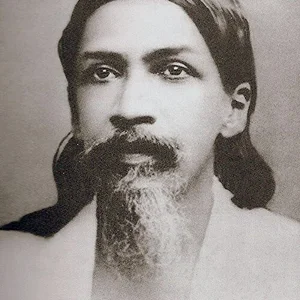

Sri Aurobindo is an Indian philosopher, poet, and spiritual master. First a militant in the Indian nationalist movement against British rule, he later withdrew to Pondicherry where he developed integral yoga and founded a celebrated ashram.
Sri Aurobindo(1872 — 1950)
Aurobindo Ghose
Inde, Raj britannique
5 min read
Frequently asked questions
Famous Quotes
« All life is yoga.»
Key Facts
- Born on August 15, 1872 in Calcutta, in British India
- Studied in England (Cambridge) before returning to India in 1893
- A leading figure of the radical nationalist movement, arrested in connection with the Alipore bomb case (1908)
- Withdrew to Pondicherry in 1910, where he developed integral yoga
- Founded his ashram and died on December 5, 1950 in Pondicherry
Works & Achievements
His major philosophical treatise, setting out the evolution of consciousness toward a “divine life” on earth.
A presentation of his “integral yoga,” uniting the traditional paths of Indian yoga.
An epic poem of nearly 24,000 lines, the major statement of his thought set into poetry.
A commentary on the Bhagavad Gita that became a landmark of modern Indian philosophy.
A reflection on the evolution of human societies toward a spiritual age.
An international spiritual community that became a major center of influence and the origin of Auroville.
Anecdotes
As a teenager, Aurobindo was sent to England by his father, who wanted to turn him into a perfect English gentleman, cut off from any Indian influence. There he learned Greek and Latin and brilliantly passed the Indian Civil Service examination... but deliberately failed the horsemanship test, refusing to serve the colonial administration.
In 1908, he was arrested and imprisoned for a year in the Alipore Bomb Case, accused of conspiring against the British. It was in prison, he said, that he had intense spiritual experiences that transformed the political activist into a spiritual seeker.
In 1910, warned of an imminent new arrest, he secretly left Bengal and took refuge in Pondicherry, then a French trading post. He would remain there for forty years without ever leaving again, completely abandoning active politics.
From 1926 onward, he withdrew into almost total seclusion, leaving his room only a few times a year for the “darshan,” when hundreds of disciples came to see him in silence. It was Mirra Alfassa, whom he called “the Mother,” who then ran the ashram day to day.
In English, Sri Aurobindo wrote an immense epic poem, *Savitri*, of nearly 24,000 lines, which he reworked over decades — one of the longest poems in the English language.
Primary Sources
The highest aspiration of an earthly Nature is the formation of a divine life in the human body; but it has always stumbled against the necessity of a fundamental transformation.
When I went to the court, I saw Krishna; when I looked at the judge, it was Krishna sitting on the bench; when I looked at the prosecutor, it was Krishna.
It was the hour before the Gods awake. Across the path of the dim Night unborn...
Integral yoga is not a flight away from life, but a transformation of the whole of life through the descent of a supramental consciousness.
Key Places
Aurobindo's birthplace and a hub of Bengali nationalism where he carried out his political activity.
Here he studied at King's College, mastering the classical languages and European culture.
Princely state where he worked for thirteen years in the administration and taught, rediscovering India.
Calcutta prison where he was detained for a year; there he underwent decisive spiritual experiences.
French trading post where he took refuge in 1910 and founded his ashram; he lived there in seclusion until his death.
Typical Objects

Sri Aurobindo spent decades writing and rewriting his epic poem by hand, accumulating thousands of manuscript pages.

A philosophical periodical founded in 1914 in which “The Life Divine,” “The Synthesis of Yoga,” and his major texts appeared in serial form.

A nationalist daily in English that he edited in Calcutta to call for the complete independence of India.

Traditional Indian cotton garment that he wore during his years of spiritual retreat in Pondicherry.

An emblem formed of two interlaced triangles and a central lotus, representing the union of the descending divine and rising human aspiration.

The armchair from which he appeared a few days each year, in silence, before his gathered disciples.
School Curriculum
Vocabulary & Tags
Key Vocabulary
Daily Life
Morning
In his years of seclusion, Sri Aurobindo slept little and often worked at night. The morning was spent in the quiet of his room in Pondicherry, devoted to meditation and to correspondence with his disciples.
Afternoon
The afternoon was dedicated to writing: he tirelessly composed and revised his philosophical works and his poem *Savitri*, sometimes dictating to a secretary in his final years.
Evening
In the evening, he answered in writing the many letters from his disciples about the practice of yoga. The day-to-day running of the ashram was handled by the Mother, Mirra Alfassa.
Food
He led a sober and frugal life, typical of an Indian ascetic, eating little and simply. In his English youth, he had by contrast known a Western diet.
Clothing
A recluse, he wore the traditional Indian white garments, a *dhoti* and a cotton shawl. As a young man in England, he had dressed in the European style like a perfect gentleman.
Housing
He lived in a house of the Pondicherry ashram, in a room he hardly ever left after 1926, except on the rare days of *darshan*.
Historical Timeline
Period Vocabulary
Liens externes & ressources
Références
Œuvres
The Life Divine (La Vie divine)
1939-1940
The Synthesis of Yoga (La Synthèse des Yogas)
1914-1921
Essays on the Gita
1916-1920
The Human Cycle
1916-1918
Fondation de l'ashram de Pondichéry
1926